Mathematical tile shaped like a crooked hat solves decades-old Einstein problem
A nonrepeating tile built from a honeycomb framework produced pinwheel-shaped diffraction and polarization-sensitive light patterns.
 University of Tokyo Writer: Yuto Moritake

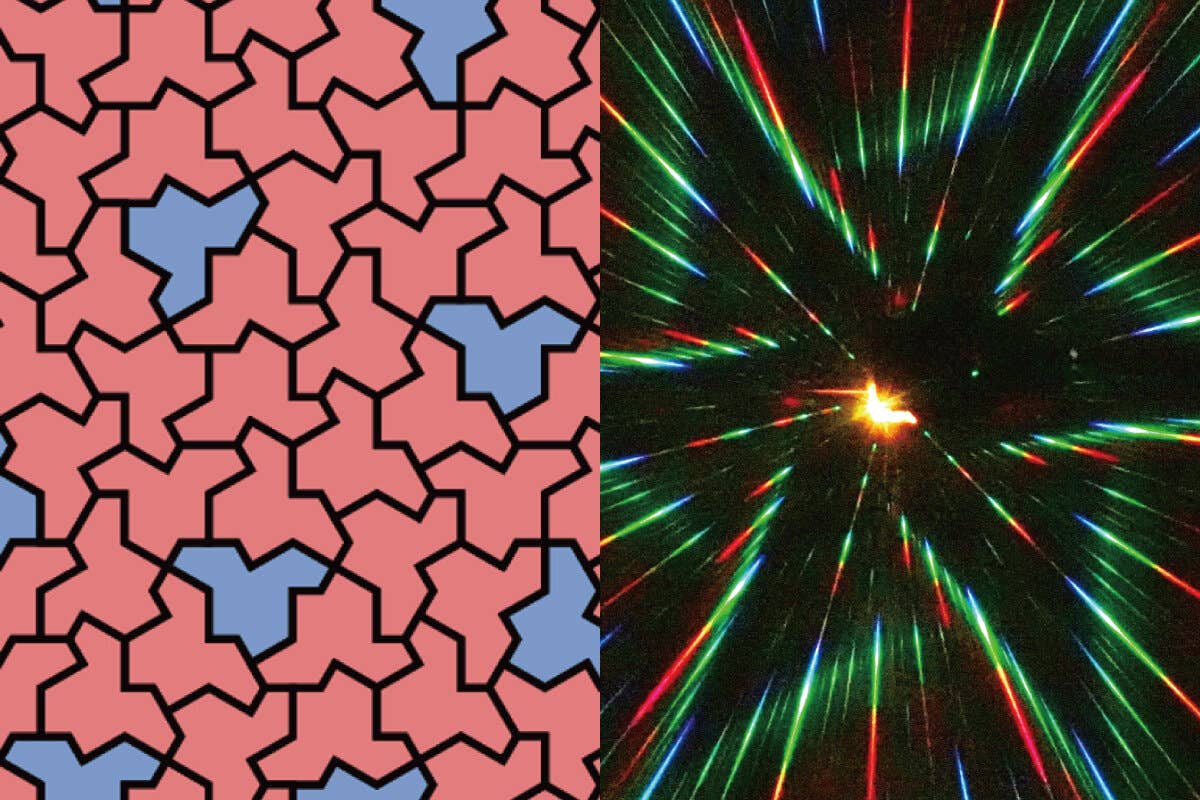
The Smith hat tile creates chiral diffraction patterns, linking a famous math puzzle to new ways of controlling light. (CREDIT: Yuto Moritake et al, The University of Tokyo)
- The nonrepeating Smith hat tile created twisting, pinwheel-like light patterns that ordinary quasicrystals do not produce.
- Its unusual effect comes from combining long-range order with a lack of mirror symmetry, giving the flat structure a clear handedness.
- The findings could help researchers study polarization control and other ways of manipulating light, although no finished optical device was demonstrated.
A mathematical tile shaped like a crooked hat has already solved one famous puzzle. Now its unusual geometry is producing pinwheel-like patterns of light that conventional quasicrystals do not create.
Researchers at the Institute of Industrial Science, The University of Tokyo, and collaborating institutions built nanoscale optical structures from the Smith hat, an aperiodic monotile. Their experiments revealed chiral diffraction, sharp light patterns that twist in one direction and reverse when the structure is mirrored.
The Smith hat emerged in 2023 as an answer to the decades-old Einstein problem. The question asks whether one tile shape can cover a flat surface without ever repeating the same arrangement. Checkerboards and honeycombs repeat periodically. The Smith hat can fill the plane aperiodically, using the same basic shape in different orientations.
“What is especially fascinating about the hat tile is that, although the resulting pattern appears irregular at first glance, it is actually constructed from the honeycomb lattice,” says lead author Yuto Moritake. “We wanted to see whether this unique shape could also produce any unexpected physical phenomena.”
A quasilattice that breaks the mirror
The team focused on points placed at the centers of the hat tiles. Together, those points form what the researchers call a monotile quasilattice, a nonrepeating arrangement with long-range quasiperiodic order.
Unlike many familiar quasicrystals, the structure has threefold rotational symmetry, known as C3 symmetry. It returns to the same form after a rotation of 120 degrees. Yet it lacks mirror symmetry. Its reflected version cannot be matched with the original pattern.
That distinction makes the structure chiral in two dimensions. Here, chirality means that the flat pattern has a handedness, much like left and right hands cannot be perfectly superimposed.
To test how this geometry affects light, the researchers patterned circular holes into 350-nanometer-thick silicon nitride films. They used electron-beam lithography and etching to produce structures based on a large H6 metatile arrangement.
One sample contained 372,100 holes across an area of about 500 micrometers by 500 micrometers. The team also fabricated mirrored versions so it could compare how reversing the structure changed the optical response.
Pinwheels appear under laser light
When white light struck the samples, the reflected diffraction formed a distinctive pinwheel. The pattern lacked mirror symmetry, directly revealing the handedness of the monotile quasilattice.
The shape remained chiral across the white-light wavelengths, even though the diffraction angles shifted with wavelength.
A green laser with a wavelength of 532 nanometers produced many sharp diffraction peaks. Those peaks showed that the structure had long-range order rather than random disorder. Their positions also stayed the same when the incoming laser spot moved across the sample.
That stability matters because a quasicrystal does not need perfect rotational symmetry around every point. Its diffraction pattern can still display the same underlying symmetry from different illuminated regions.
“We found that the diffraction patterns themselves become chiral because the structure lacks mirror symmetry,” explains senior author Masaya Notomi. “This kind of optical response is fundamentally different from that observed in conventional quasicrystalline materials.”
The mirrored sample produced the opposite pinwheel. Reversing the real-space structure therefore reversed the handedness of the diffraction pattern.
Fibonacci geometry shapes the twist
The researchers traced the rotating diffraction pattern to a gradual twist in the metatiles used to generate the hat tiling. As the inflation rule builds larger structures from smaller ones, the metatiles tilt relative to the honeycomb framework beneath them.
The coefficients describing that shift follow the Fibonacci sequence. At larger scales, their ratios approach the golden mean, a value that also appears in Fibonacci lattices and other quasiperiodic structures.
The team calculated the expected chiral angle from this geometry. Diffraction peaks in the measured and calculated patterns aligned with that predicted direction.
Some weaker peaks did not form perfectly straight lines. Instead, they followed slightly meandering paths. The calculations also revealed self-similar behavior linked to the golden mean.
The observed peak positions closely matched Fourier-transform calculations based on the monotile quasilattice. Differences at larger wave vectors arose because the mathematical model used ideal point-like scatterers, while the fabricated holes had a finite size.
Circular polarization exposes another asymmetry
The team then illuminated the structures with left-handed and right-handed circularly polarized light. Circular polarization describes light whose electric field rotates as the wave travels.
Conventional honeycomb lattices and Penrose tilings have mirror symmetry, so their diffraction peaks do not depend on the handedness of incoming circular polarization. The Smith hat quasilattice behaves differently because it combines rotational symmetry with broken mirror symmetry.
The diffraction intensity changed with the light’s helicity, or rotational handedness. Red and blue regions in the measurements marked peaks that responded differently to left-handed and right-handed polarization.
Those regions switched places in mirrored structures. Their shapes also changed when the pseudo-period of the underlying pattern changed, showing that the effect depends on both the quasilattice and experimental parameters such as diffraction angle.
This circular-polarization dependence had not been identified in earlier theoretical work on the system, according to the authors. It appeared through the optical experiments.
“These results open a new direction of research on the fusion of quasiperiodic order and chirality,” remarks Moritake. “Monotile patterns provide a platform for exploring optical phenomena that emerge from the interplay of symmetry, chirality, and aperiodicity.”
Practical implications of the research
The work gives physicists a new structure for studying how nonrepeating order and broken mirror symmetry shape light. Aperiodicity adds another design feature beyond the repeating unit cells used in conventional photonic lattices.
The findings could guide research on polarization control, symmetry-dependent diffraction, nonlinear optical effects, and valley photonic effects. The study does not demonstrate a finished device, but it shows that monotile quasilattices can generate optical responses that ordinary periodic structures and mirror-symmetric quasicrystals do not provide.
More broadly, the experiments connect an abstract tiling problem with measurable physical behavior. A shape first celebrated for solving a mathematical question now offers a controlled way to investigate how geometry can twist, sort, and redirect light.
Research findings are available online in the journal Nature Communications.
The original story "Mathematical tile shaped like a crooked hat solves decades-old Einstein problem" is published in The Brighter Side of News.
Related Stories
- Black Hole “ringing” could put Einstein’s theory to its toughest test
- Scientists use Einstein’s equations to reveal what came before the Big Bang
- Darkness can travel faster than the speed of light — without breaking Einstein’s relativity
Like these kind of feel good stories? Get The Brighter Side of News' newsletter.
Joseph Shavit
Writer, Editor-At-Large and Publisher
Joseph Shavit, based in Los Angeles, is a seasoned science journalist, editor and co-founder of The Brighter Side of News, where he transforms complex discoveries into clear, engaging stories for general readers. With vast experience at major media companies like The Los Angeles Times, Times Mirror and Tribune Publishing, he writes with both authority and curiosity. His writing focuses on space science, planetary science, quantum mechanics, geology. Known for linking breakthroughs to real-world markets, he highlights how research transitions into products and industries that shape daily life.