MIT engineers create a stretchy yarn designed to be melted down and recycled
Unlike spandex blends, this new MIT yarn is made from one recyclable plastic and held up through ten rounds of melting.

 Edited By: Joseph Shavit

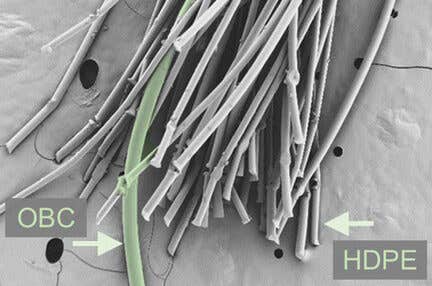
MIT’s recyclable polyethylene yarn stays strong after repeated melting and could replace hard-to-recycle spandex blends. (CREDIT: MIT Researchers)
- MIT engineers made a new stretchy yarn out of polyethylene, the same plastic used in milk jugs and grocery bags, instead of spandex blends that can't be recycled.
- The new yarn can be melted down and respun into new yarn over and over, and it stayed just as strong after ten rounds of recycling.
- Because most stretchy clothing today mixes materials that can't be separated, almost none of it gets recycled, so this single-material design could help close that gap.
The average American throws away about 81 pounds of clothing a year. Add that up across the country and it comes to more than 11 million tons of textiles sent to landfills and incinerators annually. Bottles and cans have a recycling system. Old clothes, for the most part, do not.
A team of MIT engineers thinks part of the fix could be a new yarn. Made from polyethylene, the same plastic used in milk jugs and grocery bags, the yarn has the stretch and strength of spandex, but unlike spandex it can be melted down and respun again and again.
The researchers envision it as a stand-in for elastic spandex-polyester or spandex-nylon yarns, the blends used in most stretchy clothing today. Those blends mix fibers that cannot be recycled together. The new yarn is built from a single family of plastic instead.
"Eighty percent of textiles on the U.S. market currently contain some amount of spandex, which makes them nonrecyclable," said Svetlana Boriskina, a research scientist in MIT's Department of Mechanical Engineering. "There's no widely adopted technology now that recycles textiles into textiles. With our new yarn, we hope to change that."
Why stretchy clothes don't get recycled
Spandex is a polyurethane-based fiber that stretches well but isn't very strong on its own. To compensate, manufacturers wrap a spandex core in a sheath of tougher polyester or nylon. That combination gives elastic yarns their familiar snap and durability.
It also makes them nearly impossible to recycle. Separating the polyester sheath from the spandex core requires chemical treatment before either material can be reused.
"Even though chemical separation technologies exist, they add extra cost and complexity, and usually require toxic chemicals that are harmful to the environment," Boriskina said. "That's why most stretchy garments go to the dump."
Turning grocery bag plastic into thread
Polyethylene has never really been treated as a textile material, even though it's the most common plastic in the world, found in everything from grocery bags and water bottles to trash bins and industrial pipes. Because it's a thermoplastic, it can be melted and remade, which makes it inherently recyclable.
In 2021, Boriskina's group first spun polyethylene into yarn and wove it into garments, focusing on properties like moisture wicking and cooling. For the new study, the team set out to tailor the material to match spandex's stretch and strength, while proving it could be recycled.
They searched through scientific literature and industrial reports for polyethylene formulations that could act as a stretchy core, and separately engineered a sturdier version for the sheath.
"The chemical structure of polyethylene is like Christmas garland — a backbone of carbon, carbon, carbon, and also these dangling 'decorations' of hydrogen atoms or short branches with the same structure as a backbone," Boriskina explained. "How these chains are arranged can change the properties of the whole structure."
"Polyethylene can give us a wide range of properties, depending on how you make it," added SeongHyeon Kim, the study's first author.
Spinning plastic pellets into hair-thin fiber
The team obtained pellets of two different polyethylene resins from a chemical manufacturer, one for the stretchy core and one for the stiffer sheath. Each type was poured into a hopper and heated to about 350 degrees Fahrenheit, past its melting point, then drawn through small extruders into fibers as thin as hair.
"You just melt it in a barrel with a heater, and then you extrude and spin it into fibers," Kim said. "It's like a spaghetti machine."
An industrial yarn spinner then wound the sheath fibers around the core fiber to form the finished elastic yarn.
Melting it down, ten times over
Because the core and sheath are made from the same chemical family, they never need to be separated before recycling, unlike spandex-based yarns. The whole yarn can simply be melted and reformed.
"Because they are exactly the same chemistry, they play nicely together," Boriskina said. "That's what makes this yarn very recyclable."
To test that claim, the team twisted a core-sheath yarn, melted it down, and respun it 10 times, checking its mechanical strength after each round by stretching a thread until it broke. The recycled yarn held up just as well as the original.
"Now we have something that can be knitted and woven," Boriskina said. "That is the next stage."
Scaling up to industrial spools
The team says the process can scale up to industrial-sized spools of yarn. As with conventional spandex, it would take kilometers of thread to weave a single garment. Once that garment had reached the end of its life, the researchers envision it could be dropped into a recycling bin, sent to a facility, melted down and respun into new yarn or other plastic products, from buttons to belt buckles.
It's a small shift aimed at a large goal: making stretchy clothing genuinely circular instead of destined for the landfill.
"Hopefully it will prevent the need for making more and more textile materials, because you can keep recycling a large portion of it," Boriskina said.
Practical implications of the research
If the process scales as the team expects, it could give the clothing industry something it has largely lacked: a real pathway for turning old textiles back into new ones rather than sending them to landfills or incinerators.
Because the yarn is built entirely from polyethylene, worn-out garments made from it could potentially be processed through recycling systems already set up for other polyethylene products, rather than requiring an entirely new type of recycling infrastructure.
The next step is weaving and knitting the recycled yarn into finished fabrics, to see whether garments made this way perform as well as those made from virgin material.
If that holds up, the approach could reduce how much new plastic and textile fiber needs to be manufactured, since much of what's already in circulation could be melted down and reused instead of replaced.
Research findings are available online in the journal ACS Materials Letters.
The original story "MIT engineers create a stretchy yarn designed to be melted down and recycled" is published in The Brighter Side of News.
Related Stories
- Scientists turn everyday wool into record-breaking ultrablack fabric
- Ultra-thin semiconductor fibers turn everyday fabrics into wearable electronics
- Super lightweight, fabric-based solar cell turns any surface into a power generator
Like these kind of feel good stories? Get The Brighter Side of News' newsletter.
Shy Cohen
Writer