Scientists discover six types of nanoplastics polluting Antarctica’s soil for the first time
Tiny plastic particles turned up in Antarctic topsoil and deeper layers, raising new questions about their origins and ecological effects.

 Edited By: Joseph Shavit

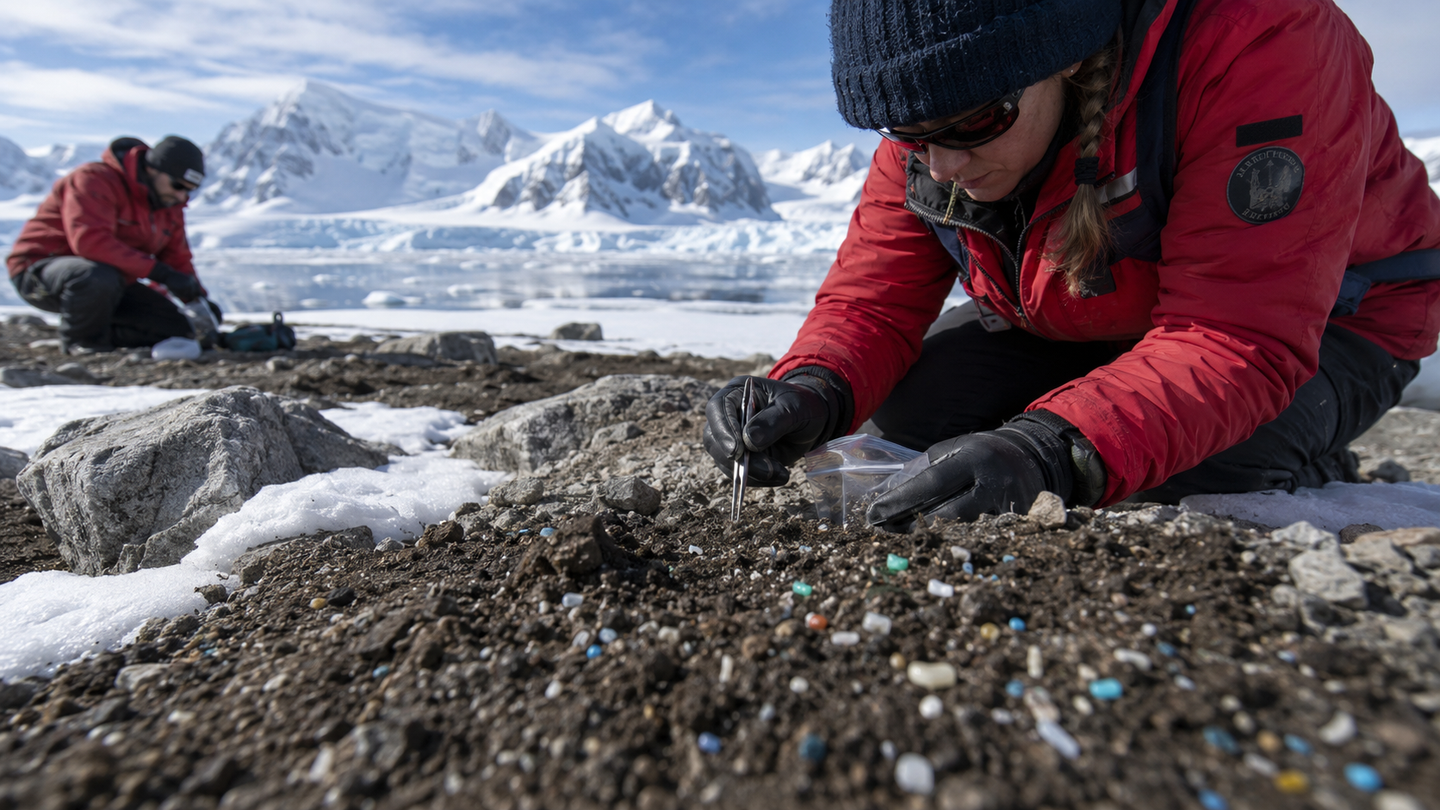
Nanoplastics in Antarctic soil reveal how plastic pollution reaches the remote McMurdo Dry Valleys through local and long-range sources. (CREDIT: Wikimedia / CC BY-SA 4.0)
- Nanoplastics appeared in more than half of the Antarctic topsoil sites tested, and some were also found deeper underground.
- The particles may come from nearby research activity, distant regions through the air, or plastics released from snow, ice and coastal areas.
- The results create a baseline for studying how plastic pollution could affect Antarctica’s slow-growing and vulnerable soil life.
Plastic particles smaller than one micrometer are lodged in the barren soils of Antarctica’s McMurdo Dry Valleys, an isolated landscape once expected to sit beyond much of the world’s pollution. Their path there remains unresolved.
An international team led by Lancaster University detected nanoplastics in both surface and deeper soils collected during January 2023. The particles measured between 20 nanometers and 1 micrometer, a range that standard plastic surveys often miss.
The work marks the first detection of nanoplastics in mainland Antarctic soil. It also adds land to a growing list of contaminated Antarctic environments that already includes seawater, snow, glaciers, sea ice and freshwater systems.
“This evidence shows that soils in one of Earth’s most pristine environments are not exempt from plastic contamination. These findings highlight the urgent need to study plastic fate, transport and ecological impacts in polar regions,” said lead author Dr Nhu Phan, who conducted the work as a PhD researcher at Lancaster University.
Tiny particles turn up across the valleys
The team sampled Taylor and Wright valleys, part of the largest ice-free region in Antarctica. Their inland position and limited human activity made them useful places to investigate whether airborne pollution can reach remote polar soils.
Nanoplastics appeared above polymer-specific detection limits in 54% of 13 topsoil sites. The median concentration was 26.6 nanograms per gram, while the highest reading reached 295 nanograms per gram.
The particles also appeared in half of four deeper-soil samples taken below 20 centimeters. Their median concentration there was much lower, at 1.95 nanograms per gram, although one deep sample contained 223.8 nanograms per gram.
The researchers detected six plastic types: polypropylene, polyethylene, polyethylene terephthalate, polystyrene, polyvinyl chloride and tyre wear particles. Polypropylene accounted for 40% of the total nanoplastic mass, followed by tyre wear particles at 28% and polyethylene at 15%.
Larger microplastics were much less common. Only one of 17 samples exceeded the method’s detection limits, with 11.4 particles per gram at a 10-micrometer threshold and 4.7 particles per gram at a 20-micrometer threshold.
A method sensitive enough for Antarctic soil
Finding particles this small required a newer analytical method called thermal desorption-proton transfer reaction-mass spectrometry. The technique heats extracted material, then identifies chemical signals from plastic vapors at extremely low concentrations.
The researchers paired that approach with a new soil extraction protocol. Together, the methods allowed them to detect nanoplastics at nanogram levels, where contamination can be difficult to separate from background noise or laboratory interference.
Even so, the measurements remain semi-quantitative. The reported concentrations represent particles recovered, thermally released and ionized by the instrument, not every particle originally present in the soil.
Overall recovery was not complete, and the method carries about 30% uncertainty. The authors therefore describe the measurements as lower-threshold values, meaning actual concentrations may be higher.
The microplastic analysis had separate limits. Its recovery rate was estimated at 23%, fluorescence microscopy could not chemically identify polymers, and particles between 1 and 10 micrometers were not measured.
Pollution may arrive by several routes
The findings do not identify one source. Plastic could come from research stations, clothing, equipment, tyre wear, wastewater or older waste sites. Several stations and outposts sit roughly 100 to 120 kilometers from the sampling areas.
Long-distance atmospheric transport offers another possible route. The team used the FLEXPART particle dispersion model to examine where deposited material could have originated during the three years before sampling.
The model indicated that seasonal patterns matter. During the Antarctic summer, likely source influence was largely confined to the continent. From March through October, the Southern Ocean, New Zealand and the southern tip of South America became more important potential source regions.
Those results do not prove where the measured particles began. Nanoplastics could arrive directly through the atmosphere, settle onto snow or ice during winter, then move into soil after melting. Previously deposited particles could also be lifted again by wind.
“Our findings raise concerns regarding the global reach of plastic contamination. At present, it is unclear whether ultrafine nanoplastic particles have arisen through direct long-range atmospheric transport from afar, or through the weathering of larger plastic debris found in marine areas along the Antarctic coastline,” said Professor Crispin Halsall of Lancaster University, a co-author.
A fragile ecosystem with unanswered risks
The McMurdo Dry Valleys look nearly lifeless, but their soils support bacteria, cyanobacteria, fungi and other microbial communities. Antarctic invertebrates also tend to grow slowly, have low metabolisms and possess limited detoxification capacity.
Those traits may leave polar organisms less able to adjust to chemical stress. Nanoplastics also have a large surface area relative to their size, which can increase their mobility and their ability to carry additives or other pollutants.
The study did not measure biological harm. It establishes exposure levels and polymer types that future toxicity research can use instead of relying on assumptions about what Antarctic organisms might encounter.
Several uncertainties remain. The number of samples was modest, only three locations offered paired surface and deeper soils, and concentrations varied sharply between sites. The apparent difference between Taylor and Wright valleys was not statistically significant.
The lack of overlap between sites containing larger microplastics and those containing nanoplastics may point to different sources or transport routes. However, uneven particle distribution and very low concentrations make that pattern difficult to interpret.
Practical implications of the research
The measurements provide a baseline for tracking how plastic contamination changes across Antarctic land environments. They also give future experiments more realistic concentrations and polymer mixtures for testing possible effects on soil organisms and food webs.
Better monitoring could help separate local pollution from material carried across oceans and continents. That will require repeated atmospheric, snow, ice and soil sampling, along with stronger transport models.
The findings also support calls for stricter waste management at Antarctic stations and broader international efforts to reduce plastic emissions. Without clearer source data, prevention must address both nearby activities and pollution that travels far beyond national borders.
Research findings are available online in the journal Scientific Reports.
The original story "Scientists discover six types of nanoplastics polluting Antarctica's soil for the first time" is published in The Brighter Side of News.
Related Stories
- Why Antarctica turned into an ice world millions of years before the Arctic
- Antarctica’s ice shelves face a growing threat from warm waters below
- Antarctica’s ice sheet losses could rebound — if history can repeat itself
Like these kind of feel good stories? Get The Brighter Side of News' newsletter.
Rebecca Shavit
Writer
Based in Los Angeles, Rebecca Shavit is a dedicated science and technology journalist who writes for The Brighter Side of News, an online publication committed to highlighting positive and transformative stories from around the world. Having published articles on MSN, AOL News, and Yahoo News, Rebecca's reporting spans a wide range of topics, from cutting-edge medical breakthroughs to historical discoveries and innovations. With a keen ability to translate complex concepts into engaging and accessible stories, she makes science and innovation relatable to a broad audience.