Dust from the Chicxulub asteroid baked dinosaurs alive within hours of impact
Fine impact dust may have baked Earth’s surface before helping trigger years of darkness and global cold.

 Edited By: Joshua Shavit

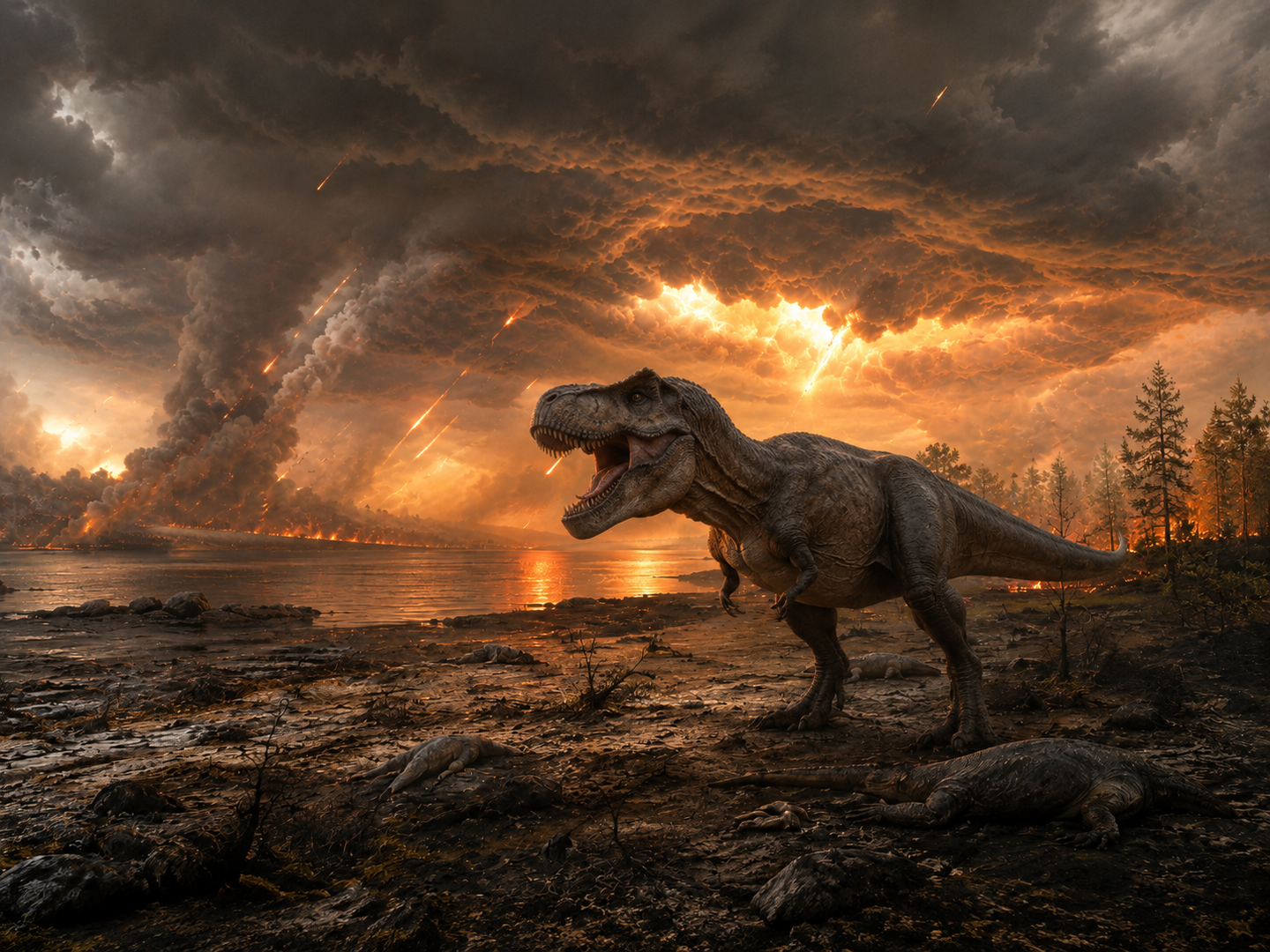
A Chicxulub asteroid dust cloud may have trapped lethal heat, ignited wildfires and killed exposed dinosaurs within hours. (CREDIT: Wikimedia / CC BY-SA 4.0)
- Fine asteroid dust may have trapped intense heat near Earth’s surface, killing exposed animals and starting widespread fires.
- Animals that hid underground or underwater had better protection, which may help explain why some groups survived.
- After trapping heat, the same dust may have blocked sunlight and caused years or decades of cold and darkness.
Sixty-six million years ago, the sky above Earth may have turned into a furnace. Dust from the Chicxulub asteroid impact could have trapped returning heat so efficiently that forests ignited and exposed animals died within hours.
An analysis led by Purdue University planetary scientist Brandon Johnson argues that fine dust played a decisive role in the catastrophe. The dust did more than block sunlight later. In the first hours after impact, it may have acted like a lid, forcing thermal radiation back toward the surface.
“We're in the realm where we might be essentially killing off everything within that first hour or two,” Johnson said.
The study, published in the Journal of Geophysical Research: Biogeosciences, revives a long-running debate over what killed the dinosaurs. Some explanations emphasize a prolonged global winter. Others point to immediate heat and widespread fires. The new work argues that both effects could have come from the same dust cloud.
A planet-sized cloud of vapor and rock
The roughly six-mile-wide asteroid struck near today’s Yucatán Peninsula with enough force to vaporize enormous amounts of rock. Johnson’s team estimates that more than 1,000 cubic kilometers of material entered the expanding vapor plume.
As the plume rose and cooled, part of the vapor condensed into tiny droplets of molten rock called spherules. These particles, about 250 micrometers wide, traveled around the planet before falling through the atmosphere.
Air resistance slowed the spherules and converted their motion into heat. Earlier simulations showed that their reentry could produce a global pulse of thermal radiation comparable to an oven set to broil.
That alone would have been devastating, especially for thin-skinned animals without shelter. Yet previous work suggested the pulse might not have been strong enough to ignite forests worldwide.
The missing factor may have been the vapor that did not form spherules.
Fine dust turns heat into a lethal pulse
Johnson and his colleagues examined evidence that much of the remaining rock vapor condensed into far smaller particles. Fine dust found above impact deposits at the Tanis site in North Dakota has a median grain size near 2.88 micrometers.
The team calculated that roughly 1.6 × 10^15 kilograms of this dust could have spread globally. Its optical depth was at least 620, meaning it would have blocked almost all upward thermal radiation from escaping into space.
“With this fine dust cloud capping the atmosphere, the heat radiation can’t escape to space,” Johnson said. “So the only place that radiation can go is back down to the earth.”
The dust increased surface heating by about 3.5 times compared with spherules alone. Exposed Cretaceous organisms may have received 17 times the thermal radiation dose considered completely lethal to humans.
Grass, pine needles, and lichen could ignite at the modeled heat levels. Those fuels might then have started larger wildfires, even where the radiation could not ignite thick wood directly.
“That much kinetic energy has to go somewhere and eventually it is converted to heat,” Johnson said. “With the dust cloud trapping thermal radiation, it was like the surface and everything on it was being charbroiled.”
Shelter may explain who survived
The findings fit a striking pattern in the fossil record. Animals able to hide underground, swim, or shelter in another way were more likely to survive the end-Cretaceous extinction.
Burrows would have insulated small animals from the atmospheric heat pulse. Water could have protected swimmers. Plants survived through buried seeds and roots.
Birds were the only dinosaur group to survive. The research notes that birds included burrow-nesters and swimmers, giving at least some species access to shelter.
Exposed land animals, including thick-skinned dinosaurs, would still have faced lethal heat. Burns were one danger. Heat stroke may also have killed animals unable to escape rising temperatures.
Alexandria Johnson, a Purdue cloud scientist and study co-author, compared the dust layer to a lid on a pot.
“We found that the cloud layer was so impermeable that it trapped almost all of the heat from the falling spherules near the surface of the planet,” she said.
The particles were about 2.5 micrometers wide, similar in size to smoke particles that threaten human health today. They could enter lungs and bloodstreams, creating another danger for survivors.
“When you look at the time scales of the cooking versus the inhalation risks, the cooking is much faster,” Alexandria Johnson said.
Fire first, winter afterward
The same dust that intensified the early heat could later have driven the colder phase of the disaster.
Once the spherules stopped falling and fires weakened, the dust remained high in the atmosphere. It could have blocked sunlight for years or decades, causing a prolonged global winter.
“It seems counterintuitive,” Brandon Johnson said, “but actually it’s the same effect.”
The comparison resembles an insulated mug, which can keep soup hot or iced coffee cold. At first, the dust trapped outgoing heat. Later, it blocked incoming sunlight.
Johnson and his co-authors argue that fire and heat were probably the main killers on land. They also acknowledge that the geologic evidence remains incomplete.
The strongest wildfire evidence comes from North America. Conditions may have differed farther from the crater. Alfio Alessandro Chiarenza, a University College London paleontologist who was not involved, said researchers have not found a global wildfire record.
“It could be that we will eventually find the record of completely global wildfires,” Chiarenza said. “We just don’t have it so far.”
Practical implications of the research
Determining whether dinosaurs died mainly from sudden heat or prolonged starvation changes how scientists interpret the extinction. A rapid kill would place more weight on shelter, habitat, and access to water during the first hours.
A slower collapse would emphasize food shortages, darkness, cooling, and ecosystem failure over years.
The distinction also affects how researchers study recovery. Knowing which traits helped animals survive could explain why mammals, birds, and other sheltered species expanded afterward.
More detailed dust records from sites outside North America could test whether the heat pulse and wildfires were truly global. Better ignition experiments could also show which plants would burn under the modeled radiation.
“It would be great to figure out which animals survived right at the impact and what their biological features were,” Chiarenza said. “This could finally tell us why some animals made it when others, like the dinosaurs, didn’t.”
Research findings are available online in the Journal of Geophysical Research: Biogeosciences.
The original story "Dust from the Chicxulub asteroid baked dinosaurs alive within hours of impact" is published in The Brighter Side of News.
Related Stories
- New evidence reveals massive earthquake linked to dinosaur extinction
- Why flowering plants survived Earth’s greatest extinction while dinosaurs did not
- Dinosaurs thrived until the end: New Mexico fossils rewrite extinction story
Like these kind of feel good stories? Get The Brighter Side of News' newsletter.
Joseph Shavit
Writer, Editor-At-Large and Publisher
Joseph Shavit, based in Los Angeles, is a seasoned science journalist, editor and co-founder of The Brighter Side of News, where he transforms complex discoveries into clear, engaging stories for general readers. With vast experience at major media companies like The Los Angeles Times, Times Mirror and Tribune Publishing, he writes with both authority and curiosity. His writing focuses on space science, planetary science, quantum mechanics, geology. Known for linking breakthroughs to real-world markets, he highlights how research transitions into products and industries that shape daily life.