NASA finds a surprisingly complex history of water on ancient Mars
Mars’ Margin Unit records repeated encounters with groundwater, possible lake water and heated fluids long after its igneous rocks formed.
 JPL Writer: DC Agle

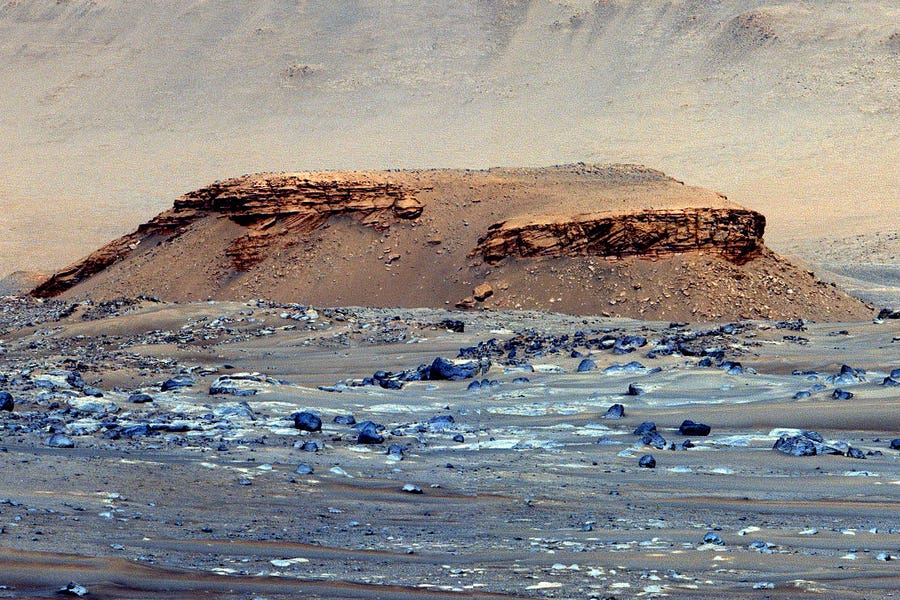
Perseverance found Jezero rocks altered by at least three water systems involving carbonates, silica and later hydrothermal fluids. This Mastcam-Z-enhanced color photo mosaic shows a butte near Jezero crater. (CREDIT: NASA/JPL-Caltech/LANL/CNES/CNRS/ASU/MSSS)
- Perseverance found that Mars’ carbonate-rich Margin Unit is largely altered igneous rock rather than the straightforward ancient shoreline sediments scientists expected from orbital observations.
- The rocks record at least three episodes of water activity, including carbonate-forming fluids, later silica-producing alteration and a final episode that deposited calcium sulfate and fluorite in mineral veins.
- The complicated history strengthens the Margin Unit’s astrobiological importance because carbonate and silica can preserve records of ancient environments, although the rover cannot yet determine when the individual water events occurred.
A stretch of rock along the edge of an ancient Martian lake has turned out to preserve a much more complicated history of water than scientists expected.
When NASA’s Perseverance rover reached Jezero Crater’s Margin Unit in September 2023, researchers anticipated sedimentary rocks associated with the former lake shoreline. Orbital observations had revealed unusually strong carbonate signatures, making the area particularly interesting because carbonates on Earth often form in watery environments and can preserve evidence of past conditions.
Instead, Perseverance encountered abundant olivine-rich igneous rock that had been repeatedly transformed after it formed. New measurements indicate that water interacted with different parts of the unit during at least three distinct episodes involving groundwater, possible lake water and later hydrothermal fluids.
The study, published in Communications Earth & Environment by researchers including scientists at Purdue University and the University of Hawaii at Manoa, reconstructs a history in which the same rocks repeatedly encountered changing Martian water systems.
Perseverance found an unexpected igneous foundation
The Margin Unit follows part of Jezero Crater’s inner western rim and covers hundreds of meters in elevation. Perseverance investigated more than 185 bedrock targets there using SuperCam, which can analyze rocks several meters away with laser-induced breakdown spectroscopy and reflectance measurements.
At the unit’s higher elevations, researchers encountered coarse, crystalline rock rich in olivine, a magnesium- and iron-bearing mineral commonly associated with igneous environments. The texture indicates that at least part of the material cooled relatively slowly, consistent with magma crystallizing underground.
These upper rocks show comparatively little alteration by water. Lower in the Margin Unit, however, the picture changes dramatically. Olivine grains become fractured and increasingly surrounded by carbonate, silica and other secondary minerals produced when fluids react with existing rock.
The findings support other recent Perseverance investigations indicating that much of the Margin Unit began as a crystalline, olivine-rich igneous body. Some areas near the western fan also show signs that original material was later physically reworked by shoreline or sedimentary processes.
“Before we arrived at the Margin Unit, the main hypothesis, derived from orbital observations, was that the carbonate seen from orbit formed from interaction with the lake that existed in Jezero Crater,” lead author Candice Bedford said. The new observations instead point toward several different water systems.
Carbon-rich groundwater may have arrived first
The earliest major alteration event recorded in the rocks appears to have involved carbon dioxide-rich fluids moving through fractures.
Those fluids reacted with olivine and produced magnesium- and iron-bearing carbonate. Carbonate accumulated inside fractures, creating mineralized zones that resisted erosion better than the surrounding bedrock.
As softer material gradually wore away, some of these carbonate-filled fractures remained standing as ridges.
The precise source of the water remains uncertain. One possibility involves groundwater circulating through the fractured igneous body. Another allows water associated with Jezero’s ancient lake to participate in at least some of the alteration.
That distinction is difficult to resolve because features consistent with alteration occur mainly at lower elevations beneath reconstructed lake levels, but they are not distributed uniformly. The pattern could therefore reflect varying groundwater flow rather than simple immersion beneath one long-lived lake.
A second episode left silica behind
Later fluids altered the already carbonated rocks again.
Silica is particularly abundant around fractured olivine grains in portions of the East and West Margin. Researchers propose that changing water chemistry may have dissolved or remobilized some carbonate while silica precipitated into newly created pore spaces.
Cooling, evaporation and loss of carbon dioxide can change which minerals remain dissolved in water. Under some conditions, these processes favor silica precipitation while destabilizing carbonate.
Lake water could have contributed to that second phase because the strongest silica signatures occur below one of Jezero’s reconstructed ancient lake levels. Groundwater evolving through prolonged interaction with the rocks provides another plausible explanation.
“Turning olivine into carbonate can leave silica behind, and we see more of that silica in rocks that sat below the water line,” coauthor Eleni Ravanis said.
The source matters for astrobiology because silica can be unusually effective at preserving microscopic and chemical evidence of ancient life on Earth. Carbonate can also lock away information about the chemistry of the water in which it formed.
Fluorite points to a later hydrothermal system
The final major event identified by the researchers looks different from the earlier alteration.
At a target called Point Cloates in the East Margin, Perseverance examined a mineral vein roughly 25 centimeters thick extending for several meters. SuperCam detected calcium sulfate along with evidence of calcium fluoride, or fluorite.
Fluorite is significant because substantial fluorite-bearing veins on Earth commonly form when heated fluids circulate through rock. The researchers therefore interpret the deposit as evidence for a later hydrothermal episode that used younger fractures to move through the Margin Unit.
That water probably came from a different source than the earlier carbonate-forming fluids. Jezero lies near volcanic terrain, and its crater floor contains igneous rocks, providing several possible sources of heat capable of driving underground circulation.
The study cannot establish exactly when any of these events occurred. Their relative order, however, reveals an environment that changed repeatedly rather than experiencing one simple episode of lake activity.
A more complicated history improves the search for ancient life
The Margin Unit now appears to preserve several chapters of Jezero’s environmental history in the same rock body. It began with olivine-rich igneous material, experienced carbonate-forming alteration, encountered later fluids that produced silica and eventually hosted a younger mineralizing system capable of depositing fluorite and sulfate.
Some rocks were also reworked by shoreline activity or debris flows, adding another layer to the geological record. That complexity helps explain why observations from orbit could not reveal the unit’s full history.
“If there is one thing I have learned after 10 years working with Mars rovers, it is that Mars constantly throws surprises at you,” Bedford said.
Perseverance has collected samples from the Margin Unit for possible return to Earth. Laboratory analysis could eventually determine mineral ages, identify microscopic textures beyond the rover’s capabilities and test whether any of these water-rich environments preserved chemical traces of ancient biology.
For now, Jezero’s shoreline is proving less like a single frozen moment in Martian history and more like a crossroads where groundwater, lake water and heated underground fluids repeatedly transformed the same ancient rocks.
Dig deeper into Jezero Crater’s watery history
These recent studies provide additional context on the origin, alteration and astrobiological importance of the rocks explored by Perseverance.
Carbonated ultramafic igneous rocks in Jezero crater, Mars: Perseverance observations show that olivine-rich rocks extending from the crater floor toward the rim likely originated as igneous cumulates before extensive water-driven carbonation. (Science, 2026)
Stratigraphy of Carbonate-Bearing Rocks at the Margin of Jezero Crater, Mars: Evidence for Shoreline Processes?: Detailed outcrop mapping examines whether parts of the Margin Unit were reworked along the shoreline of Jezero’s ancient lake. (Journal of Geophysical Research: Planets, 2026)
In Situ Detection of Opal-A in Jezero Crater, Mars: Perseverance measurements identify hydrated silica in Jezero, strengthening interest in silica-rich rocks as archives of aqueous conditions and possible biosignatures. (Journal of Geophysical Research: Planets, 2026)
Redox-driven mineral and organic associations in Jezero Crater, Mars: Analysis of the nearby Bright Angel formation reveals organic-carbon-bearing rocks altered by low-temperature chemical reactions involving iron, phosphorus and sulfur. (Nature, 2025)
From hydrated silica to quartz: Potential hydrothermal precipitates found in Jezero crater, Mars: Perseverance observations of opal, chalcedony and quartz provide evidence for ancient hydrothermal activity and identify silica-rich rocks as valuable sampling targets. (Earth and Planetary Science Letters, 2025)
Research findings are available online in the journal Communications Earth & Environment.
The original story "NASA finds a surprisingly complex history of water on ancient Mars" is published in The Brighter Side of News.
Related Stories
- Tardigrades and water reveal potential for food growth on Mars
- NASA orbiter data challenges the idea that liquid water exists on Mars
- First direct evidence of how Mars lost its thick atmosphere and water
Like these kind of feel good stories? Get The Brighter Side of News' newsletter.
Joseph Shavit
Writer, Editor-At-Large and Publisher
Joseph Shavit, based in Los Angeles, is a seasoned science journalist, editor and co-founder of The Brighter Side of News, where he transforms complex discoveries into clear, engaging stories for general readers. With vast experience at major media companies like The Los Angeles Times, Times Mirror and Tribune Publishing, he writes with both authority and curiosity. His writing focuses on space science, planetary science, quantum mechanics, geology. Known for linking breakthroughs to real-world markets, he highlights how research transitions into products and industries that shape daily life.