The eruption that buried Pompeii is helping scientists synchronize Earth’s geological clocks
Sanidine crystals buried with Pompeii turned a Roman catastrophe into a precision test for dating volcanoes and Earth’s past.
 UC Berkeley Writer: Robert Sanders

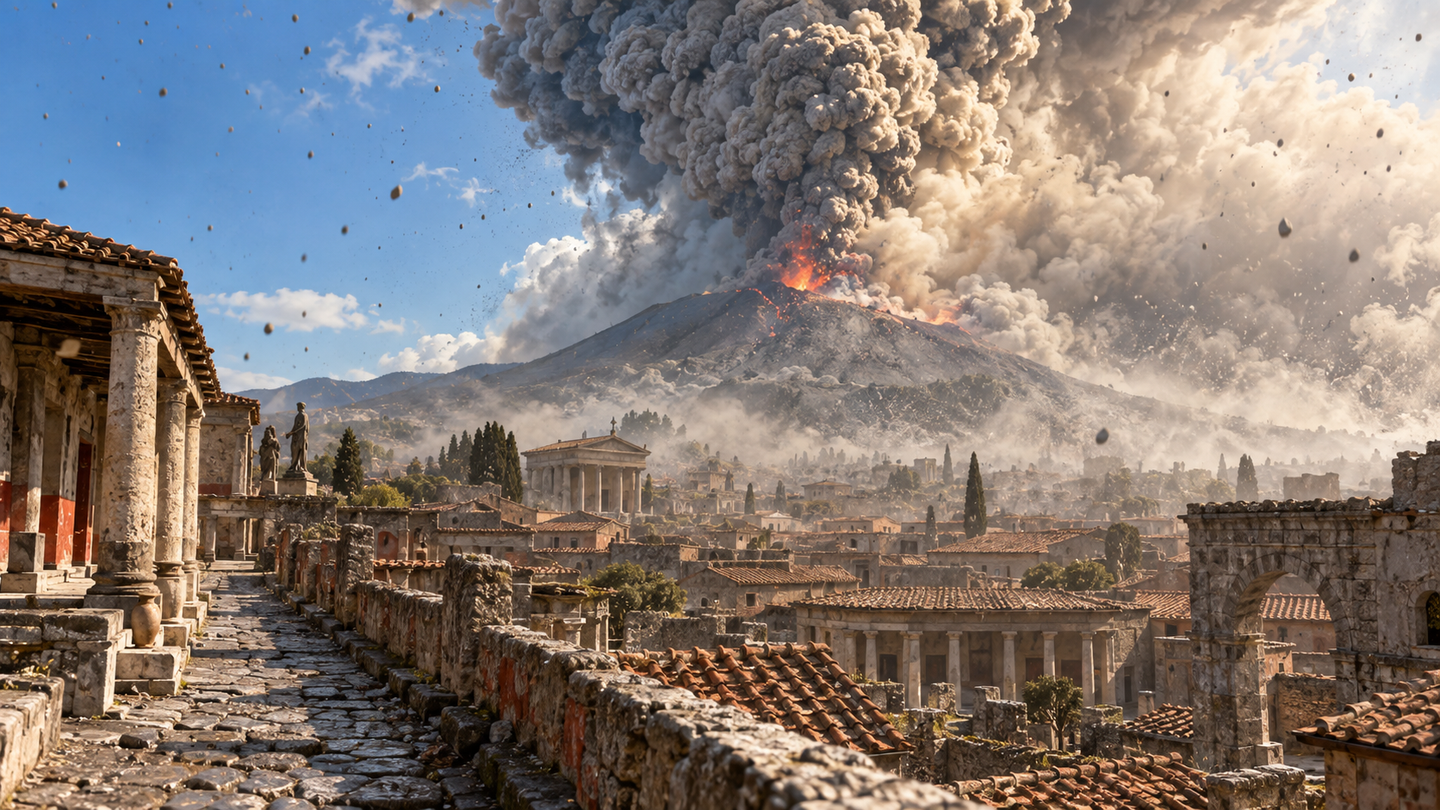
The 79 CE Vesuvius eruption helped scientists reduce argon-argon dating uncertainty to just 13 years for a 2,000-year-old event. (CREDIT: Shutterstock)
- Scientists used the precisely recorded 79 CE eruption of Mount Vesuvius to recalibrate argon-argon dating, reducing uncertainty for a nearly 2,000-year-old volcanic event to just 13 years.
- The new measurements dated Vesuvius to 87 ±13 CE, statistically consistent with the historically supported eruption date of August 24, 79 CE, while achieving about 0.7% precision.
- The benchmark also produced a nearly twofold improvement in the precision of a key potassium-40 decay constant, potentially strengthening volcanic, archaeological and geological timelines far beyond Pompeii.
Nearly 2,000 years after Mount Vesuvius buried Pompeii, the disaster is helping scientists tell geological time with unprecedented precision.
Researchers used minerals ejected during the famous 79 CE eruption to test and recalibrate argon-argon dating, one of geology’s most versatile radioactive clocks. Their measurements produced an age of 1,938 ±13 years before the samples were analyzed in 2025, corresponding to 87 ±13 CE and agreeing closely with the historical date.
The study, published in Science Advances, was led by researchers at the Berkeley Geochronology Center, UC Berkeley and the University of Padua. By tying laboratory measurements to an event witnessed and recorded by people, the team created a powerful benchmark for dating young volcanic eruptions and refining geological timelines reaching much deeper into Earth’s history.
(CREDIT: North Carolina Museum of Art)
Pliny left scientists an unusual calibration point
Argon-argon dating becomes increasingly difficult as researchers examine younger rocks. A 100-year uncertainty means little for an event millions of years old but can make a major difference when reconstructing eruptions only thousands of years apart.
Vesuvius offers an unusually valuable test because its eruption occurred near the boundary between geological and recorded history. Pliny the Younger described the catastrophe in letters recounting the eruption and the death of his uncle, Pliny the Elder.
The letters give August 24 as the day and month, while other Roman historical records place the disaster in 79 CE. Some archaeologists have argued for an autumn eruption based on evidence including food remains, clothing, graffiti and a Roman coin found at Pompeii.
Graduate student Caroline Hasler reviewed that evidence before the team adopted August 24 as its benchmark. A coin once interpreted as having been minted after September was recently reassessed and no longer provides strong evidence against an August eruption.
The researchers allowed a generous two-month uncertainty around the historical date. Their review concluded that there is no compelling reason to reject the traditional August 24 date supported by Pliny and the Roman historian Cassius Dio.
Volcanic crystals became miniature radioactive clocks
The experiment centered on sanidine, a potassium-rich volcanic mineral found in pumice from Oplontis, a Roman town buried during the same eruption.
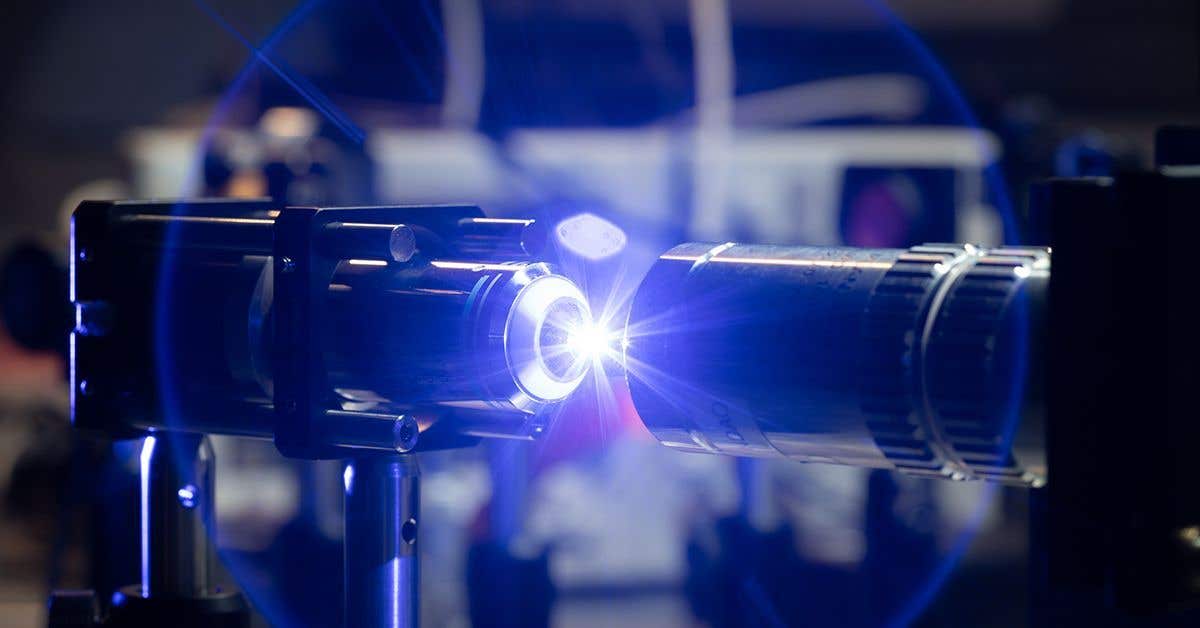
Argon-argon dating relies on radioactive potassium-40, which slowly decays into argon-40. Scientists irradiate a sample with neutrons, converting potassium-39 into argon-39, then measure ratios between argon isotopes to calculate how much radioactive decay has occurred.
The new pumice was particularly useful because it came from an early stage of the eruption. Stratified magma beneath Vesuvius placed potassium-rich material near the top of the chamber, causing that magma to erupt early and become concentrated in lower pumice deposits.
Researchers analyzed sanidine from eight uncontaminated irradiation wells. In total, 153 incremental heating measurements from roughly 700 milligrams of mineral produced a tightly defined age of 1,938 ±10 years. After accounting for additional statistical scatter, the uncertainty expanded to ±13 years.
That corresponds to roughly 0.7% precision. The calculated calendar age of 87 ±13 CE falls within one standard deviation of the historical 79 CE eruption.
Better instruments cut decades from the uncertainty
The result represents a dramatic improvement over earlier attempts to date Vesuvius with the same technique.
A 1997 study led by Paul Renne produced an argon-argon age with an uncertainty of roughly 94 years. Later measurements improved that figure, but uncertainty remained measured in many decades.
Several advances made the new result possible. Modern multicollector mass spectrometry allowed researchers to measure multiple argon isotopes with greater stability, while improved detectors handled extremely small ion signals more precisely.
The team also used only six minutes of neutron irradiation, carefully shielded the samples and closely bracketed them with known standards. Laser heating progressively released argon from the crystals, allowing researchers to distinguish radioactive argon from trapped gas.
“It was really just a combination of better samples, instrumental advantage and a more concerted effort,” Renne said.
The achievement shows that argon-argon dating can resolve sufficiently favorable eruptions from the recent geological past on timescales approaching decades rather than centuries.
A more precise clock could improve volcanic histories
That resolution matters for volcanoes whose prehistoric activity is poorly constrained.
Tens of millions of people live near explosive volcanic systems, including those around Naples, Mexico City and Yogyakarta. Reconstructing when eruptions occurred helps scientists estimate recurrence intervals and understand how volcanic systems change over time.
“If you want to put together the eruptive history of a volcano in relatively recent time, precision and accuracy really count,” Renne said.
The benefits extend beyond volcanic hazards. Precisely dated ash layers can act as chronological markers across large regions, linking archaeological sites, climate records and geological deposits.
Accurate timelines also help scientists test cause and effect. Renne previously used high-precision argon-argon dating to compare the Chicxulub asteroid impact, major volcanic activity in India and the mass extinction 66 million years ago.
When geological events occur close together, smaller dating uncertainties can determine whether one could plausibly have influenced another.
Vesuvius also refined radioactive decay itself
The experiment produced an additional result by improving scientists’ measurement of the rate at which potassium-40 produces argon-40.
Because the eruption date is known independently, Vesuvius functions almost like a controlled experiment that has been running for nearly two millennia. Researchers know when the volcanic crystals cooled and can measure how much radiogenic argon accumulated afterward.
The resulting partial decay constant was determined almost twice as precisely as the best previous direct nuclear-physics measurement. That improved value can help calibrate argon-argon ages across geological time.
Researchers ultimately hope to link multiple dating systems through common statistical methods. Uranium-lead dating reaches into Earth’s earliest history, while radiocarbon dating dominates archaeological and environmental records younger than about 55,000 years.
Volcanic deposits containing both datable minerals and charred organic material could provide direct bridges between those clocks. More precisely dated eruptions could therefore strengthen radiocarbon calibration as well as geological chronology.
Vesuvius destroyed Roman communities in a matter of hours. Nearly two millennia later, the date preserved in historical records is helping turn that catastrophe into one of geology’s most precise tests of time.
Dig deeper into argon dating and geological time
These resources provide recent and directly relevant context on argon-argon calibration, Vesuvius dating and the geological clocks that can benefit from improved intercalibration.
Bayesian calibration of the 40K decay scheme with implications for 40K-based geochronology: This recent study develops the Bayesian framework used to reconcile potassium-argon, argon-argon and uranium-lead chronometers across nearly two billion years. (Geochimica et Cosmochimica Acta, 2025)
The IntCal20 Northern Hemisphere Radiocarbon Age Calibration Curve (0–55 cal kBP): The current major Northern Hemisphere calibration curve illustrates why radiocarbon ages require independent chronological anchors and how improved volcanic dates can strengthen archaeological timelines. (Radiocarbon, 2020)
40Ar/39Ar ages of the AD 79 eruption of Vesuvius, Italy: An earlier high-precision study tested argon-argon dating against the historically known Vesuvius eruption and demonstrated its value for young volcanic deposits. (Bulletin of Volcanology, 2007)
Joint determination of 40K decay constants and 40Ar*/40K for the Fish Canyon sanidine standard, and improved accuracy for 40Ar/39Ar geochronology: This influential calibration study refined key constants and standards underlying modern argon-argon dating. (Geochimica et Cosmochimica Acta, 2010)
A refined astronomically calibrated 40Ar/39Ar age for Fish Canyon sanidine: Researchers used astronomical chronology to refine one of the most important mineral standards employed in argon-argon geochronology. (Earth and Planetary Science Letters, 2011)
Research findings are available online in the journal Science Advances.
The original story "The eruption that buried Pompeii is helping scientists synchronize Earth’s geological clocks" is published in The Brighter Side of News.
Related Stories
- A giant Pompeii-scale eruption buried an ancient Andes landscape and preserved it for 22 million years
- Pompeii DNA study shatters myths about their ancient lives
- The 364-day Qumran calendar may solve an ancient Dead Sea Scrolls mystery
Like these kind of feel good stories? Get The Brighter Side of News' newsletter.
Joshua Shavit
Writer and Editor
Joshua Shavit is a NorCal-based science and technology writer with a passion for exploring the breakthroughs shaping the future. As a co-founder of The Brighter Side of News, he focuses on positive and transformative advancements in technology, physics, engineering, robotics, and astronomy. Having published articles on AOL.com, MSN, Yahoo News, and Ground News, Joshua's work highlights the innovators behind the ideas, bringing readers closer to the people driving progress.