Saturn’s icy moon Enceladus may make alien life easier to find than scientists thought
Two studies suggest Saturn’s moon could both support methane-producing microbes and deliver concentrated traces of biology into space.
 Freie Universitat Berlin Writer: Christine Müller

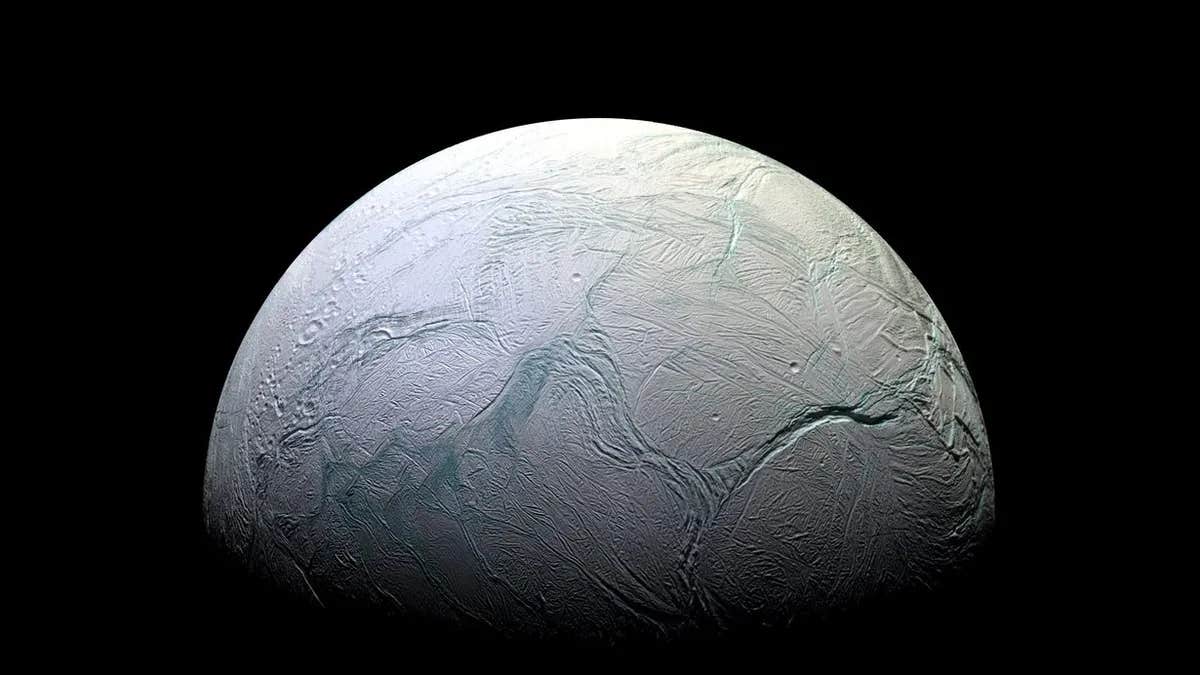
(CREDIT: NASA/JPL-Caltech)
- Cassini data and laboratory freezing experiments suggest that ocean droplets escaping from Enceladus slowly separate salts, organics and other dissolved materials before shattering into tiny ice grains, potentially concentrating biosignatures into individual particles.
- In a separate laboratory study, the methane-producing archaeon Methanothermococcus okinawensis survived and produced methane under simulated Enceladus ocean conditions despite extremely low carbon dioxide availability and a highly alkaline environment.
- Together, the studies strengthen Enceladus as a target in the search for extraterrestrial life by suggesting that its ocean may support microbial metabolism and naturally prepare concentrated samples for future spacecraft to analyze.
Saturn’s icy moon Enceladus may be doing something remarkably useful for scientists searching for extraterrestrial life. Its towering plumes could naturally sort and concentrate material from the hidden ocean below, making traces of biological material easier for future spacecraft to detect.
A second experiment adds another reason for optimism. Researchers recreated important chemical conditions from Enceladus’s ocean and found that a methane-producing microorganism from Earth could continue growing there despite conditions previously considered highly restrictive.
Both studies appeared in Science Advances. Together, they address two separate questions that have long shaped interest in Enceladus: Could life survive in its ocean, and if it did, could a spacecraft actually detect evidence of it?
The results do not show that Enceladus is inhabited. They instead suggest that its internal chemistry may be more compatible with certain forms of microbial metabolism than expected, while its icy vents may provide an unusually favorable way to sample the ocean without drilling through kilometers of ice.
An ocean hidden beneath the ice
Enceladus has become one of the Solar System’s most compelling astrobiology targets because liquid water does not remain completely sealed beneath its crust.
A global ocean lies beneath the moon’s icy shell and above a rocky interior. Near the south pole, fractures allow water vapor and ice particles to erupt hundreds of kilometers into space. Some of those particles escape into Saturn’s E ring.
NASA’s Cassini spacecraft repeatedly sampled this material during its mission. Its Cosmic Dust Analyzer found salts, organic compounds, phosphates and other evidence pointing toward extensive water-rock chemistry inside Enceladus.
Scientists have also found evidence consistent with hydrothermal activity on the seafloor, raising the possibility that chemical energy could be available to microbial life.
The new work led by Frank Postberg of Freie Universität Berlin revisited 961 salt-rich ice grain spectra measured by Cassini and asked why individual particles often contained dramatically different combinations of salts.
Freezing droplets sort their own chemistry
Researchers had generally assumed that droplets launched from the ocean froze extremely quickly. Laboratory experiments now suggest that at least some parent droplets freeze much more slowly.
The team recreated Enceladus-like ocean water and froze droplets at different sizes and cooling rates. When larger droplets cooled slowly, individual dissolved salts separated from one another as freezing progressed.
Phosphates precipitated first at relatively warm temperatures. Carbonates followed, while sodium and potassium chlorides formed later as the remaining brine became increasingly concentrated.
Instead of remaining evenly mixed, those compounds accumulated in different microscopic parts of each frozen droplet.
The laboratory pattern resembled Cassini’s observations. Among the spacecraft’s salt-rich grains, chloride-rich and carbonate-rich particles rarely appeared mixed. Phosphate-rich grains were also chemically distinct.
“Enceladus actually does a lot of the work for us in preparing samples for analysis that usually take a lot of effort in chemical labs on Earth,” Postberg said. “The oceanic constituents are separated from each other and simultaneously concentrated into individual ice particles.”
Large droplets may shatter into tiny samples
The particles Cassini encountered were typically only a few micrometers across, but the researchers propose that they began as considerably larger droplets.
Bubbles rising through Enceladus’s ocean could burst near the water surface, spraying droplets tens or hundreds of micrometers wide into the moon’s icy vents. As the droplets traveled upward, gradually falling temperatures could allow them to freeze slowly enough for chemical segregation to occur.
Farther up, the vapor and frozen particles accelerate dramatically. Collisions with the walls of twisting ice fractures could then shatter the larger frozen droplets into much smaller fragments.
Each resulting fragment might therefore contain a highly concentrated portion of one component from the original ocean water rather than a dilute mixture of everything.
That possibility matters for astrobiology. If microbial cells, cell fragments or biologically produced molecules were trapped in a droplet, freezing could concentrate them into a relatively small subset of particles.
A future spacecraft would need to sample many grains, but an especially informative particle could contain a strong biosignature.
A microbe survives Enceladus-like chemistry
The second Science Advances study examined whether organisms resembling some of Earth’s most ancient forms of metabolism could function under Enceladus-like conditions.
Researchers focused on Methanothermococcus okinawensis, an archaeon found near hydrothermal vents. It is a methanogen, meaning it can produce methane without oxygen by using hydrogen and carbon dioxide.
That type of metabolism is particularly interesting on Enceladus because its ocean appears oxygen-poor, strongly alkaline and influenced by interactions between water and rock.
The scientists recreated those conditions in the laboratory, including a pH of roughly 10 to 11 and extremely low availability of dissolved carbon dioxide.
Under a conventional laboratory growth medium adjusted to such high alkalinity, the microorganism failed to grow. Under the more realistic Enceladus simulation, however, it continued reproducing and producing methane.
The simulated water-rock chemistry apparently supplied conditions that allowed the cells to adapt their metabolism despite severe carbon dioxide limitation.
“This was really a surprise to us,” said Nozair Khawaja of Freie Universität Berlin. “This was an experiment for which we did not expect such a successful outcome.”
Two pieces of the life-detection problem
The studies complement each other because habitability and detectability are not the same problem.
An ocean could support microbial life yet remain nearly impossible to sample. Conversely, a plume could provide excellent samples from an ocean whose chemistry is hostile to life.
Enceladus may offer advantages on both fronts. Hydrogen generated through water-rock reactions could support methanogenic metabolism, while the moon’s plume could deliver material from the ocean directly into space.
The newly proposed freezing and fragmentation mechanism may make that material even easier to analyze by concentrating different chemicals into individual grains.
Future missions could therefore examine particles one by one with instruments designed to search for characteristic organic molecules, cellular fragments or unusual chemical patterns.
The European Space Agency has been studying a future mission concept targeting Enceladus as part of its long-term exploration plans. Any mission specifically designed around life detection could carry instruments far more sensitive than Cassini, which was launched before the moon’s astrobiological potential was understood.
Enceladus still has not provided evidence of life. But the emerging picture suggests that if biology exists beneath its frozen surface, nature may already be delivering carefully separated samples into space.
Dig deeper into Enceladus and the search for life
These resources provide broader context on Enceladus’s ocean chemistry, hydrothermal activity and the evidence that makes the moon a leading astrobiology target.
The Cassini Cosmic Dust Analyzer: This paper describes the instrument that analyzed individual ice grains from Enceladus and Saturn’s E ring during the Cassini mission. (Space Science Reviews, 2004)
Evidence for hydrothermal activity on Enceladus: Cassini measurements of silica nanoparticles provided evidence that hot water interacts with rock beneath Enceladus’s ocean. (Nature, 2015)
Molecular hydrogen in the Enceladus plume: Evidence for hydrothermal processes: Detection of molecular hydrogen indicated ongoing water-rock reactions capable of supplying chemical energy to potential microbial ecosystems. (Science, 2017)
Macromolecular organic compounds from the depths of Enceladus: Cassini ice grains revealed complex organic material originating from the moon’s subsurface ocean. (Nature, 2018)
Detection of phosphates originating from Enceladus’s ocean: Analysis of E-ring particles revealed abundant phosphates, showing that Enceladus possesses an element essential to known biological chemistry. (Nature, 2023)
Research findings are available online in the journal Science Advances.
The original story "Saturn’s icy moon Enceladus may make alien life easier to find than scientists thought" is published in The Brighter Side of News.
Related Stories
- Supercomputers unlock secrets of Enceladus’ icy plumes and hidden ocean
- Key building block for life found at Saturn’s moon Enceladus
- Scientists predict the discovery of life on Saturn's icy moon Enceladus
Like these kind of feel good stories? Get The Brighter Side of News' newsletter.
Joseph Shavit
Writer, Editor-At-Large and Publisher
Joseph Shavit, based in Los Angeles, is a seasoned science journalist, editor and co-founder of The Brighter Side of News, where he transforms complex discoveries into clear, engaging stories for general readers. With vast experience at major media companies like The Los Angeles Times, Times Mirror and Tribune Publishing, he writes with both authority and curiosity. His writing focuses on space science, planetary science, quantum mechanics, geology. Known for linking breakthroughs to real-world markets, he highlights how research transitions into products and industries that shape daily life.