50 years later, Viking 1’s legacy is powering NASA’s next giant leap on Mars
The Viking 1 Mars legacy stretches from NASA’s first landing to rovers, sample searches and helicopters exploring the Red Planet.

 Edited By: Joshua Shavit

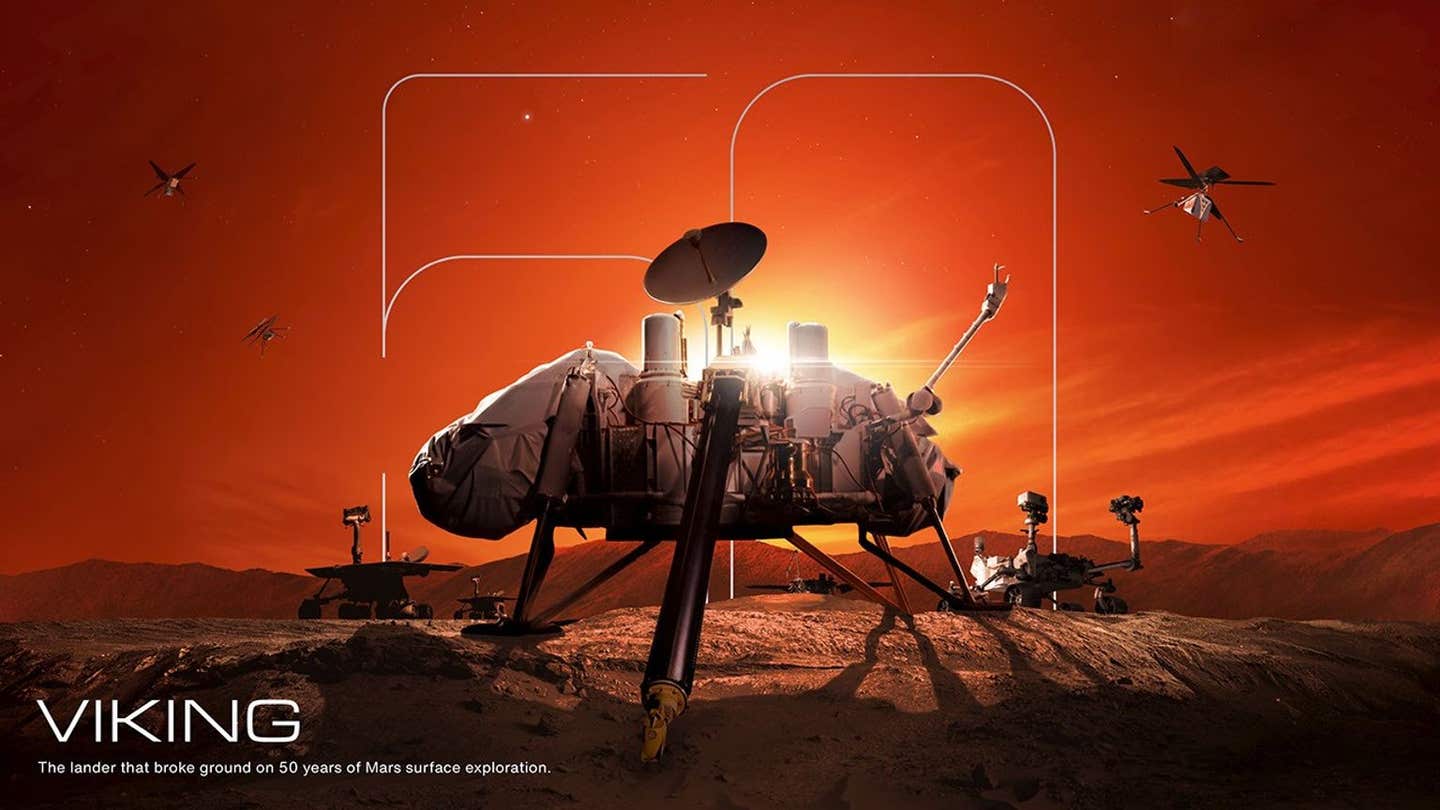
Fifty years after Viking 1 landed, NASA’s search for life on Mars is moving from red soil into the planet’s thin skies. (CREDIT: NASA)
Half a century after NASA first placed working hardware on Mars, the agency is preparing to explore not only the planet’s surface, but its skies.
The story began on July 20, 1976, when Viking 1 touched down in the western reaches of Chryse Planitia, a broad plain north of the Martian equator. It was NASA’s first successful landing on Mars.
Viking 2 followed on Sept. 3, 1976, landing in another region of the Red Planet. A Soviet probe, Mars 3, had reached the ground in 1971, but stopped transmitting less than two minutes later.
The Viking spacecraft arrived as paired landers and orbiters. They returned more than 52,000 images. The landers added over 4,500 more, giving humanity its first sustained view from the ground.
Mars comes into focus
Mars still appeared through Earthbound telescopes as a mottled orange sphere with few recognizable features.
NASA flybys in the 1960s captured grainy images of small portions of the planet. Then Mariner 9 entered orbit in 1971 and photographed about 85 percent of the surface. Its pictures revealed enormous volcanoes, deep canyons and evidence that water had once flowed across Mars.
By then, NASA had landed 12 astronauts on the Moon and returned them safely to Earth. Mars remained far more mysterious. No robotic lander had survived long enough to study its rocks, soil or atmosphere directly.
Viking changed that.
The first lander reached the ground at 7:53 a.m. EDT on the seventh anniversary of the Apollo 11 landing. Its confirmation signal took another 19 minutes to cross 212 million miles and reach the mission team at NASA’s Jet Propulsion Laboratory in Southern California.
After celebrating, engineers and scientists turned quickly to the first images and measurements.
A disputed search for life
Both Viking landers carried laboratories designed to search for signs of life. Three biological experiments tested Martian soil.
Two produced negative results. The third, called Labeled Release, delivered something harder to explain.
The experiment added nutrients to soil and detected a steady release of carbon dioxide. That response could have indicated microbial metabolism. Some scientists interpreted it as possible evidence of life.
Most researchers disagreed. They argued that nonliving chemical reactions could explain the result, especially when viewed alongside the other Viking findings. The broader mission data appeared to describe a dry, hostile and apparently lifeless world.
The disagreement became one of Viking’s most important legacies. It showed that detecting extraterrestrial life would require more than a single intriguing signal. Researchers needed a stronger understanding of Martian chemistry, geology and environmental history before attempting another direct search.
NASA did not return a spacecraft to the Martian surface for two decades. Viking’s high cost and ambiguous biological results helped produce the long pause.
Following the water
The drought ended in July 1997, when NASA’s Pathfinder lander reached Chryse Planitia about 530 miles from Viking 1.
Pathfinder tested a lower-cost approach to Mars exploration, demonstrated an airbag landing system and deployed Sojourner, the first rover to travel across the planet’s surface.
The small robot encountered rounded pebbles, evidence that flowing water had once shaped the landscape. That observation helped guide NASA toward a new strategy: follow the water before searching directly for life.
Water is essential to life as we know it. NASA therefore developed rovers that could search for ancient lakes, rivers and groundwater.
Spirit and Opportunity arrived in 2004. Curiosity landed in 2012, followed by Perseverance in 2021.
Each rover found evidence of past watery environments. Curiosity and Perseverance carried larger scientific payloads and examined the planet’s chemistry in greater detail. They detected complex organic molecules, including compounds that may be difficult to explain through nonbiological processes alone.
Perseverance has also identified potential biosignatures, clues that could point to ancient microbial activity. Such findings remain uncertain and require additional testing.
That need for caution echoes Viking. Mars can produce suggestive evidence without providing an easy answer.
Samples could settle the question
Perseverance has collected rock and soil samples for possible return to Earth. Laboratories here could examine them with instruments too large or complex to send to Mars.
That level of scrutiny may be necessary to determine whether the planet ever supported life. Yet returning the samples remains uncertain. NASA’s original plan became too expensive, forcing the agency to consider a different strategy.
Even without those samples, Perseverance has already helped open another frontier.
The rover carried Ingenuity, a four-pound helicopter built to test powered flight in an atmosphere only about one percent as dense as Earth’s at sea level.
Ingenuity was expected to make five short flights. Instead, it completed 72 over nearly three years. Its first flight occurred on April 19, 2021, and its last on Jan. 18, 2024.
The $80 million technology demonstration proved that aircraft could operate in Martian skies. It also showed that aerial vehicles could scout routes, photograph difficult terrain and support future surface missions.
From Ingenuity to Skyfall
NASA is now developing more ambitious aerial exploration.
Skyfall, planned for launch in 2028, would send three Ingenuity-like helicopters to Mars aboard a nuclear-powered rocket. The aircraft would map buried ice, study weather and chart terrain in remarkable detail.
Those maps could help identify safe, resource-rich destinations for future astronauts.
Engineers at the Jet Propulsion Laboratory are also studying larger helicopters capable of carrying heavier instruments and covering more ground. Such machines could reach cliffs, craters and other places that wheeled rovers cannot easily enter.
The progression from Viking to Ingenuity reflects how Mars exploration has advanced through linked missions. Viking proved that NASA could land and operate a laboratory on another planet. Pathfinder introduced mobile exploration. Later rovers followed water, studied organic chemistry and gathered samples.
Now helicopters are extending that reach above the ground.
Fifty years after Viking 1 opened humanity’s view from the Martian surface, its influence can still be seen in every rover track, sample tube and spinning rotor blade. The mission began as a search across red soil. Its legacy is carrying that search into the sky.
The original story "50 years later, Viking 1’s legacy is powering NASA’s next giant leap on Mars" is published in The Brighter Side of News.
Related Stories
- 50 years ago NASA may have accidentally destroyed life on Mars
- NASA is looking for four volunteers willing to spend a year inside a simulated Mars mission
- Enormous, Earth-like magma systems once existed inside Mars
Like these kind of feel good stories? Get The Brighter Side of News' newsletter.
Joseph Shavit
Writer, Editor-At-Large and Publisher
Joseph Shavit, based in Los Angeles, is a seasoned science journalist, editor and co-founder of The Brighter Side of News, where he transforms complex discoveries into clear, engaging stories for general readers. With vast experience at major media companies like The Los Angeles Times, Times Mirror and Tribune Publishing, he writes with both authority and curiosity. His writing focuses on space science, planetary science, quantum mechanics, geology. Known for linking breakthroughs to real-world markets, he highlights how research transitions into products and industries that shape daily life.