NASA’s Curiosity rover finds a vast field of honeycomb fractures on Mars
A sea of small geometric cracks now surrounds Curiosity as it climbs a Martian valley near Mount Sharp.
 NASA JPL Writer: Andrew Good

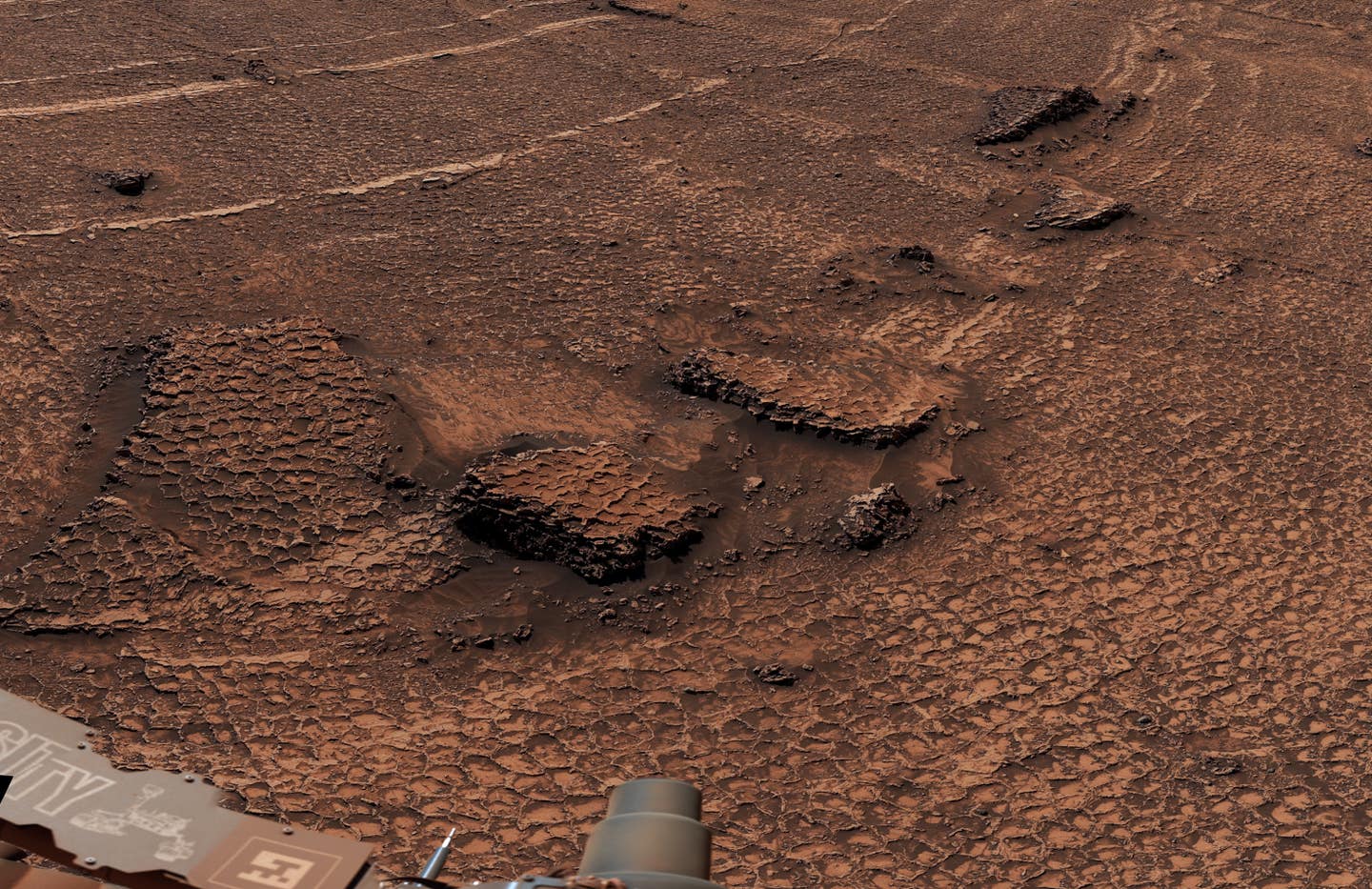
A close-up of the polygon fractures discovered by NASA’s Curiosity Mars rover highlights their honeycomb-like textures. (CREDIT: NASA/JPL-Caltech/MSSS)
- Curiosity has entered a broad Martian valley covered with small honeycomb-like fractures that stretch far beyond earlier patches.
- The shapes may reflect mud cracking, temperature swings, or pressure that forced water from buried sediment.
- Their size, chemistry, and wide distribution could help scientists reconstruct how water once shaped the lower slopes of Mount Sharp.
A field of honeycomb-like fractures now surrounds NASA’s Curiosity rover on Mars, spreading across a valley floor and around a nearby butte. Their scale has surprised the mission team and raised new questions about how the landscape formed.
The rover encountered the formations while climbing through a Martian valley nicknamed “Valle Grande.” Each polygon measures about 1.5 to 3 inches (4 to 8 centimeters) across.
Curiosity has seen small patches of similar shapes before. Valle Grande is different. Here, the cracked patterns extend in every direction visible to the rover.
A 360-degree panorama captured on June 19 and 20 shows the polygons covering the ground across the scene. Those dates marked the mission’s 4,930th and 4,931st Martian days, known as sols.
The same textures also wrap around the sides of a nearby butte called “Miraflores.” The landform rises about 20 feet (6 meters) and carries a thick cap of sand.
A sea of geometric fractures
“We’ve seen a lot of fascinating landscapes through Curiosity’s eyes, but this sea of polygons took our breath away,” said Ashwin Vasavada, the mission’s project scientist at NASA’s Jet Propulsion Laboratory in Southern California. “We measured their shapes and chemistry carefully and are hopeful there are clues in the data as to how these features formed.”
The panorama presents a rocky, reddish landscape divided into repeated geometric cells. In close-up images, the fractures create a honeycomb appearance across the surface.
Mission scientists already know that some Martian polygons formed as mud cracks. Wet sediment can shrink as it dries, leaving intersecting fractures behind.
But mud is not the only possible explanation.
Cycles of warmer and colder temperatures can also produce polygonal patterns. Compression offers another route. When sediment becomes buried, pressure can squeeze water from it and leave fractures within the material.
The Valle Grande formations may preserve evidence of one of those processes, or a combination of them. The team has not yet identified a single cause.
That uncertainty makes the measurements important. The shapes, dimensions, chemical makeup, and setting could help distinguish among the possible origins.
A pattern larger than earlier patches
Curiosity’s earlier encounters with polygons involved smaller areas. The new field stands out because it appears to continue across the valley and around Miraflores.
That broad reach changes the question from how one isolated patch formed to what process affected a much larger section of the landscape.
The rover’s view does not reveal where the field ends. From its position, the honeycomb pattern continues as far as its cameras can see.
The formations also add another unusual feature to Curiosity’s long record on Mars. Since landing on Aug. 5, 2012, the rover has encountered sulfur crystals, shiny meteorites, and many other geologic structures.
Those discoveries have appeared during a mission focused on the ancient Martian environment.
Curiosity’s most important work has shown that ancient Mars possessed water, useful chemistry, and nutrients that could have supported microbial life.
The rover has not shown that life existed there. Its findings instead establish that some ancient Martian settings had the ingredients needed to make life possible.
Water once crossed Mount Sharp’s foothills
Billions of years ago, lakes and streams dotted the lower foothills of Mount Sharp. The mountain rises about 3 miles (5 kilometers) above the surrounding terrain.
Curiosity has been climbing Mount Sharp since 2014. As it moves upward, it passes through rock layers that preserve different parts of Mars’ environmental history.
Valle Grande and its polygons now join that record.
Their relationship to water remains one of the main questions. Mud cracks would point to wet sediment that later dried. Fractures caused by compression could indicate water being forced from buried material.
Temperature-driven cracking would tell a different story, tied more closely to repeated heating and cooling.
The chemistry may help the team determine which process fits best. The dimensions and distribution of the shapes may also reveal whether they formed near the surface or after sediment was buried.
For now, the scene remains both visually striking and scientifically unresolved.
Chemistry tied to a wetter Mars
Curiosity has already uncovered chemical traces left from the planet’s watery past. Among them are carbon-based molecules believed to be precursors to RNA and DNA.
RNA and DNA are nucleic acids that carry genetic information.
Scientists cannot tell whether biological or geological processes created the molecules found on Mars. Either possibility remains open.
Their presence still matters because it confirmed that ancient Mars had chemistry compatible with life.
The new polygon field adds a physical structure to that chemical history. Its fractures may record what happened as water, sediment, temperature, and pressure changed over time.
The team’s careful measurements may reveal whether Valle Grande formed during a wet period, a drying period, burial, temperature cycling, or some overlap among those conditions.
Practical implications of the research
Understanding the polygons could sharpen the timeline of environmental change on the lower slopes of Mount Sharp.
If the fractures formed from drying mud, they would add evidence of repeated wet and dry conditions. If pressure forced water from buried sediment, they could clarify how water moved through the ground after layers accumulated.
A temperature-based origin would instead help scientists trace physical stress at the Martian surface.
Each explanation would place the landscape within a different part of Mars’ history.
The field’s unusual size also gives the mission a larger area to compare. Measurements taken across the valley and around Miraflores may show whether the same process acted consistently or varied from place to place.
That comparison could help scientists connect visible landforms with chemistry already measured by the rover.
The result will not answer whether life ever existed on Mars. It can, however, refine the environmental picture that makes that question possible.
By identifying how these fractures formed, Curiosity may reveal another chapter in the long shift from a world with lakes and streams to the dry landscape seen today.
The original story "NASA’s Curiosity rover finds a vast field of honeycomb fractures on Mars" is published in The Brighter Side of News.
Related Stories
- NASA’s Curiosity rover detects never-before-seen organic compounds on Mars
- Curiosity rover reveals ancient carbon cycle on Mars
- NASA's Curiosity Rover may have found evidence of life on Mars
Like these kind of feel good stories? Get The Brighter Side of News' newsletter.
Joseph Shavit
Writer, Editor-At-Large and Publisher
Joseph Shavit, based in Los Angeles, is a seasoned science journalist, editor and co-founder of The Brighter Side of News, where he transforms complex discoveries into clear, engaging stories for general readers. With vast experience at major media companies like The Los Angeles Times, Times Mirror and Tribune Publishing, he writes with both authority and curiosity. His writing focuses on space science, planetary science, quantum mechanics, geology. Known for linking breakthroughs to real-world markets, he highlights how research transitions into products and industries that shape daily life.