New findings complicate the search for life beneath Europa’s ice
Europa’s icy shell may block water rising from its deep ocean, changing how future missions interpret shallow reservoirs.

 Edited By: Joshua Shavit

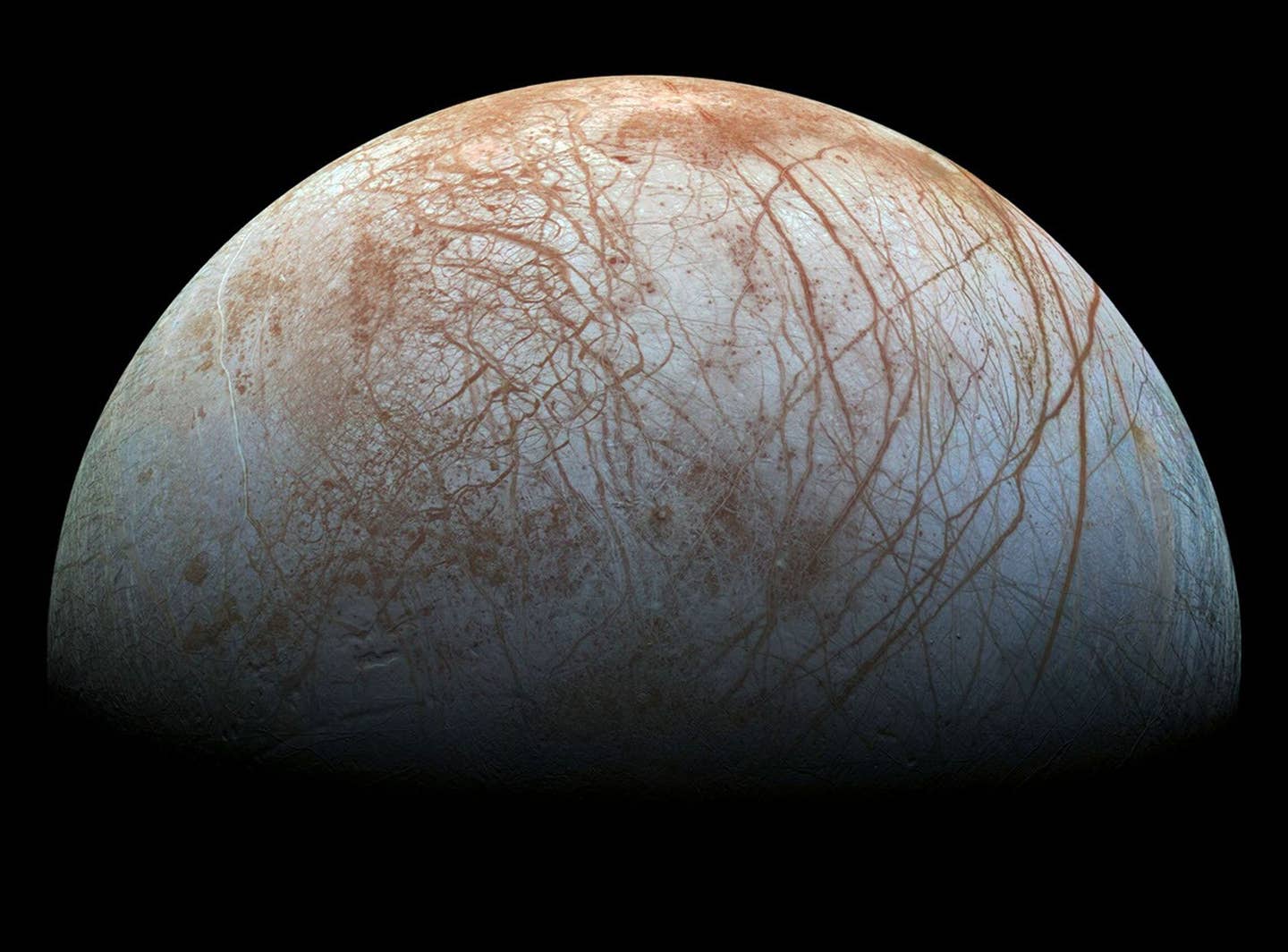
Europa ocean water transport may stall as turbulence forms ice crystals that clog fractures beneath the moon’s surface. (CREDIT: NASA/JPL-Caltech/SETI Institute)
- Water trying to rise from Europa’s ocean would likely cool quickly and begin freezing inside cracks.
- Tiny ice crystals could build into slush and clog those pathways within hours.
- Shallow water, if detected, may have melted locally instead of coming from the deep ocean.
Europa’s buried ocean may be one of the solar system’s most promising places to search for habitable conditions. Yet the icy moon’s surface may be far less connected to that ocean than scientists once hoped.
A Rutgers-led study in Nature Astronomy examined whether liquid water can rise from Europa’s deep ocean through cracks in the ice. The simulations suggest that water may cool, form ice crystals and clog its route before reaching shallow depths.
“The mystery we wanted to solve was whether this journey is actually possible,” said Lujendra Ojha, an associate professor in Rutgers University’s Department of Earth and Planetary Sciences. “Can liquid water rise from Europa’s deep ocean toward the surface without freezing along the way?”
A frozen barrier above a restless ocean
Europa’s global ocean may stay liquid because Jupiter’s gravity repeatedly squeezes and stretches the moon. That motion generates heat beneath the frozen exterior.
Scientists have proposed that water could move upward through narrow fractures called dykes. On Earth, similar cracks carry molten rock toward the surface. On Europa, the process would involve water and ice instead of magma and stone.
Those fractures could feed shallow reservoirs called sills. Such pockets would be easier for spacecraft to detect than the ocean below. They also may help form lenticulae, double ridges, chaos terrain, domes and pits.
“Ice and liquid water are fundamentally different than lava and the volcanoes that we see here on Earth,” Ojha said. “I think there’s some fundamental physics that’s missing here, and so I wanted to explore that.”
The team used COMSOL Multiphysics simulations combining fluid flow and heat transfer. The models tested how pure and salty water would behave in cold sections of Europa’s shell.
Turbulence changes the journey
Earlier models often treated the flow as orderly. The new analysis found that water would likely move turbulently at about 5 to 20 meters per second.
That swirling motion pushes warmer water against frozen walls. Heat then escapes quickly into the surrounding ice.
“This water that’s going to come up, it’s going to be turbulent,” Ojha said. “It’s going to be left and right, it’s going to be up and down, it’s going to have a swirling motion. And when that happens, that liquid water is going to cool very, very fast as it approaches the surface.”
The researchers modeled the upper 1 to 2 kilometers of a possible fracture. Surrounding ice there could be about 140 to 200 kelvins, or roughly minus 208 to minus 100 degrees Fahrenheit.
Even without turbulence, narrow fractures closed quickly. A dyke 0.1 meter wide could freeze shut within two to six hours. Delivering 1 billion cubic meters of water would require a crack about 77 kilometers long under favorable conditions.
At colder conditions, one fracture would need to stretch more than 200 kilometers. A realistic one-kilometer crack would require roughly 200 to 800 parallel dykes. Supplying 10 billion cubic meters could require thousands.
Wider cracks still face freezing
A one-meter-wide fracture seemed more promising under conduction-only modeling, remaining open for one week to 23 days. That advantage weakened once turbulence entered the calculation.
As water loses heat, it can become supercooled, meaning it remains liquid below its normal freezing point.
In the simulations, water crossing a one-kilometer section cooled by about 1 to 2 kelvins. Longer fractures could allow more cooling.
Supercooled water can produce frazil ice, small crystals that form in turbulent water. The process requires seed crystals, but only a tiny amount may be needed.
Fragments could come from the walls as a crack opens or as turbulent water scrapes against the ice. A wall-ice layer between 0.13 and 19 micrometers thick could trigger rapid frazil growth.
Ice crystals can choke the flow
The crystals can collide, stick together and build a slushy mixture. Cooling could turn about 1% to 3% of the water into frazil ice.
Even when only 1% to 5% of crystals striking the wall remained attached, a one-meter-wide fracture could clog within hours.
“There’s an icy shell, there’s water underneath, and there’s all this speculation about how that water can come from deep underground and make its way all the way up without freezing en route,” Ojha said. “That’s really what we think we disproved.”
Shallow water may form locally
The findings do not rule out liquid water near Europa’s surface. Instead, they change the most likely explanation for how it got there.
Localized heating inside the shell could melt ice in place. A sealed fracture might also focus tidal strain, producing heat and perhaps temporary melting nearby.
That matters because shallow water may not represent the chemistry of the deep ocean. A nearby reservoir could still interest scientists, but it may not provide a direct sample of Europa’s most compelling environment.
“Our work suggests that Europa’s ice shell may be a stronger barrier between the ocean and the surface than previously assumed,” Ojha said. “This helps future missions interpret what they find and better understand where to look for signs of habitability.”
NASA’s Europa Clipper launched in October 2024 and is scheduled to reach Jupiter in April 2030. It will make 49 close flybys. The European Space Agency’s JUICE mission launched in April 2023 and is scheduled to arrive in July 2031.
Practical implications of the research
Europa Clipper’s radar may test whether the moon contains shallow reservoirs, frozen fractures or groups of parallel dykes. Those observations could show whether water pathways once connected deeper layers to the surface.
The work also gives mission scientists a warning. Detecting shallow water would not automatically mean that a spacecraft had found material from the global ocean.
Future measurements of Europa’s ice structure, ocean conductivity and possible salt content could refine the freezing models. They may reveal whether any conditions allow water to travel farther.
For now, Europa’s ice appears less like a simple lid and more like an active barrier. That makes the search for habitability harder, but it gives future missions sharper questions.
Research findings are available online in the journal Nature Astronomy.
The original story "New findings complicate the search for life beneath Europa’s ice" is published in The Brighter Side of News.
Related Stories
- Salty ice may hold the key to life on Jupiter’s moon Europa
- New study uncovers the formative conditions that made Io dry and Europa watery
- The case for water plumes on Europa just got much harder to make
Like these kind of feel good stories? Get The Brighter Side of News' newsletter.
Joseph Shavit
Writer, Editor-At-Large and Publisher
Joseph Shavit, based in Los Angeles, is a seasoned science journalist, editor and co-founder of The Brighter Side of News, where he transforms complex discoveries into clear, engaging stories for general readers. With vast experience at major media companies like The Los Angeles Times, Times Mirror and Tribune Publishing, he writes with both authority and curiosity. His writing focuses on space science, planetary science, quantum mechanics, geology. Known for linking breakthroughs to real-world markets, he highlights how research transitions into products and industries that shape daily life.