New analysis reveals why Ganymede has a magnetic field when other moons do not
Ganymede may still be building its core, and that slow process could be powering its strange magnetic field today.

 Edited By: Joseph Shavit

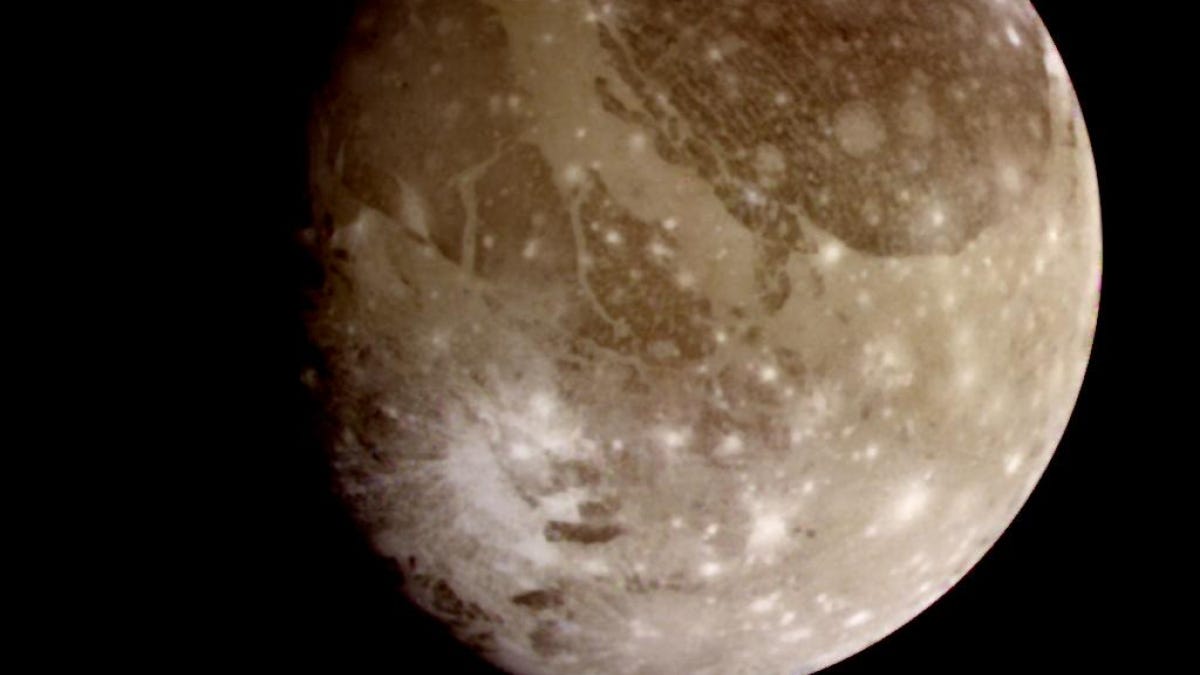
This natural-color image of Ganymede was captured by the Galileo spacecraft during its first flyby of the moon. (CREDIT: NASA/JPL)
Ganymede has long looked like a contradiction in orbit.
Jupiter’s largest moon is the only moon known to generate its own magnetic field, a trait more commonly associated with planets like Earth and Mercury. But that magnetic shield points to a liquid, churning metal core, and by many formation models, Ganymede should have started out too cold to build one.
A new analysis argues that both ideas may be true, at least in part. Instead of forming a metallic core near the beginning of the solar system and slowly cooling ever since, Ganymede may have begun cold and then warmed over billions of years. In that picture, metal inside the moon melted late, sank inward, and may still be feeding the core today.
The result is a different kind of dynamo, the deep planetary engine that creates magnetic fields.
“For decades, studies have progressed in parallel with conflicting assumptions about how Ganymede formed and evolved,” Kevin Trinh lead author from Arizona State University’s School of Earth and Space Exploration said. “Many formation studies suggest that Ganymede formed too cold to start with a metal core. Meanwhile, many modeling studies of Ganymede’s dynamo assume that Ganymede formed its metal core roughly when the moon itself formed, as Earth did.
“Both of these things cannot be simultaneously true.”
A moon that never quite fit the standard story
Ganymede is a giant among moons, about 3,300 miles wide, larger than Mercury and more than 1,000 miles wider than Earth’s moon. NASA’s Galileo spacecraft discovered its intrinsic magnetic field in 1996, giving scientists one of the clearest signs that something active and metallic lies deep below its outer layers of water and ice.
That field is usually explained by a core-hosted dynamo, where liquid metal moves in a way that sustains magnetism. On Earth, that process is tied to a core that formed very early and then gradually cooled. Many models of Ganymede borrowed the same basic idea.
The trouble is that icy moons are not expected to have had the same thermal head start. According to the new study in Science Advances, they likely formed after much of the short-lived radioactive isotope aluminum-26 had decayed away. They also appear too small to rely on accretional heating alone to melt metal quickly. Formation models for icy satellites typically place local temperatures at roughly 200 to 300 kelvin, far below the levels needed to melt iron-sulfur mixtures.
That mismatch has lingered for years. Ganymede clearly behaves like a body with a metal core, yet standard formation scenarios suggest it may not have been able to make one at birth.
Turning the usual dynamo inside out
To test another route, Trinh and his colleagues built one-dimensional thermal evolution models of Ganymede’s interior, starting from a cold state with no initial metal core. They assumed the moon’s core material is made of iron and iron sulfide, a conservative choice because that mixture melts at lower temperatures than other plausible metal alloys.
In their model, Ganymede’s rocky interior slowly warms through radioactive decay and, in some cases, past tidal heating from Jupiter’s gravitational pull. As temperatures rise high enough to melt iron and iron sulfide, droplets of liquid metal begin moving downward toward the center. That gradual rain of dense melt helps build a growing “protocore.”
“Our study hypothesizes a warming-driven dynamo for Ganymede, where the downward migration of liquid iron could stir the growing protocore. This idea contrasts with conventional cooling dynamos, which invoke thermal or chemical convection to mix the core,” Trinh said.
That detail matters. In a traditional cooling dynamo, the core already exists and generates motion as it loses heat. In the new version, the act of core formation itself helps stir the liquid metal.
The authors’ nominal model starts with Ganymede finishing accretion 4 million years after solar system formation. In that run, the interior eventually reaches the melting point for iron and iron sulfide around 2.4 billion years after accretion. Core growth then continues through the present, fast enough to sustain dynamo action today.
Heat from within, and a push from Jupiter
The study highlights two main heat sources. One is radioactive decay, which releases energy as unstable isotopes transform into lighter elements. The other is tidal heating tied to Jupiter’s immense gravity. As Ganymede moves through its orbit, the giant planet squeezes and stretches the moon, creating friction inside.
That second factor appears especially important, but only up to a point.
The team ran a sensitivity analysis across several key variables, including accretion timing, water content in silicates, sulfur content, potassium-40 leaching, and past tidal heating. Among 1,000 Monte Carlo simulations, many models with little or no tidal heating in the silicate interior were able to produce an ongoing dynamo alongside active core formation. Models with very high tidal heating almost always failed, suggesting that too much early heating could push the moon down a different evolutionary path.
In the authors’ view, Ganymede’s present magnetic field is consistent with a still-warming interior if the moon’s core composition is sub-eutectic and if tidal heating in the silicate interior stayed limited. They do not claim this is the only explanation. More conventional cooling-driven dynamos remain possible, but the paper argues those models need to revisit their starting assumptions if Ganymede truly formed cold.
“Our results do not rule out a cooling-driven dynamo at Ganymede. However, we introduce a new dynamo mechanism that is aligned with the idea that Ganymede started out cold and without a metal core. More work is needed to identify the most likely mechanism to explain Ganymede’s dynamo today,” Trinh said.
Why one moon has a dynamo and its neighbors do not
The idea also changes how scientists may compare Ganymede with nearby moons.
Europa and Callisto do not show clear signs of active dynamos today, though the paper notes that weak fields below the detection limit cannot be fully excluded. Europa may have warmed faster, because of earlier accretion, less silicate hydration, different potassium behavior, or stronger tidal heating. Callisto, by contrast, may have followed a colder path that never melted enough iron-sulfur material at all.
Those differences could help explain why Ganymede stands apart despite sharing the same Jovian neighborhood.
The study also underscores how little direct evidence scientists can access from Ganymede’s deepest interior. Its rock-metal layers sit buried beneath more than 1,000 kilometers of water and ice, leaving magnetic measurements and bulk properties as some of the few clues available. That makes the origin of its dynamo more than an academic puzzle. It is one of the best ways researchers can probe the hidden history of the moon.
Future observations could sharpen that picture. The European Space Agency’s Juice mission, now headed toward Jupiter, is expected to gather new data on Ganymede and the other icy moons. Those measurements may help show whether the moon’s magnetic engine is the fading legacy of an ancient core, or evidence that its center is still taking shape.
Practical implications of the research
If the new model holds up, magnetic fields may not always belong only to worlds that formed hot and early. Some bodies could build or sustain protective magnetism much later through slow internal warming and delayed core formation.
That possibility broadens the ways scientists think about the interiors of icy moons and rocky planets, including worlds beyond the solar system.
It also gives future missions a sharper question to test at Ganymede itself: whether the moon’s magnetic field comes from an old core cooling down, or a core that is still growing.
Research findings are available online in the journal Science Advances.
The original story "New analysis reveals why Ganymede has a magnetic field when other moons do not" is published in The Brighter Side of News.
Related Stories
- Gigantic asteroid impact knocked the Solar System's biggest moon off its axis
- NASA's Juno celebrates 10 years with new infrared view of moon Ganymede
- For the first time, evidence found for water on Jupiter's Moon Ganymede
Like these kind of feel good stories? Get The Brighter Side of News' newsletter.
Joshua Shavit
Writer and Editor
Joshua Shavit is a NorCal-based science and technology writer with a passion for exploring the breakthroughs shaping the future. As a co-founder of The Brighter Side of News, he focuses on positive and transformative advancements in technology, physics, engineering, robotics, and astronomy. Having published articles on AOL.com, MSN, Yahoo News, and Ground News, Joshua's work highlights the innovators behind the ideas, bringing readers closer to the people driving progress.