Alien civilizations could be using Dyson spheres to collect energy from black holes
Black holes can release enormous energy through hot disks, surrounding plasma and powerful jets, enough to support a civilization far beyond ours.

 Edited By: Joshua Shavit

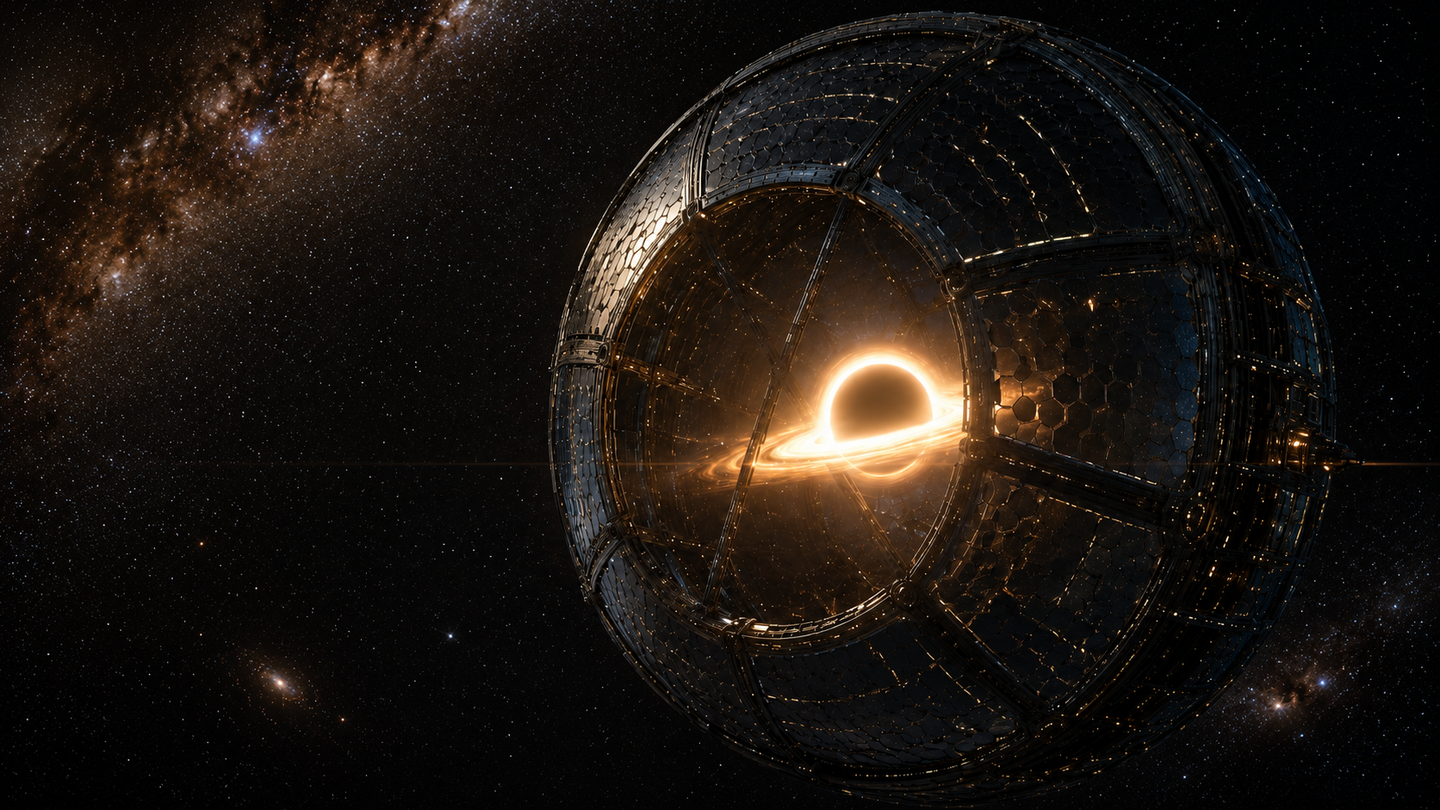
Black hole Dyson spheres could harvest immense energy while releasing waste heat detectable by current telescopes. (CREDIT: Wikimedia / AI-Generated / CC BY-SA 4.0)
- Black holes can release enormous energy through hot disks, surrounding plasma and powerful jets, enough to support a civilization far beyond ours.
- Any giant collector would release unused energy as heat, creating a glow that current telescopes could potentially detect.
- Astronomers could search existing black hole catalogs for unusual ultraviolet, visible or infrared signals that normal stars and disks cannot explain.
Black holes appear built to hide energy, not advertise it. Yet a civilization wrapping one in vast collectors could create a detectable glow, turning one of the universe’s darkest objects into a beacon of technology. The clue would come from heat.
An international team led by researchers at National Tsing Hua University in Taiwan examined whether an advanced civilization could build a Dyson sphere around a black hole. Their analysis also asked whether existing telescopes could detect it.
A Dyson sphere is a hypothetical system that surrounds an energy source and captures its output. A complete shell would be mechanically unstable, so the team also considered swarms, rings, bubbles and light sails.
Six ways to draw power from darkness
The researchers evaluated six possible energy sources: the cosmic microwave background, Hawking radiation, an accretion disk, Bondi accretion, a hot corona and relativistic jets.
The cosmic microwave background is leftover radiation from the early universe. A black hole could act as a cold sink while a surrounding structure collected that background energy. However, the available power would be far too low for a Type II civilization, defined as one able to use roughly the energy of a star.
Hawking radiation would be even less practical. This faint theoretical emission arises from quantum effects near a black hole’s event horizon. For a black hole with five times the Sun’s mass, the expected output would be about 10 to the minus 30 watts. Type II energy use is roughly 10 to the 26 watts.
The strongest opportunities lie outside the event horizon. Matter falling toward a black hole can form an accretion disk, where intense heating produces radiation. Even a stellar-mass black hole operating at a low Eddington ratio, a measure of brightness relative to a theoretical limit, could produce hundreds of times the Sun’s luminosity.
Spin could raise that output. The analysis used an accretion efficiency of 5.7 percent for a nonrotating Schwarzschild black hole and 39.9 percent for an extreme rotating Kerr black hole. At the same accretion rate, the Kerr disk could be seven times brighter.
Jets could carry the largest prize
A black hole’s corona could add another substantial source. This extremely hot plasma surrounds the inner disk and produces high-energy radiation. The team estimated that a corona could increase useful radiative output by about 30 to 50 percent beyond the disk alone.
Relativistic jets may offer even more. These narrow plasma flows shoot from the poles and carry radiation and kinetic energy. Jet radiation could equal about 60 to 80 percent of the disk’s luminosity. Total jet power may be about 10 times its radiative output.
For a five-solar-mass black hole with a low Eddington ratio, the researchers calculated total jet energy of about 1.7 million solar luminosities. Around a supermassive black hole similar in mass to Sagittarius A*, combining disk, corona and jet power could raise a civilization’s Kardashev index to 3. That level represents galaxy-scale energy use.
Collecting that power would pose severe engineering problems. A structure absorbing disk radiation would need to sit beyond the disk. The likely range for a hot system was between 1,000 and 100,000 Schwarzschild radii, depending on temperature, luminosity and black hole mass.
Known solid materials would require greater distance. To keep a structure at or below 3,000 kelvins, the team calculated distances of about 7.12 million Schwarzschild radii for a five-solar-mass black hole and 11.3 million for a 20-solar-mass black hole.
Waste heat would expose the collectors
No energy conversion is perfect. A civilization could use part of the captured power, but the rest would leave as waste heat. Depending on the structure’s temperature and distance, that glow could appear in ultraviolet, visible, near-infrared or mid-infrared wavelengths.
The team modeled a five-solar-mass black hole 10 kiloparsecs away, about one-third of the Milky Way’s diameter. Under its example configurations, hot and solid collector systems would be bright enough for existing survey instruments to detect.
Potential tools include the Hubble Space Telescope’s WFC3 camera, GALEX ultraviolet surveys, Pan-STARRS1, the VISTA Hemisphere Survey, the Wide-field Infrared Survey Explorer and the Sloan Digital Sky Survey. A closer or more massive system would appear brighter.
Detection would remain difficult. Dust could dim ultraviolet and visible light, while companion stars, planets and ordinary X-ray binary behavior could imitate parts of the signal. A small covering fraction or poor transfer efficiency could also bury waste heat beneath normal emission.
The authors recommend starting with known black holes and candidates. Astronomers could compare several wavelength bands and fit the full spectral energy distribution. An unexplained thermal bump, especially one inconsistent with a companion star, could justify closer examination.
Spectroscopy could separate artificial waste heat from cool stars, whose spectra contain strong molecular bands. Radial-velocity measurements could test whether an apparent companion has enough mass to be a star or planet. A collector system should have far less mass.
Practical implications of the research
The work does not provide evidence that Dyson spheres exist. It identifies physical signatures that could guide searches using data already gathered by major sky surveys.
Instead of looking only for deliberate messages or visible structures, astronomers could search for unusual heat around known black holes. Strong candidates would combine unexpected ultraviolet, optical or infrared emission with a disk that appears dimmer than its physical state should allow.
Such searches could also sharpen models of ordinary black hole systems. Any candidate would need to survive tests involving dust, stellar companions, accretion changes and spectral features before an artificial explanation became credible.
The central result is testable: black holes could supply enough energy for an extremely advanced civilization, and the unavoidable disposal of heat offers a way to look for one.
Research findings are available online in the journal arXiv.
The original story "Alien civilizations could be using Dyson spheres to collect energy from black holes" is published in The Brighter Side of News.
Related Stories
- Scientists identify several stars possibly wrapped by Dyson Spheres
- Detecting nuclear fusion energy could reveal advanced alien civilizations
- Astronomers observe the final acts of a dying giant star
Like these kind of feel good stories? Get The Brighter Side of News' newsletter.
Joseph Shavit
Writer, Editor-At-Large and Publisher
Joseph Shavit, based in Los Angeles, is a seasoned science journalist, editor and co-founder of The Brighter Side of News, where he transforms complex discoveries into clear, engaging stories for general readers. With vast experience at major media companies like The Los Angeles Times, Times Mirror and Tribune Publishing, he writes with both authority and curiosity. His writing focuses on space science, planetary science, quantum mechanics, geology. Known for linking breakthroughs to real-world markets, he highlights how research transitions into products and industries that shape daily life.