New scan data of Turkish formation is reviving the Noah’s Ark debate
Fresh scan data from Turkey are giving new life to one of history’s most disputed biblical mysteries.

 Edited By: Joseph Shavit

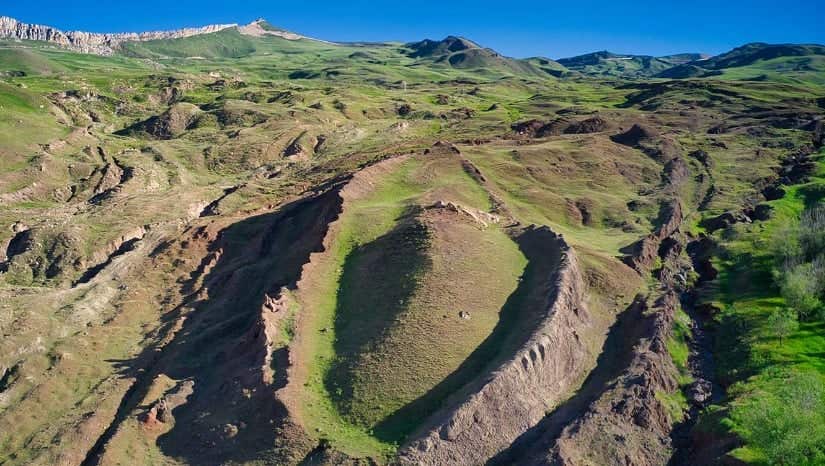
These discoveries hint that the area was once submerged, strengthening theories that the site could be linked to the biblical vessel. (CREDIT: NoahsarkScans)
Four meters below the surface, researchers say they are seeing something that has changed the conversation around one of the world’s oldest mysteries.
New scan data from a boat-shaped formation in eastern Turkey appear to show tunnel-like spaces running through the structure, along with features that may resemble walls, support beams, and interior divisions. For a team that has spent years trying to prove the site is more than an odd hill, the findings have become their strongest argument yet.
Andrew Jones, who works with the Noah’s Ark Scans project, said the latest results have only deepened his conviction.
“I do believe that this is the real, decayed, buried remains of Noah’s Ark, the famous ship,” he said in a recent TV interview on "Fox & Friends First". “And we’re doing our best to convince the skeptics and show the world this site.”
The formation, known as the Durupinar site, lies in Turkey’s Doğubayazıt district near the Iranian border. It stretches about 538 feet and has long drawn attention because of its shape, which resembles a giant vessel pressed into the landscape. The site was first noticed in 1948 and later took its name from Turkish Army Captain İlhan Durupınar, who identified it during a NATO mapping mission in 1951.
Now a fresh round of work has brought new claims.
“Our new research has shown that there are tunnels about four meters down and about two meters high, going down the center of the boat and on the inside edge of the hull shape,” Jones said.
He said the layout matters.
“We really believe that this layout, showing tunnels and also possible support beams and walls, would suggest that it’s a manmade object and not just a natural formation.”
A site that keeps pulling people back
The Durupinar formation has been debated for decades, and not gently. Supporters point to its outline, its size, and its location near Mount Ararat. Many geologists say it is simply a natural formation made of iron-rich limonite. The disagreement has become part of the site’s identity.
Jones and others on the project argue that the case does not rest on shape alone.
“We have the ship shape, and we’re in the right location, and now we’re also seeing that the soil inside is different from right outside the formation,” he said. “So we have three times more organic matter found inside versus right outside. So it’s a distinct object and not just part of the mountainside.”
To him, that points to the remains of ancient biological material or manmade substances preserved within the structure.
The broader research team has also reported other findings from the site. Scientists working with Istanbul Technical University, Agri Ibrahim Cecen University, and Andrews University collected nearly 30 soil and rock samples there. Those samples contained traces of marine materials, clay, and what the team described as seafood remnants buried deep within the area. Back in Istanbul, the material was dated to between 3,500 and 5,000 years old, placing it in the Chalcolithic era.
That timing has attracted attention because it overlaps with the biblical timeframe often associated with the flood story in Genesis.
Professor Faruk Kaya, vice rector at Agri Ibrahim Cecen University, said initial results suggest human activity in the region during that period. For believers in the site’s significance, that adds another layer to the argument. It does not prove a massive wooden vessel once rested there, but it places people in the area at a time when large construction would at least have been possible.
The case for caution
The team is not moving straight to excavation.
Instead, Jones said the next step would be to send a robot into the tunnels to film the interior and collect samples. That approach, he said, would avoid needless damage while allowing researchers to gather better evidence from inside the formation.
The group’s website explains the reasoning in plain terms: archaeology is destructive. Once material is removed, it cannot simply be put back into place. That is why the team says geophysical scans and core drilling have to come first, with excavation only later if the data justify it.
That slower method may frustrate people who want a dramatic reveal, but it reflects the stakes. If the formation does contain something significant, digging too early or in the wrong place could erase part of the record researchers are trying to understand.
The caution also reflects a deeper problem. Noah’s Ark claims have surfaced again and again since the 1800s, especially around Mount Ararat. Reports of beams, ship shapes, and buried remnants have repeatedly fallen apart under scrutiny. In some cases, snow or rock formations were mistaken for something built by human hands.
Mount Ararat itself adds another wrinkle. The Bible says the Ark came to rest on the “mountains of Ararat,” which is broader than the modern volcanic peak that now carries that name. Older Jewish, Christian, and Muslim traditions have pointed to other places too, including Mount Cudi near the Iraqi border. Over the years, the search has drifted between faith, folklore, and field science, with no consensus in sight.
Why the debate won’t go away
Part of the reason this site keeps returning to public attention is that it offers several things at once. It has the right scale for believers, the right mystery for documentarians, and just enough physical evidence to keep researchers coming back with new tools.
The dimensions have helped fuel that persistence. Supporters say the formation lines up closely with the Ark’s proportions as described in Genesis, 300 cubits long, 50 cubits wide, and 30 cubits high. Add the site’s location near Mount Ararat, and the narrative becomes hard for many people to ignore.
Still, none of this has produced definitive proof.
That remains the central tension. The scans may suggest interior spaces. The soil may differ inside and outside the formation. Organic material may be more concentrated within it. But none of those facts, on their own, settle the question of whether this is a natural structure or the decayed remains of a giant ancient vessel.
For now, the Turkish site remains what it has long been, a place where geology, belief, and history keep colliding.
Practical implications of the research
The latest scans do not end the Noah’s Ark debate, but they do shape what comes next. If the tunnel-like spaces hold up under closer study, researchers may have a clearer path for targeted sampling and less destructive exploration.
The work also shows how newer tools, such as geophysical scans, soil analysis, and robotic imaging, can push old archaeological claims beyond guesswork.
Even if the site turns out not to be Noah’s Ark, the investigation could still help researchers understand the formation itself and sharpen methods for studying disputed historical locations.
The original story "New scan data of Turkish formation is reviving the Noah’s Ark debate" is published in The Brighter Side of News.
Related Stories
- 500 year-old ‘Bible map’ reveals how maps reinvented faith and nations
- Historic 2,600-year-old Turkish artifact finally decoded: 'The Mother' goddess revealed
- 1,500 year-old ivory box connected to Moses and the Ten Commandments
Like these kind of feel good stories? Get The Brighter Side of News' newsletter.
Rebecca Shavit
Writer
Based in Los Angeles, Rebecca Shavit is a dedicated science and technology journalist who writes for The Brighter Side of News, an online publication committed to highlighting positive and transformative stories from around the world. Having published articles on MSN, AOL News, and Yahoo News, Rebecca's reporting spans a wide range of topics, from cutting-edge medical breakthroughs to historical discoveries and innovations. With a keen ability to translate complex concepts into engaging and accessible stories, she makes science and innovation relatable to a broad audience.