New Stanford-built optical chip ‘recycles’ light for faster computing and satellite communication
A silicon chip learns hidden patterns in partially coherent light and routes them to separate outputs, pointing toward new imaging and communication tools.

 Edited By: Joseph Shavit

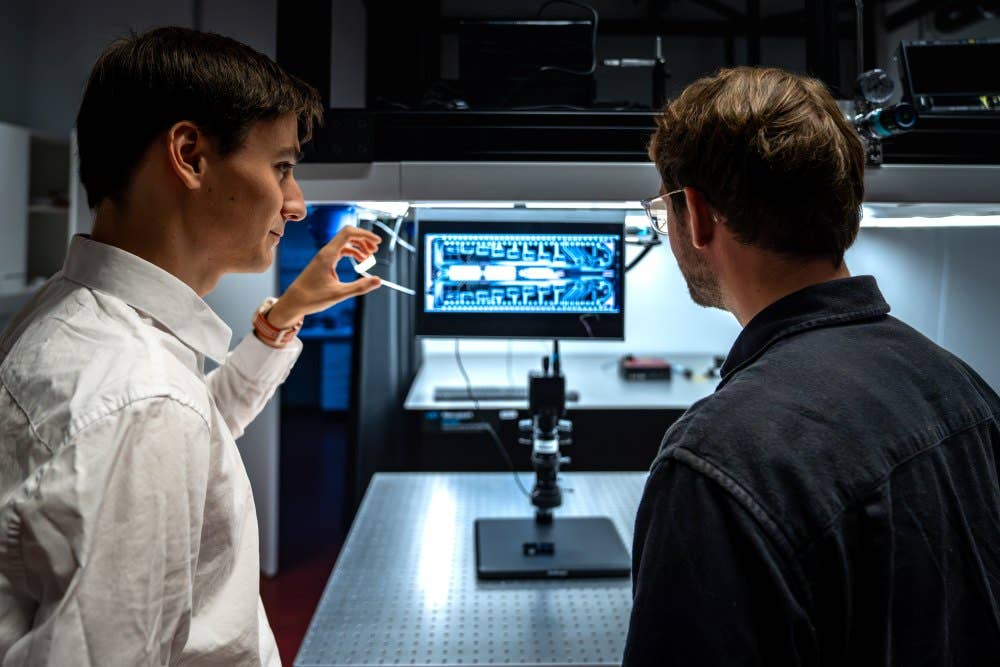
A self-configuring chip separates partially coherent light into optical modes, with potential uses in microscopy and communication. (CREDIT: ISTA)
- A self-configuring photonic chip separates partially coherent light into distinct optical modes that emerge through different outputs.
- Tests with overlapping laser beams showed that the device accesses phase information missed by intensity-only measurements.
- The work could support microscopy and optical communication, but those applications still need testing.
Two beams of light can overlap so completely that their brightness patterns look alike, yet still carry distinguishable information. A new silicon chip can find that hidden structure and direct its components into separate optical channels. The result offers a way to process light that conventional intensity measurements cannot fully describe.
The system, developed by researchers at Stanford University and the Institute of Science and Technology Austria, appears in Nature Photonics. It automatically learns patterns within partially coherent light, whose waves have some statistical relationships but lack complete coordination. Rather than treating that complexity as interference to discard, the team built a device that can work with it.
The research combines a silicon photonic chip with detectors, electronics and control algorithms. Most of the work took place at Stanford, where Charles Roques-Carmes began the project with graduate student Paul-Alexis Mor. Roques-Carmes, now an assistant professor at ISTA, is continuing that research with Mor, a co-first author of the paper.
What brightness alone cannot reveal
Coherence describes how consistently light waves maintain relationships between their phases, or positions within an oscillation cycle. Laser light typically maintains strong correlations, making it useful for precise interference experiments. Light from many other sources has only partial coherence, which can complicate its measurement and use.
The team focused on spatial coherence: relationships between the light fields at different positions across a beam. Measuring brightness at those positions does not capture every relationship. Two overlapping fields can produce similar intensity profiles while differing in phase, for example because they arrive at slightly different angles.
That distinction matters for optical information processing, which depends on the information a device can actually access. A numerical analysis can describe partially coherent light as a collection of independent coherence modes. Each mode has a coherent spatial pattern, while the different modes have no mutual phase correlation.
The experimental challenge was to turn that mathematical description into a physical operation. Instead of merely calculating the modes, the researchers wanted to send them through different waveguides, the tiny channels that guide light around a chip. Those separated outputs would then remain available for further optical processing.
A circuit that learns its settings
The main device received light through nine input structures called grating couplers. These fed two layers of Mach-Zehnder interferometers, components that divide and recombine light along separate paths. Adjusting the relative phases changes how light interferes and where it emerges.
Each interferometer contained two independently controlled thermal phase shifters. The researchers applied small oscillating adjustments to these controls and monitored the resulting output power. An algorithm used that feedback to improve the settings, first maximizing power at one layer's output and then optimizing the next.
This process allowed the circuit to learn the incoming light's coherence modes without being told their spatial profiles beforehand. Detectors and electronics supplied the feedback needed during configuration. Once configured, the optical network physically routed the modes into separate outputs, rather than separating them only in a computer reconstruction.
Such integration addresses a familiar obstacle in miniaturizing optical instruments: conventional arrangements can require many carefully aligned components. Roques-Carmes said advances in chip manufacturing made it possible to place hundreds of optical elements within a few square millimeters. An equivalent arrangement of individual mirrors and other components would be far harder to align and stabilize.
Testing the hidden patterns
For the main experiments, two independent lasers supplied light at approximately 1,535 nanometers, in the near-infrared. Each beam was spatially coherent, but the pair lacked mutual coherence. Combining them created a controlled input whose coherence structure the chip could learn.
The researchers checked its accuracy against a separate reconstruction method implemented on the same chip. In this benchmark, which used four input ports, the recovered mode patterns had fidelities of 97.8% and 99.9%. Fidelity describes agreement with the reference patterns; these percentages do not measure how much incoming light passed through the device.
For that comparison, the team switched the input lasers on individually and reconstructed their combined statistical structure from separate measurements. The new method instead learned the modes while both beams entered together. Comparing the two approaches provided a check on whether the automatic settings represented the incoming field correctly.
Another experiment moved one beam across the input region while keeping the other fixed. Even where their intensity distributions were indistinguishable, phase differences revealed two distinct coherence modes. The chip detected information that an intensity-only description missed, showing why brightness measurements alone can overlook important structure.
The researchers also tested three lasers using a separate, fully reconfigurable nine-by-nine photonic circuit. Three optimized outputs became mutually incoherent after the configuration process. That experiment supported extending the approach beyond two modes, although the main demonstrations used the two-layer device.
Separating modes is not always separating sources
The chip does not generally recover each original laser beam intact. Its task is to separate the light's coherence modes, which can contain contributions from both incoming beams. Those modes form the independent mathematical patterns that describe the combined field.
There is an important special case in which the modes match the original beams. This occurs when the input fields are orthogonal, meaning their spatial patterns have zero overlap in the mathematical comparison used here. They can still occupy the same physical region, because that comparison includes phase as well as intensity.
Under those conditions, the chip sent the overlapping beams to distinct output ports. The researchers describe this broader approach as effectively recycling light into useful separate channels. It organizes existing optical information, rather than creating additional photons or guaranteeing recovery of every original source.
From laboratory beams to useful instruments
One possible destination is satellite communication, where atmospheric turbulence can distort laser signals. A receiver that recognizes changing coherence patterns might handle those disturbed fields more effectively. The present experiments did not demonstrate a working satellite link or establish performance under real atmospheric conditions.
At ISTA, the team is also exploring microscopy and imaging, particularly the processing of weak optical signals. Astronomy offers another potential application because distant objects supply very little light. Learning which measurements extract useful information could matter when photons are scarce, although astronomical observations were not part of this demonstration.
“We want to make our chips as efficient as possible so that every photon counts,” Roques-Carmes said. His group is preparing another generation of chips for operation at ISTA. For faint signals, the challenge includes collecting enough reliable feedback to configure the circuit while preserving useful light for the intended measurement.
Mor said the team is working toward larger, faster chips with additional modes and a microscope developed with biologists. Achieving useful tracking speeds will depend on the electronics, signal quality and speed of the phase shifters. The next challenge is to establish how well that expanded system performs with faint, changing light from an actual imaging or communication task.
Dig deeper into optical coherence
These resources explain coherence modes, programmable optics and ways partially coherent light can become useful.
Shaping partially coherent light by the coherent mode decomposition
Explores how breaking light into coherent modes can guide the design of systems that shape partially coherent fields. (Optics Express, March 2025)
Measuring, processing, and generating partially coherent light with self-configuring optics
Develops the theoretical framework for using adaptive optical networks to measure, separate and generate coherence modes. (Light: Science & Applications, September 2024)
Partial coherence enhances parallelized photonic computing
Demonstrates a different use of partial coherence: increasing parallel processing in photonic computing systems. (Nature, July 2024)
Programmable photonic circuits
Reviews the optical components, circuit designs and electronic controls behind reconfigurable photonic chips. (Nature, October 2020)
Self-configuring universal linear optical component
Provides a foundational design for optical devices that configure themselves through detectors and feedback. (Photonics Research, June 2013)
Research findings are available online in the journal Nature Photonics.
The original story "New Stanford-built optical chip 'recycles' light for faster computing and satellite communication" is published in The Brighter Side of News.
Related Stories
- Quantum chip opens new way to read complex quantum systems
- New quantum chip design uses phonons to link distant qubits
- Google's new quantum chip is 1.05 million septillion times faster than today's fastest supercomputers
Like these kind of feel good stories? Get The Brighter Side of News' newsletter.
Joshua Shavit
Writer and Editor
Joshua Shavit is a NorCal-based science and technology writer with a passion for exploring the breakthroughs shaping the future. As a co-founder of The Brighter Side of News, he focuses on positive and transformative advancements in technology, physics, engineering, robotics, and astronomy. Having published articles on AOL.com, MSN, Yahoo News, and Ground News, Joshua's work highlights the innovators behind the ideas, bringing readers closer to the people driving progress.