ETHOS satellite mission could transform how scientists predict space weather
The ETHOS satellite mission will track the Sun, Earth’s upper atmosphere and orbital motion to investigate drag and help preserve solar-radiation records.

 Edited By: Joshua Shavit

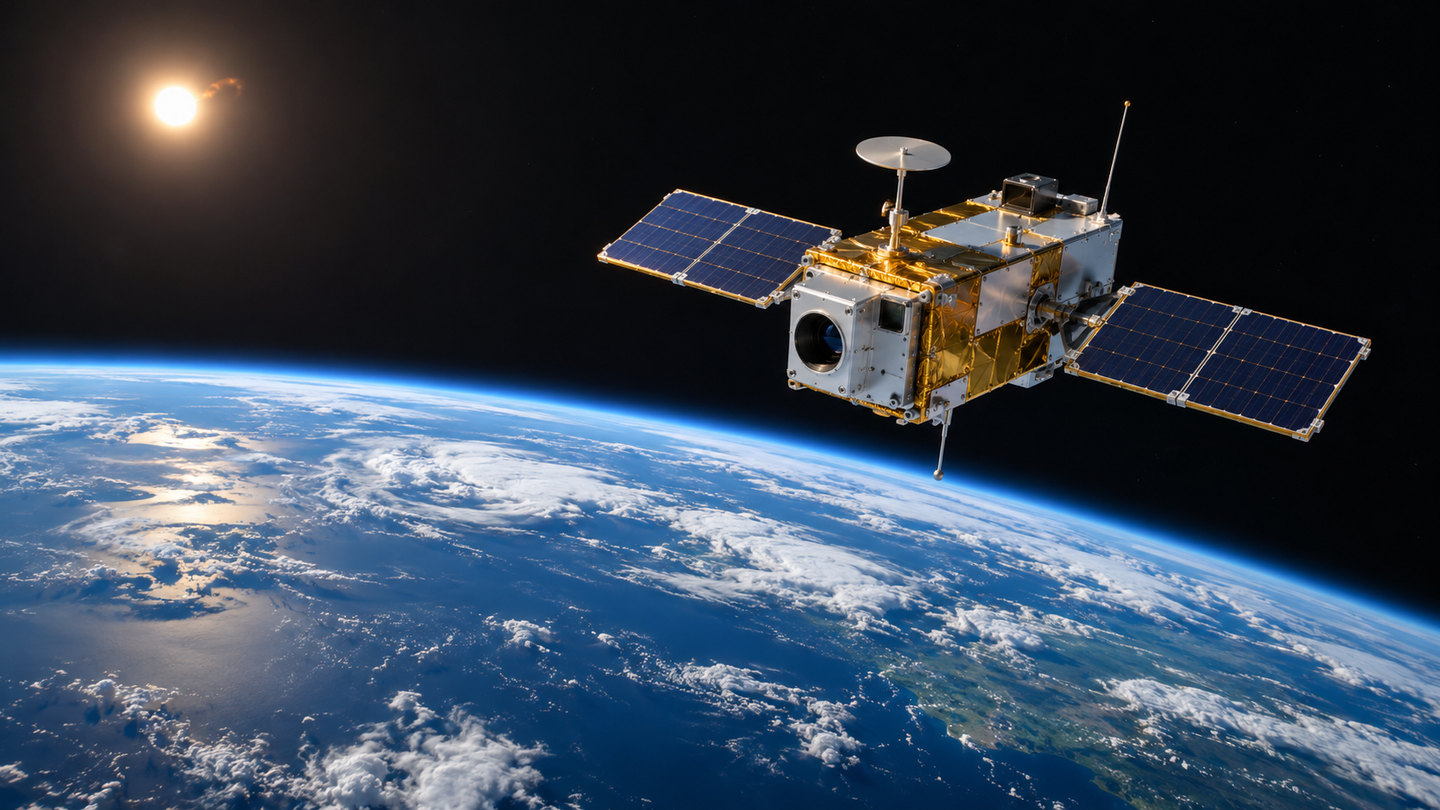
Artist’s impression of a small research satellite above Earth. The planned ETHOS mission will investigate how solar activity changes the upper atmosphere and increases drag on orbiting spacecraft. (CREDIT: The Brighter Side of News)
- Switzerland’s planned ETHOS satellite will measure solar radiation, changes in the upper atmosphere and its own orbit together.
- The 25- to 30-kilogram spacecraft is expected to collect data from 2030 at an altitude of 550 kilometers.
- Researchers hope the measurements will improve understanding of satellite drag while extending solar-radiation records used in climate research.
A solar storm can change a satellite’s orbit by changing the atmosphere around it. When energy from the Sun heats Earth’s upper atmosphere, the gas expands, increasing resistance along some orbital paths. A planned Swiss mission will investigate that connection by observing the Sun and the atmosphere from the same spacecraft.
The ETHOS mission, short for Earth Thermosphere & Heliophysics Observing Satellite, is being developed under the leadership of ETH Zurich. Partners include the Physical Meteorological Observatory Davos, the University of Bern and EPFL. The spacecraft is expected to weigh between 25 and 30 kilograms and begin collecting data from 2030.
At a planned altitude of 550 kilometers, ETHOS will operate within the region it aims to understand. Its instruments will examine solar radiation, changes in the ionosphere and the satellite’s orbit. Bringing those measurements together could help researchers explain why solar storms affect spacecraft differently as atmospheric conditions change.
Why a solar storm can change an orbit
Low Earth orbit is not a perfect vacuum. Although the atmosphere there is extremely thin, its particles still exert drag on moving spacecraft. When heating increases the density at a satellite’s altitude, the additional drag removes orbital energy and can cause the spacecraft to descend faster.
Solar flares and geomagnetic storms contribute through different processes. Flares release radiation, including X-rays and extreme ultraviolet light, while eruptions called coronal mass ejections can trigger geomagnetic storms when they reach Earth. Energy deposited during these storms heats the upper atmosphere, making the response more complicated than a single burst of sunlight.
The May 2024 Gannon geomagnetic storm exposed the operational consequences. An analysis published in the Journal of Spacecraft and Rockets documented thousands of satellites maneuvering after enhanced drag caused altitude losses. Such widespread adjustments complicate tracking and collision avoidance, because predicted encounters must be reassessed using the spacecraft’s changed trajectories.
“The upper atmosphere is among the least-understood areas of near-Earth space,” said Louise Harra, the mission’s scientific lead. Harra directs the World Radiation Centre at the Physical Meteorological Observatory Davos and is an affiliated professor at ETH Zurich. ETHOS aims to supply linked observations that help researchers investigate this poorly understood response.
Predicting that response requires more than knowing an eruption has occurred. Operators need to anticipate how much drag will change along a particular orbit and how that change will evolve. Uncertainty in the atmosphere can therefore become uncertainty in a satellite’s future position, even when its present position is known.
Four instruments connect the Sun to the atmosphere
The mission will combine four scientific instruments on a commercially supplied satellite. ETH Zurich and its partners are developing the scientific equipment rather than building every spacecraft component themselves. The payload’s purpose is to follow related changes in solar output, the upper atmosphere and orbital motion.
Some measurements will track energy emitted by the Sun. Others will observe X-rays and extreme ultraviolet radiation associated with solar flares. Together, those observations should help characterize the solar input while the satellite records changes closer to Earth.
The mission will also monitor the ionosphere, the electrically charged region of the upper atmosphere. It overlaps the thermosphere, where heating and changes in neutral gas density affect drag. Measuring the ionosphere therefore provides part of the picture, rather than treating all upper-atmospheric changes as the same phenomenon.
Precise orbit determination will connect those observations with the spacecraft’s motion. Benedikt Soja, an ETH Zurich professor of space geodesy, and his team are developing a compact receiver for navigation satellite signals, including GPS. Tracking ETHOS accurately will help researchers investigate how atmospheric changes correspond to the drag experienced along its path.
Collecting these different measurements on one platform should help researchers examine their relationships together. The solar instruments characterize incoming radiation, while the atmospheric observations describe part of Earth’s response. The orbit measurements add a practical consequence to compare against both, allowing the team to investigate the chain from solar variability to spacecraft motion.
A second job: preserving the solar record
ETHOS will also contribute to a much longer scientific record. Climate researchers need continuous measurements of solar radiation across decades to understand changes in the energy reaching Earth. An individual flare is a short event, but a reliable climate record requires observations that continue through many such events and quieter periods.
The mission planners say several solar-radiation missions are expected to end around 2030. ETHOS is intended to help maintain measurements as that observing fleet changes. Its planned start therefore matters for continuity as well as for the study of space weather.
That objective remains dependent on the mission reaching operation as expected. A planned spacecraft cannot yet guarantee an uninterrupted record or demonstrate improved forecasts. The scientific opportunity lies in collecting measurements that connect short-lived solar activity with atmospheric responses while also supporting long-term monitoring.
From instrument builder to mission leader
ETH Zurich already has experience contributing hardware to major space projects. Components developed there have flown on the James Webb Space Telescope, which observes distant astronomical objects. ETHOS extends that experience into responsibility for an entire satellite mission, rather than a contribution to another organization’s spacecraft.
The university’s researchers also developed the seismometer used by NASA’s InSight Mars mission. That work involved measuring vibrations on another planet, a different scientific task from monitoring Earth’s upper atmosphere. Both projects nevertheless form part of the institution’s experience designing instruments for operation in space.
For ETHOS, the university will oversee the mission throughout its life cycle. “ETH Zurich Space is leading the mission, from its inception through to operation and to the end of its life cycle,” said Florian Kehl, who oversees the institution’s space research initiatives. He said the project would build experience and skills for leading future missions with partners.
Swiss partners share the work
The Physical Meteorological Observatory Davos is contributing instruments for observing solar radiation. Bern brings expertise in space weather and satellite-based laser ranging through its Zimmerwald Observatory. Laser ranging uses the travel time of light to measure distance, providing another approach to determining where a satellite is.
EPFL is evaluating a highly sensitive camera as a possible test for future space applications. Its participation could give the mission a technology-testing role alongside the main scientific observations. The camera remains under evaluation, while the partners develop the instruments and expertise needed for the planned mission.
Students will also be able to participate under the ETH Zurich Space team’s supervision. Potential roles include system development, assembly, testing and operations. Their involvement will extend beyond analyzing finished data to the practical work needed to prepare and operate a spacecraft.
The central scientific challenge is turning simultaneous measurements into better explanations of atmospheric behavior. More reliable space weather forecasts would require those explanations to improve predictions, not simply add observations. Once ETHOS begins collecting data, researchers will be able to test how well its linked measurements account for changes in satellite drag.
Dig deeper into solar storms and satellite drag
These resources explain storm-driven orbital changes, forecasting research and the value of long-term solar measurements.
Data-Driven Satellite Drag Modeling Without Dynamic Knowledge of the Atmosphere
Explores how correlated satellite motions can support drag modeling without relying on conventional atmospheric-density models. (Space Weather, February 2026)
TSIS-1
Explains how measurements of total and spectral solar irradiance help track the Sun’s energy input to Earth. (NASA, updated January 2026)
What NASA Is Learning from the Biggest Geomagnetic Storm in 20 Years
Reviews the May 2024 storm’s effects on satellites, navigation, aviation and Earth’s upper atmosphere. (NASA, May 2025)
Satellite Drag Analysis During the May 2024 Gannon Geomagnetic Storm
Documents forecasting difficulties and widespread satellite maneuvers during the storm; this author-submitted record identifies the published journal article. (Journal of Spacecraft and Rockets, 2024)
Satellite Drag
Explains how solar activity changes upper-atmospheric density and alters spacecraft orbits. (NOAA Space Weather Prediction Center)
The original story "ETHOS satellite mission could transform how scientists predict space weather" is published in The Brighter Side of News.
Related Stories
- A delayed Victorian train reveals a 185 year-old error in space weather history
- Space weather near stars may be hiding alien signals from Earth
- Solar Orbiter traces space-weather particles back to solar flares and CMEs
Like these kind of feel good stories? Get The Brighter Side of News' newsletter.
Joseph Shavit
Writer, Editor-At-Large and Publisher
Joseph Shavit, based in Los Angeles, is a seasoned science journalist, editor and co-founder of The Brighter Side of News, where he transforms complex discoveries into clear, engaging stories for general readers. With vast experience at major media companies like The Los Angeles Times, Times Mirror and Tribune Publishing, he writes with both authority and curiosity. His writing focuses on space science, planetary science, quantum mechanics, geology. Known for linking breakthroughs to real-world markets, he highlights how research transitions into products and industries that shape daily life.