Researchers identify nearly 600 genetic differences in human chimpanzee and gorilla brains
Human, chimpanzee and gorilla brain organoids reveal how shared genes operate differently, offering clues to stem-cell shape and human neocortex expansion.
 TU Dresden Writer: Benjamin Griebe

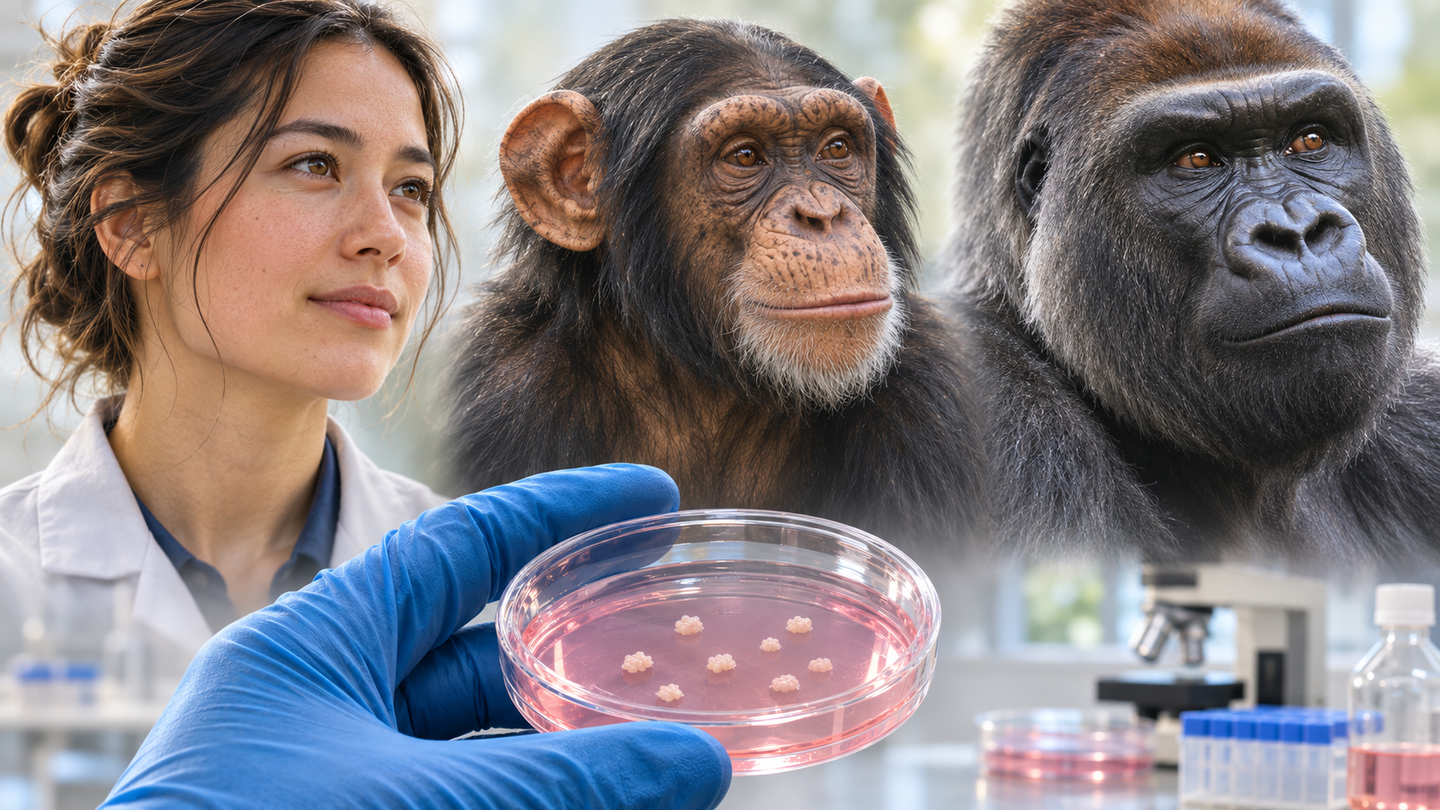
Illustrative composite of a human, chimpanzee and gorilla alongside brain organoids. Researchers compared stem-cell-derived organoids from all three species to investigate gene regulation during early brain development. (CREDIT: The Brighter Side of News)
- Human, chimpanzee and gorilla brain organoids revealed differences in how developing stem cells regulate shared genes.
- Researchers identified 599 candidate regulatory regions with greater accessibility in human basal radial glia and tested two cell-shape genes.
- The findings connect gene regulation with stem-cell structure, but do not establish a complete explanation for human brain expansion.
The cells that build the human brain may owe part of their distinctive behavior to different settings on familiar genes. Comparing laboratory-grown tissues from humans, chimpanzees and gorillas, researchers found regulatory differences linked to the shape of neural stem cells. Disrupting two genes changed those cells’ structural complexity, and one disruption also reduced neuron numbers.
The international study, led by Mareike Albert at TUD Dresden University of Technology, appeared in Nature Communications. It investigates how changes in gene regulation could contribute to the evolutionary expansion of the neocortex. This brain region supports abilities including speech, abstract thinking and long-term planning, but the experiments did not measure those abilities.
Comparing development without studying living ape brains
Differences in adult brain size begin much earlier, while developing stem cells are producing neurons. Human-specific genes explain some relevant developmental mechanisms, but they do not account for the full expansion of the human neocortex. Researchers therefore need ways to compare how shared genetic instructions operate during development.
“Changes in brain size actually arise during development. This is when the majority of neurons are generated. But developing brain tissue of non-human great apes is not available for research, and for good ethical reasons,” said Albert, who leads a group at Dresden’s Center for Regenerative Therapies. Her team turned to organoids as an alternative route into that otherwise inaccessible period.
Brain organoids are three-dimensional tissue models grown from stem cells that reproduce selected features of a developing brain. Here, the researchers generated models from all three species and compared early neocortical development. These models allow controlled cellular experiments, while remaining different from complete brains developing inside living animals.
A 2021 comparative organoid study examined an earlier transition in the shape of developing human and ape cells. Delaying that transition in human organoids was associated with larger models. Together, such experiments show why researchers examine multiple developmental stages rather than seeking one universal explanation for brain expansion.
Shared genes can have different settings
Having similar protein-coding genes does not mean two species use them with identical timing or intensity. Regulatory DNA helps determine where, when and how strongly genes operate. A change in that control system can affect development without requiring an entirely new protein-coding gene.
“These genetic switches are short DNA sequences that control how active a gene is. You can think of them as sort of dimmers that turn genes up or down,” said Theresa M. Schütze, who led the experimental work. The dimmer analogy emphasizes differences in activity levels, rather than a simple division between genes being present or absent.
The team identified 599 candidate regulatory regions with greater DNA accessibility in human basal radial glia than in the corresponding ape cells. Basal radial glia are neural progenitors involved in building the neocortex. Accessibility helps identify potentially active regulatory regions, but the full list should not be read as 599 individually proven causes of brain enlargement.
Why the shape of a stem cell matters
Many of the highlighted regions were associated with genes involved in shaping cells and their extensions. That pattern directed attention toward how elaborate a progenitor cell’s structure becomes. The researchers were interested in the cells producing neurons, rather than simply comparing the final shapes of mature nerve cells.
Earlier work has connected more complex progenitor shapes with greater capacity to generate neurons. In a 2019 study, researchers linked the number of cellular extensions with progenitor proliferation across experimental systems. This background gives the Dresden findings a plausible developmental context, rather than proving that every additional extension necessarily produces a larger brain.
That earlier work examined a protein called PALMDELPHIN and found that increasing its expression promoted progenitor extensions and proliferation in mouse and ferret tissue. Disrupting its gene in human fetal tissue reduced both. The findings helped establish cell shape as a functional part of developmental biology, rather than merely a visible difference between species.
One proposed explanation is that more elaborate cells encounter more growth-promoting signals in their surroundings. Their extensions could increase contact with the local environment and provide access to signals from different sources. Under that model, cellular signaling connects physical structure with decisions about division and neuron production.
Testing two genes moved beyond comparison
The team selected FAM107A and CNGA3 for functional experiments in human organoids. Using CRISPR-Cas9, they disrupted each gene separately and examined basal radial glia. Both interventions reduced the proportion of cells classified as having complex morphologies, supporting a role for these genes in cell structure.
The detailed measurements nevertheless differed between the two genes. FAM107A disruption reduced the number of extensions growing directly from the cell body, while CNGA3 disruption did not significantly change the individual structural measurements examined. Describing both interventions simply as reducing branching would therefore miss an important distinction in the results.
FAM107A disruption also reduced neuron numbers in the examined organoid regions. That provides a connection between the gene’s activity, progenitor structure and a developmental outcome. It does not establish that both genes produce the same consequences or quantify their contribution to the historical enlargement of the human neocortex.
More activity is not always better
The experiments also complicate a simple story in which increasing a gene’s activity always makes a stem cell more elaborate. Raising human FAM107A expression in chimpanzee organoids produced a structural effect resembling its disruption in human organoids. The authors interpret this as evidence that the appropriate level of expression matters.
That result fits the broader idea of coordinated settings rather than a single growth switch. Regulatory networks must control genes in the appropriate cells and developmental context. A gene’s importance therefore cannot be reduced to a rule that turning it up necessarily increases neuron production or brain size.
The work also separates two kinds of evidence: identifying regulatory differences between species and testing what particular genes do. Disrupting FAM107A or CNGA3 supports their involvement in progenitor morphology. It does not, by itself, establish the complete causal chain from every candidate DNA switch to gene activity, cell behavior and neocortex expansion.
A window into evolution with clear limits
“It is not necessarily different genes that make a human brain special. As the nearly identical genomes suggest, we use largely the same toolkit as apes, just with different settings,” Albert said. The findings give researchers specific gene-regulatory mechanisms to investigate within that broader evolutionary idea.
Organoids make such experiments possible without obtaining developing brain tissue from endangered great apes. They provide access to individual cells, their genetic activity and responses to experimental changes. However, observations in these models cannot directly establish adult brain size, intelligence or the evolutionary history of an entire species.
The next challenge is to determine how particular regulatory changes work together to shape progenitor behavior and neuron production. That requires connecting candidate DNA regions with their target genes and developmental consequences, rather than treating the initial list as a finished explanation. The study narrows the question from what makes humans different to which cellular settings can help account for those differences.
Dig deeper into brain development and evolution
These studies explore gene regulation, neural progenitors and the cellular changes that help shape the developing neocortex.
Dissecting gene regulatory networks governing human cortical cell fate
Functional experiments investigate how regulatory proteins influence whether developing cortical cells renew themselves or adopt specialized identities. (Nature, January 2026)
A human-specific enhancer fine-tunes radial glia potency and corticogenesis
This study connects changes in a regulatory DNA element with neural progenitor behavior and cortical development. (Nature, May 2025)
A cell fate decision map reveals abundant direct neurogenesis bypassing intermediate progenitors in the human developing neocortex
Imaging traces how basal radial glia divide and generate neurons in developing human tissue and organoid models. (Nature Cell Biology, March 2024)
An early cell shape transition drives evolutionary expansion of the human forebrain
Comparative human and ape organoids reveal how the timing of an early cell-shape transition contributes to developmental differences. (Cell, March 2021)
Neocortical Expansion Due to Increased Proliferation of Basal Progenitors Is Linked to Changes in Their Morphology
This foundational study examines how progenitor extensions relate to cell proliferation and neuron production across experimental systems. (Cell Stem Cell, March 2019)
Research findings are available online in the journal Nature Communications.
The original story "Researchers identify nearly 600 genetic differences in human chimpanzee and gorilla brains" is published in The Brighter Side of News.
Related Stories
- Humans walk very differently from chimpanzees, helping our ancestors to conquer the world
- Wild monkeys challenge a long-held assumption about the common ancestor of humans and chimpanzees
- Apes and humans share an ancient laughter rhythm dating back 15 million years
Like these kind of feel good stories? Get The Brighter Side of News' newsletter.
Joshua Shavit
Writer and Editor
Joshua Shavit is a NorCal-based science and technology writer with a passion for exploring the breakthroughs shaping the future. As a co-founder of The Brighter Side of News, he focuses on positive and transformative advancements in technology, physics, engineering, robotics, and astronomy. Having published articles on AOL.com, MSN, Yahoo News, and Ground News, Joshua's work highlights the innovators behind the ideas, bringing readers closer to the people driving progress.