Seven new frog species discovered in Madagascar reveal hidden biodiversity
Scientists discover seven new frog species in Madagascar, revealing hidden biodiversity and urgent conservation needs.

 Edited By: Joseph Shavit

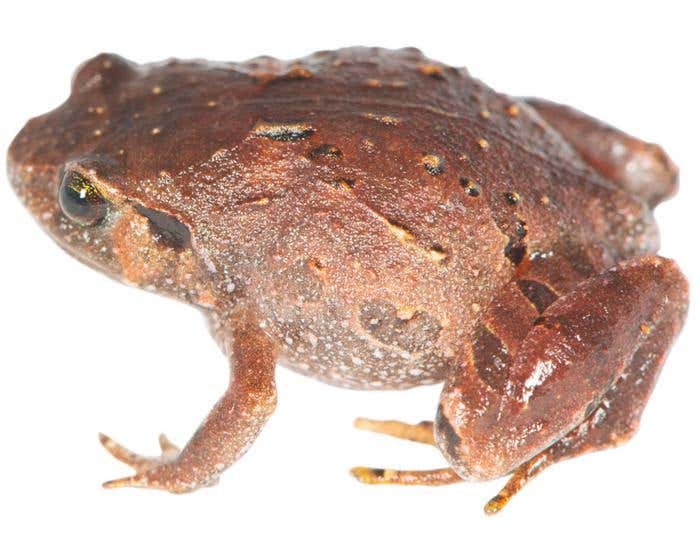
A new study uncovers seven hidden frog species in Madagascar, offering fresh insight into biodiversity and conservation challenges. (CREDIT: Mark D. Scherz, Natural History Museum Denmark)
A quiet shift in scientific understanding is unfolding beneath the leaf litter of Madagascar’s forests. A new study has revealed that one of the island’s most elusive frog groups is far more diverse than scientists once believed. By identifying seven new species of diamond frogs, researchers have expanded a hidden world that had long gone unnoticed.
The findings, built on more than a decade of work, reshape how scientists understand these secretive amphibians. They also highlight how much of Earth’s biodiversity remains undiscovered.
A Hidden Diversity Beneath The Forest Floor
Diamond frogs, known scientifically as Rhombophryne, are among Madagascar’s most unusual amphibians. Many spend most of their lives buried beneath soil and leaves. Even when they appear, they often look nearly identical to one another.
“Diamond frogs have been hiding their diversity beneath our feet,” said Dr. Mark D. Scherz, Curator of Herpetology at the Natural History Museum Denmark and lead author of the study.
Their appearance can be misleading. Most are brown and blend into their surroundings. Yet some reveal flashes of orange or bold markings on their legs when disturbed. These sudden colors may help startle predators.
Their shapes vary widely. Some are round and compact, while others have longer limbs suited for movement across mossy ground. Despite these differences, their secretive habits have made them difficult to study.
A Puzzle That Took Years To Solve
The project began more than 12 years ago. Researchers repeatedly encountered frogs that did not match known species. Each discovery raised new questions.
“When I started this project twelve years ago, we already knew there were several species waiting to be described,” Scherz said. “Untangling that puzzle took years.”
The challenge was not only finding new frogs. It was also matching them to older scientific names. Many historical specimens lacked clear genetic data, making comparisons difficult.
Without a reliable way to connect past and present findings, confusion persisted for decades.
Unlocking Clues From The Past
The breakthrough came through a method called museomics. This approach involves extracting DNA from preserved museum specimens, some collected many years ago.
By sequencing this genetic material, scientists could compare old samples with newly collected frogs. This allowed them to match historical names with modern genetic lineages.
“Museum collections are far more than archives of the past,” said Dr. Alice Petzold of the University of Potsdam. “They are essential scientific resources for understanding biodiversity today.”
The team combined this genetic work with field observations, skeletal analysis, and recordings of frog calls. Together, these methods provided a clear picture of species differences.
Seven New Species Come To Light
The study identified seven previously unknown species, raising the total number of known diamond frogs to 27. Each species represents a unique branch of evolutionary history.
The discoveries show that these frogs are more diverse than scientists once believed. They also suggest that more species may still be waiting to be found.
Even after years of research, the forests of Madagascar continue to hold surprises.
Why These Frogs Are Hard To Study
Diamond frogs are not easy to observe. Many spend most of their lives underground. Others emerge only under certain conditions, such as after rainfall.
Their similar appearance adds another layer of difficulty. Two species may look almost identical but differ in their calls or genetic makeup.
These challenges have made them one of the least understood groups of vertebrates on the island.
Despite this, they play an important role in their ecosystems. Like other amphibians, they help control insect populations and serve as indicators of environmental health.
A Race Against Time For Conservation
The discovery comes with a sense of urgency. Madagascar’s forests are shrinking due to deforestation and human activity. Many diamond frogs live in small, isolated areas.
“For many species, we still know almost nothing about their breeding biology, population sizes or ecological requirements,” said Dr. Andolalao Rakotoarison of the Institut d’Enseignement Supérieur de Soavinandriana Itasy.
Without this knowledge, protecting these species becomes much more difficult.
Some of the newly identified frogs are already influencing conservation planning. During a national workshop in 2026, several species helped guide proposals to expand protected areas.
One species, Rhombophryne quentini, played a role in shaping these plans.
Science And Conservation Working Together
The study shows how closely research and conservation are linked. Identifying species is not just an academic exercise. It is a crucial step in protecting them.
Knowing where species live and how they differ allows conservationists to make informed decisions. It also helps governments and organizations prioritize areas for protection.
Mike Stukel, chair of the Department of Earth, Ocean, and Atmospheric Science at Florida State University, emphasized the broader lesson. “Scientific progress often comes from integrating different perspectives into a unified framework.”
Although his comment relates to another field, the principle applies here as well. Collaboration across disciplines and institutions made this study possible.
A Beginning, Not An End
Despite the progress, researchers believe this is only the start. Evidence suggests that additional species remain undiscovered.
Each new finding adds to a growing understanding of Madagascar’s biodiversity. It also underscores how much remains unknown.
“Every newly described species represents millions of years of unique evolutionary history,” Scherz said.
The work continues, driven by both curiosity and concern for the future.
Practical Implications Of The Research
This study provides a critical foundation for protecting biodiversity in Madagascar. By identifying species and clarifying their distribution, it allows conservation efforts to be more precise and effective. Protected areas can be designed with a clearer understanding of which species live where.
The research also highlights the importance of museum collections. These preserved specimens, often overlooked, can answer questions that modern fieldwork alone cannot. This approach may guide future studies in other regions facing similar challenges.
For humanity, the benefits extend beyond conservation. Amphibians are sensitive to environmental changes, making them important indicators of ecosystem health. Understanding their diversity can help scientists monitor the effects of climate change and habitat loss.
In a broader sense, the findings remind people of the vast amount of life still waiting to be discovered. Protecting these ecosystems ensures that future generations can continue to learn from them.
Research findings are available online in the journal Vertebrate Zoology.
The original story "Seven new frog species discovered in Madagascar reveal hidden biodiversity" is published in The Brighter Side of News.
Related Stories
- New glassfrog species named in honor of Equadorian Olympic champion Neisi Dajomes
- Scientist discovers seven never-before-seen species of a distinctive frog-like insect
- Scientists regrow frog’s lost leg. Could human limbs be next?
Like these kind of feel good stories? Get The Brighter Side of News' newsletter.
Hannah Shavit-Weiner
Medical & Health Writer
Hannah Shavit-Weiner is a Los Angeles–based medical and health journalist for The Brighter Side of News, an online publication focused on uplifting, transformative stories from around the globe. Having published articles on AOL.com, MSN and Yahoo News, Hannah covers a broad spectrum of topics—from medical breakthroughs and health information to animal science. With a talent for making complex science clear and compelling, she connects readers to the advancements shaping a brighter, more hopeful future.