New ultra-black coating could help astronomers search for alien life
A thin, durable coating may help starshades block glare and sharpen future views of distant exoplanets.

 Edited By: Joseph Shavit

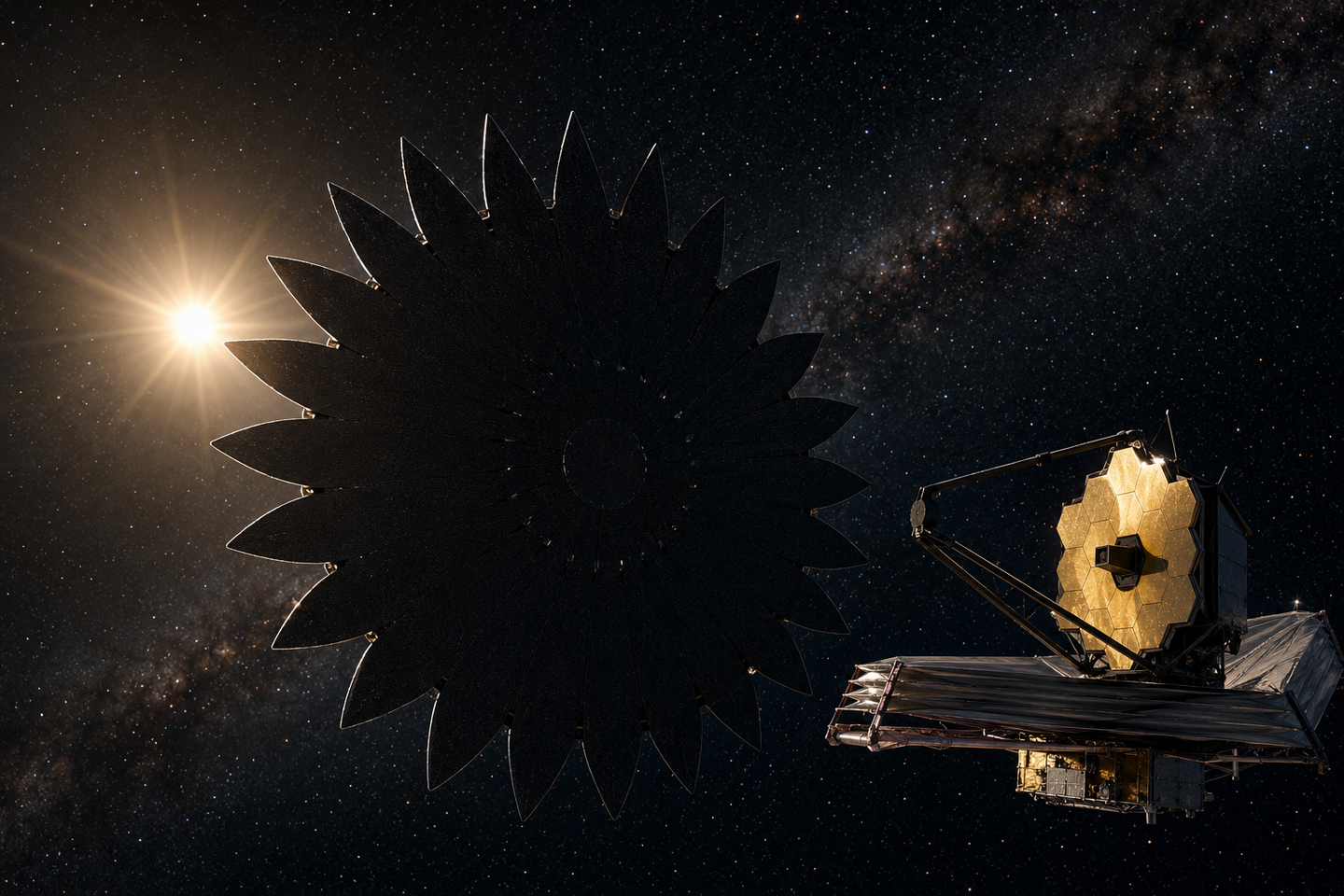
New ultra-black coating cuts stray light on starshades, improving future exoplanet imaging. (CREDIT: Wikimedia / CC BY-SA 4.0)
Somewhere out there, a planet roughly the size of Earth may be orbiting a distant star in conditions that could support life. The problem is not finding the star. However, the problem is that the star is billions of times brighter than the planet beside it. That difference in brightness has made direct imaging of such worlds essentially impossible.
A new ultra-black coating, thinner than anything previously tested in this role, may finally change that.
The coating was developed by ZeCoat Corporation, a small business founded by David Sheikh. It works by trapping incoming light inside stacked nanoscale cavities rather than reflecting it. Moreover, it is roughly 100 times thinner than coatings tested before it.
Applied to the sharp edges of a proposed spacecraft called a starshade, it reduced reflected light by a factor of about 20 in laboratory tests. As a result, engineers say, this is enough to allow a space telescope to detect an orbiting exoplanet.
The Billion-to-One Problem
To understand why the coating matters, it helps to picture the challenge. A starshade is a large, flower-shaped spacecraft, roughly half the size of a football field. It is designed to fly between a space telescope and a distant star.
When positioned correctly, it casts a shadow on the telescope, blocking the star's glare. This lets the faint reflected light of an orbiting planet pass around its edges and reach the detector. When it works as designed, less than one part per billion of the starlight reaches the telescope.
That number is impressive. But sunlight, the light from our own Sun, also scatters off the starshade's petal edges and spills into the telescope. That scattered light is its own form of contamination. For a decade, NASA-sponsored engineers worked to suppress it.
One approach was to make starshade edges razor sharp. Engineers crafted blades from amorphous metals with edges only 300 nanometers thick. Even those were not thin enough: the metal edges still scattered too much sunlight.
Applying black coatings to the edges seemed like a natural next step, but existing coatings were part of the problem. Carbon nanotube coatings, for instance, run several microns thick, far thicker than the 300-nanometer edge they were meant to darken. Adding them made the edges blunter, which made the scattering worse.
Light Trapped Like a Standing Wave
Sheikh began working on the underlying concept in 2004, originally researching a different idea: a "black mirror" that absorbs light rather than reflecting it. He found a decades-old methodology for creating light-absorbing smooth surfaces. Then, he rebuilt it using modern computing tools and more precise material data.
The resulting coating works by layering extremely thin, partially transparent metals separated by glass-like dielectric layers. Those layers form nanoscale cavities. When the thicknesses are tuned precisely, incoming light resonates inside the cavities as a standing wave, and the metal absorbs it. The principle resembles the Fabry-Perot cavity used in lasers, but in reverse: instead of amplifying light, the structure traps and kills it.
The coating that results is vanishingly thin, and that thinness is the point. Applied to prototype starshade blades, it did not dull the edges. It darkened them without thickening them.
From Lab to Large Sheets
In 2020, NASA's Exoplanet Exploration Program at the Jet Propulsion Laboratory in Southern California launched a Starshade Science and Industry Partnership to push the technology toward readiness for actual science missions.
Engineers at JPL built a custom laser scatterometer. They used it to measure scatter from coated and uncoated 50-centimeter amorphous metal blades. The ZeCoat coating cut reflected light by a factor of roughly 20, clearing the bar set for exoplanet imaging.
That success prompted a broader challenge: coating not just the edges, but the much larger membrane surfaces of a starshade's petals and central disk.
Supported by a 2021 NASA Small Business Innovative Research contract, ZeCoat developed a roll-to-roll deposition process using multiple electron beam evaporators to apply the ultra-black finish uniformly to wide sheets of polyimide film. The resulting coated membranes, approximately one meter wide and many meters long, could be assembled into the surface panels of a full-scale starshade. This would suppress stray light across the entire structure.
Other Orbits for the Technology
The applications do not stop at starshades. The same ultra-black coating could darken satellite constellations to reduce their visibility from the ground, a growing concern as low-Earth orbit becomes more crowded. In addition, it could be used to blacken surfaces near smartphone cameras to cut lens flare.
ZeCoat has also received a NASA contract to adapt the roll-to-roll process for thermal control coatings resilient enough to survive micrometeorite strikes. This has potential use on future spacecraft including the proposed Habitable Worlds Observatory.
Practical implications of the research
If a starshade coated with this material were to fly alongside a future space telescope, the combination could produce the first direct images of Earth-sized planets around Sun-like stars. This would enable spectroscopic analysis of their atmospheres for chemical signatures of life.
Beyond that flagship goal, the same coating technology offers near-term value: dimming satellite constellations, improving optical performance in consumer electronics, and hardening spacecraft surfaces against micrometeorite damage.
The coating's durable, thin profile means it does not require a specialized substrate or exotic manufacturing environment. This lowers the barrier for adoption across both space and commercial industries.
Research findings are available online at NASA TechPort.
The original story "New ultra-black coating could help astronomers search for alien life" is published in The Brighter Side of News.
Related Stories
- New ultra-black, carbon and nanotube car paint absorbs 99.90% of visible light
- Scientists turn everyday wool into record-breaking ultrablack fabric
- Laser-etched 'black metal' boosts solar power generation by 15x
Like these kind of feel good stories? Get The Brighter Side of News' newsletter.
Joshua Shavit
Writer and Editor
Joshua Shavit is a NorCal-based science and technology writer with a passion for exploring the breakthroughs shaping the future. As a co-founder of The Brighter Side of News, he focuses on positive and transformative advancements in technology, physics, engineering, robotics, and astronomy. Having published articles on AOL.com, MSN, Yahoo News, and Ground News, Joshua's work highlights the innovators behind the ideas, bringing readers closer to the people driving progress.