Scientists discover remnants of Theia, the planet that collided with Earth 4.5 billion years ago
Two vast structures near Earth’s core could preserve pieces of Theia, the lost world linked to the Moon’s formation.

 Edited By: Joshua Shavit

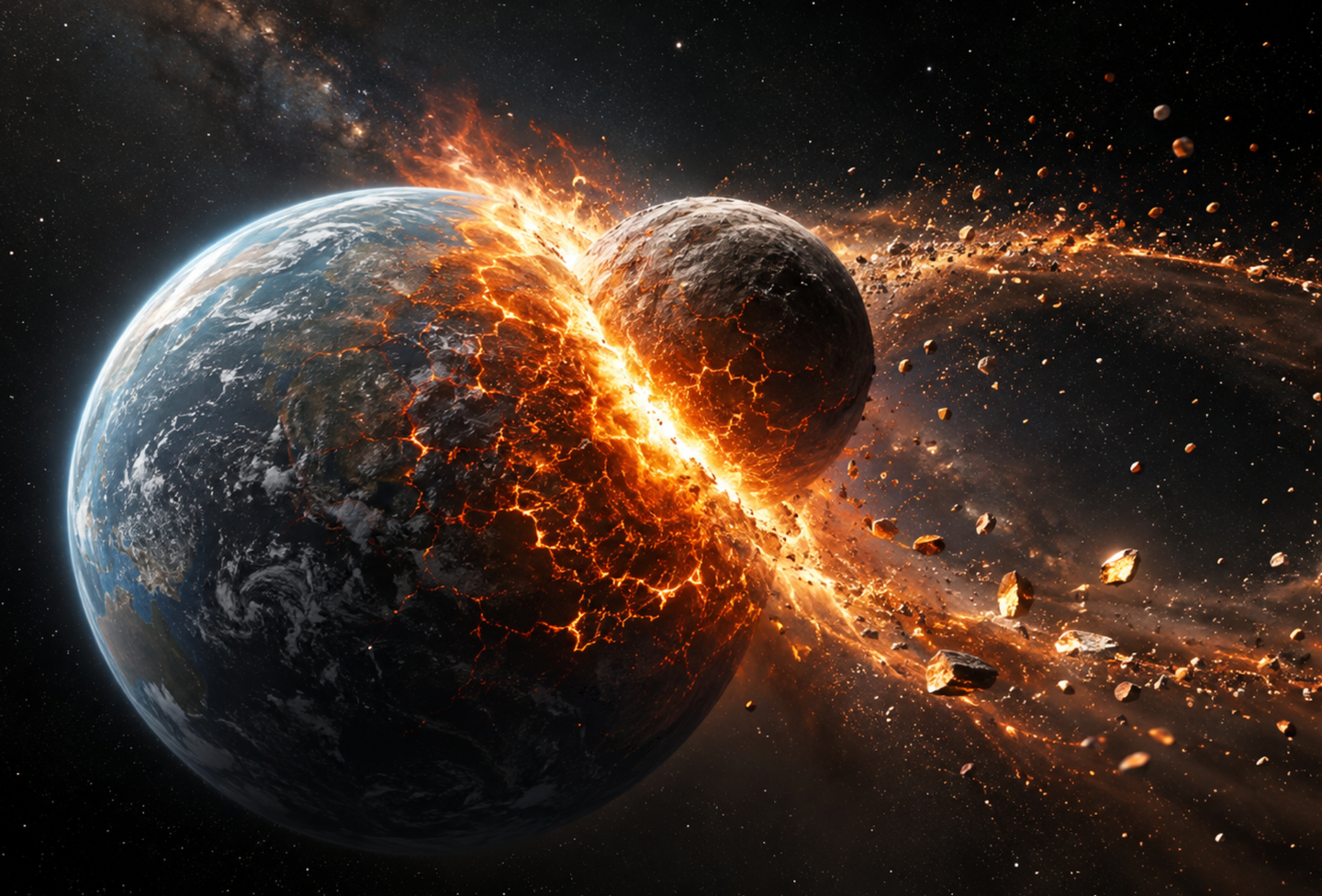
Theia remnants inside Earth may survive as two giant mantle blobs left by the collision that created the Moon. (CREDIT: Shutterstock)
- Two continent-sized structures deep inside Earth may contain remnants of Theia, the ancient planet thought to have collided with Earth and helped form the Moon.
- Computer simulations suggest dense, iron-rich material from Theia could have survived the impact, sunk toward Earth’s core and remained there for 4.5 billion years.
- Chemical tests of volcanic rocks and lunar material could help determine whether these deep structures really preserve pieces of a lost planet.
Deep beneath Africa and the Pacific Ocean sit two continent-sized masses unlike the mantle around them. Seismic waves slow as they cross these dense regions, and a new explanation traces their origin to the collision that formed the Moon.
The structures, known as large low-velocity provinces, or LLVPs, lie near Earth’s core-mantle boundary. Each is about twice the size of the Moon. Their unusual density and seismic behavior have made their origin a long-running puzzle.
A Caltech-led study published in Nature proposes that the LLVPs may contain remnants of Theia, the protoplanet thought to have struck the young Earth about 4.5 billion years ago. Debris from that impact formed the Moon, while part of Theia may have survived inside Earth.
That possibility would address two mysteries at once. The giant-impact hypothesis explains several major features of the Earth-Moon system, yet direct evidence of Theia has remained elusive.
Seismic clues point to an iron-rich interior
Geophysicists first recognized the LLVPs through seismic measurements in the 1980s. Waves from earthquakes travel at different speeds through different materials, allowing scientists to map structures that cannot be observed directly.
Near the base of the mantle, seismic waves reveal two enormous regions where their speed drops. Researchers believe these zones contain more iron than the surrounding mantle, making them denser and helping explain the slower wave speeds.
Qian Yuan, a geophysicist and O.K. Earl Postdoctoral Scholar Research Associate at Caltech, connected that puzzle to Theia in 2019. During a seminar by Arizona State University professor Mikhail Zolotov, Yuan heard that no one knew where the impactor had gone.
“Right after Mikhail had said that no one knows where the impactor is now, I had a 'eureka moment' and realized that the iron-rich impactor could have transformed into mantle blobs,” says Yuan.
Yuan and collaborators then combined hydrodynamic impact simulations, thermal evolution modeling and mantle convection simulations to test whether material from Theia could enter Earth’s deep mantle and remain distinct.
A collision that did not melt the whole mantle
The simulations suggest the Moon-forming impact could have left Earth’s mantle strongly layered. The upper region became largely molten, while much of the lower mantle remained solid and comparatively cool.
That distinction mattered. The newer simulations indicate much of the impact energy remained in the upper half of the mantle, reducing mixing below.
A portion of Theia’s mantle material could therefore have entered the lower mantle without being thoroughly blended into Earth. Estimates put that material at roughly 0.01 to 0.026 Earth masses, comparable with estimated LLVP masses of about 0.01 to 0.06 Earth masses.
The team also tested likely compositions for Theia’s mantle. Models using 13, 15 and 17 percent iron oxide by weight produced material about 2 to 3.5 percent denser than bulk silicate Earth throughout the lower mantle.
That extra density would have encouraged the material to sink. A molten blob about 50 kilometers wide could, according to the scaling analysis, solidify in as little as 1,000 years.
The researchers compare the process to colored wax in a lava lamp after the heat is turned off. Because the deep mantle remained relatively cool, dense material from Theia could descend rather than disperse completely.
Ancient material survives billions of years below
Long-term mantle simulations tested whether those dense remnants could persist. In a reference model, Theia mantle material was set 2.5 percent denser than its surroundings and introduced as 50-kilometer spheres in the lower half of the mantle.
The material quickly sank toward the core-mantle boundary. Over 4.5 billion years, mantle convection shaped it into two isolated thermochemical piles that resembled the LLVPs.
The modeled piles occupied about 3.4 percent of the mantle. Modern LLVPs occupy roughly 4 percent. Their simulated shear-wave velocities were about 1 to 5 percent lower than the surrounding mantle, matching observed seismic reductions.
Most additional models produced similar long-lived piles. Two cases did not: one used material only 1.25 percent denser than the mantle, while another used smaller 25-kilometer blobs with a 2.5 percent density contrast.
The work does not establish that the LLVPs consist entirely of Theia. Present-day structures could include other material, including ancient subducted oceanic crust. The initial size, distribution and degree of mixing of Theia’s mantle also remain poorly constrained.
Chemical traces could test the Theia connection
The hypothesis may help explain unusual chemical signatures in volcanic rocks linked to deep mantle plumes. Some ocean-island basalts preserve noble gases that appear older than the Moon-forming impact.
Theia existed before the Moon. Its mantle could therefore have retained ancient nebular gases before colliding with Earth. The research also notes similarities in noble-gas isotope ratios between some ocean-island basalts and lunar mare basalts.
Those links remain testable rather than conclusive. The authors call for more detailed chemical and isotopic comparisons between plume-related material associated with the LLVPs and rocks from the Moon.
If the interpretation holds, Earth’s deepest mantle may preserve material from the planet-building era rather than being fully homogenized by billions of years of convection.
Practical implications of the research
The proposed connection gives scientists a new way to investigate the Moon’s origin, the fate of Theia and the long-term evolution of Earth’s interior.
If LLVPs contain ancient Theia material, their survival would show that giant impacts did not necessarily erase large chemical differences inside young planets. That could change how researchers reconstruct Earth’s earliest mantle.
It could also guide work on the beginnings of plate tectonics and continent formation. Paul Asimow of Caltech said the next step is to examine whether such ancient deep structures affected “the onset of subduction before conditions were suitable for modern-style plate tectonics, the formation of the first continents, and the origin of the very oldest surviving terrestrial minerals.”
The idea may extend beyond Earth. Because giant collisions were common during the late stages of planet formation, other rocky worlds could also preserve deep material inherited from ancient impactors.
Dig deeper into Earth’s deep mantle and the Moon-forming impact
These resources explore the composition and origins of Earth’s deepest mantle structures, competing explanations for LLVPs, and evidence that helps constrain the ancient collision associated with the Moon’s formation.
Lower-mantle iron heterogeneity constrained by the electrical conductivity of Al-bearing bridgmanite
Laboratory measurements and geophysical modeling reveal substantial variations in iron across Earth’s lower mantle, including iron enrichment within large low-velocity provinces, strengthening evidence that these structures differ chemically from surrounding mantle rather than simply being hotter. (Science Advances, 2026)
Seismic and mineralogical evidence for an iron-rich mega–ultralow-velocity zone beneath Hawai'i
Seismic observations combined with mineral physics identify an enormous iron-rich ultralow-velocity region beneath Hawai‘i, providing new evidence that chemically distinct material exists near the core-mantle boundary and may interact with the Pacific LLVP. (Science Advances, 2026)
Deep mantle heterogeneities formed through a basal magma ocean contaminated by core exsolution
Thermodynamic and geodynamic models offer another explanation for LLVPs, proposing that an ancient magma ocean above Earth’s core became contaminated by material released from the core and later produced deep structures consistent with observed seismic anomalies. (Nature Geoscience, 2025)
The presence of ancient subducted oceanic crust contributes to seismic anomalies in Large Low Shear Velocity Provinces
This work examines another possible ingredient in LLVPs, finding that ancient oceanic crust carried into the deep mantle by subduction could contribute to their distinctive seismic properties, supporting the possibility that the giant structures contain material from several sources. (Communications Earth & Environment, 2025)
Tidally driven remelting around 4.35 billion years ago indicates the Moon is old
The authors argue that many lunar rocks dated to about 4.35 billion years ago record later tidal remelting rather than the Moon’s original formation, placing its birth roughly 4.43 to 4.53 billion years ago and helping constrain when the Moon-forming giant impact occurred. (Nature, 2024)
Research findings are available online in the journal Nature.
The original story "Scientists discover remnants of Theia, the planet that collided with Earth 4.5 billion years ago" is published in The Brighter Side of News.
Related Stories
- Ancient impact with Theia may have brought water and life to Earth
- Scientists reveal Theia’s origins before it struck early Earth and formed the Moon
- Massive underground structure discovered beneath the Moon’s South Pole-Aitken basin
Like these kind of feel good stories? Get The Brighter Side of News' newsletter.
Joseph Shavit
Writer, Editor-At-Large and Publisher
Joseph Shavit, based in Los Angeles, is a seasoned science journalist, editor and co-founder of The Brighter Side of News, where he transforms complex discoveries into clear, engaging stories for general readers. With vast experience at major media companies like The Los Angeles Times, Times Mirror and Tribune Publishing, he writes with both authority and curiosity. His writing focuses on space science, planetary science, quantum mechanics, geology. Known for linking breakthroughs to real-world markets, he highlights how research transitions into products and industries that shape daily life.