Paleontologists discover a giant rodent that lived in Thailand 34 million years ago
Two teeth from a mine in southern Thailand reveal an unusually large early rodent. The discovery pushes the history of rodent gigantism deeper into Southeast Asia’s fossil record.
 McGill University Writer: Kay Pettigrew

Fossilized teeth from giant prehistoric rodents discovered in Thailand’s Krabi Province, including the newly identified Yakamys sirindhornae, provide new clues about the early evolution and diversity of large-bodied rodents in Southeast Asia. (CREDIT: Yaowalak Chaimanee)
- Paleontologists found a large molar and incisor in a lignite mine in southern Thailand and named a new rodent, Yakamys sirindhornae.
- Seven equations put its estimated weight between 21.4 and 47.3 kilograms, with a central estimate of about 30 kilograms.
- The find shows that unusually large rodents had evolved in Southeast Asia long before the better-known giants of South America.
A fossil molar from a mine in southern Thailand measures just over a centimeter across. For the kind of rodent it belonged to, that is enormous. The tooth helps place an unusually large mammal in Southeast Asia about 34 million years ago, near the end of the Eocene.
The researchers named the animal Yakamys sirindhornae. The team included scientists from McGill University, Thailand’s Department of Mineral Resources, CNRS and the University of Poitiers. Their findings, published in Scientific Reports, put its weight at roughly 30 kilograms, or 66 pounds.
The discovery puts another part of the history of giant animals on the map. The largest known fossil rodents come from much later deposits in South America. Finds from the Thai fossil record show how discoveries in the region can add to a history built largely from better-sampled places.
Only two teeth are available, and the researchers used the molar as the specimen that formally defines the species. The incisor was found nearby and likely belongs to the same kind of rodent. As other work on fossil teeth shows, even isolated teeth can preserve enough detail to identify animals missing from the rest of the fossil record.
Two teeth from the same layer
The fossils came from Bang Mark Pit in the Krabi lignite mine. Both lay close together in the same fossil-bearing layer. Their shared location and exceptional size support assigning them to the same species, though finding them separately leaves open whether they came from the same individual.
The right lower second molar measures 11.56 millimeters long and 11.27 millimeters wide. Its chewing surface carries a distinctive pattern of raised cusps and ridges. The researchers compared that pattern with those of other ancient rodents. These comparisons matter because two species can have similarly sized teeth while differing in the placement and connections of their ridges. Work on molar shapes uses this kind of detail to investigate how fossil species relate to one another.
The lower incisor supplied a second line of evidence. Its cross section measured about 11 by 9 millimeters. Even on a tooth that large, the enamel layer was only about a quarter of a millimeter thick. Examining how that thin layer was built gave researchers another feature to compare with other rodents. Its enamel has a microscopic arrangement consistent with ischyromyids, an early rodent family.
Enamel can preserve clues beyond the outline of the tooth, including fine structures that help distinguish groups. Other research uses tooth enamel to investigate different questions, such as where an ancient animal lived or what it ate.
How scientists estimated the giant rodent’s weight
To estimate the animal’s mass, the team used equations that relate tooth dimensions to body weight in comparison samples. Larger animals often have larger teeth, but the relationship varies among rodent groups. A single measurement can therefore produce different answers depending on which animals and which tooth features researchers use to build the equation.
Seven equations yielded estimates from 21.4 to 47.3 kilograms. The average was 31.6 kilograms and the median was 28.6 kilograms. Those figures support an estimate of about 30 kilograms. The endpoints describe the spread of the seven estimates. Each method also has its own prediction error, so the full uncertainty extends beyond the spread of those results.
The two teeth also yielded different ranges. The incisor produced estimates of 28.2 to 47.3 kilograms, while those from the molar ran from 21.4 to 41.5 kilograms. The overlap helps explain the central estimate, and the differing endpoints show how the choice of tooth affects the result.
The measurements stand out even without a precise weight. The known molars of Hulgana, previously regarded as the largest Asian member of this early rodent family, were less than half as long and wide as the Thai molar. That comparison establishes an unusually large tooth directly.
Estimating the size of the whole animal is a separate inference. More complete mammal fossils can supply additional checks. A skull or limb bones can reveal aspects of body size that teeth alone leave uncertain.
Southeast Asia adds an early branch to the story
Ischyromyids were among the early groups of rodents to diversify. Their record is richer in North America and Europe than in Asia, where many known finds represent smaller animals. The Thai specimen shows that a large member of the family had already appeared in Southeast Asia by the late Eocene. It expands the range of sizes paleontologists can document in that part of the world.
A sparse fossil record also makes it difficult to tell how widespread this size was. One locality establishes that the animal lived in the region, while additional sites would help trace its geographic range.
One comparison comes from Manitsha tanka, an Oligocene rodent from South Dakota. It approached Yakamys in estimated mass, but its molar had a different shape. Their teeth show that similar sizes could accompany different dental designs. The same general pattern appears in other research on animal gigantism, where different lineages became large along different evolutionary paths.
Much later, South America produced rodents that far surpassed the Thai animal’s estimated mass. Their weights remain debated, in part because estimates from teeth can differ from estimates based on bones. Those species give context for the discovery. Yakamys matters because of its age and place in mammal evolution. It shows that one early rodent family included a member weighing tens of kilograms well before those later giants appeared.
The lake deposits leave a question about its life
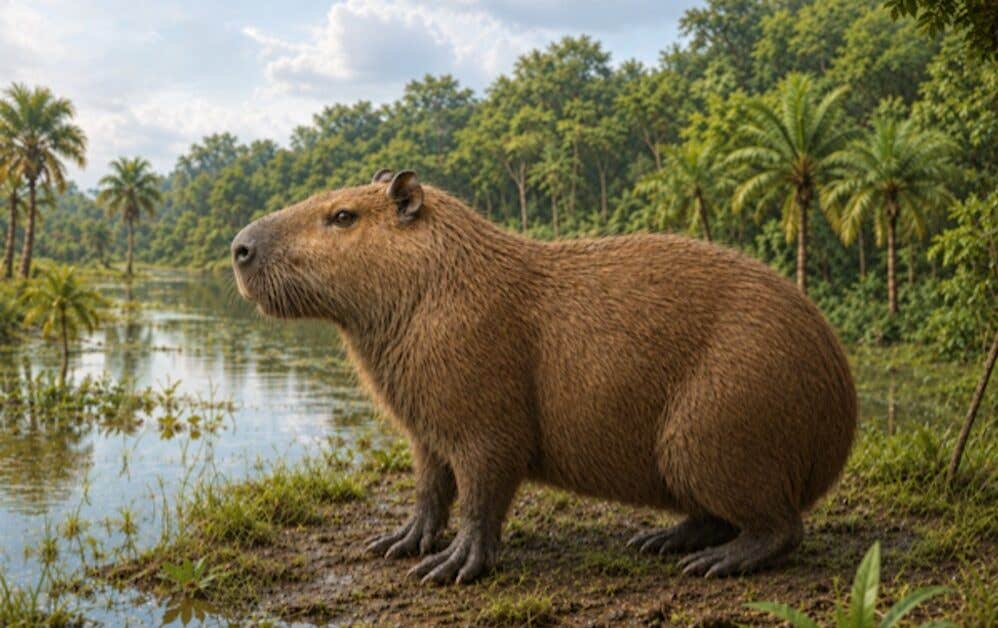
The deposits where the teeth turned up formed in a lake setting. That raises the possibility that Yakamys used lake margins. The capybara, the largest living rodent, offers a familiar example of a large rodent that thrives near water. The comparison suggests a question researchers can test about ancient habitats. Deposits can record where remains accumulated while leaving an animal’s daily habits uncertain.
The team also considered a common explanation for giant rodents. On islands, changes in competition and predation can give some small mammals room to evolve larger bodies. The geology and other mammals known from Krabi offer little support for an island setting at the end of the Eocene. The cause of the large size therefore remains open. Additional fossils from the basin could help show whether other animals underwent similar changes.
The genus name combines yak, Thai for giant, with mys, Greek for mouse or rat. The species name honors Princess Maha Chakri Sirindhorn for supporting science and paleontology in Thailand. A jaw could help test how the two kinds of teeth fit together, while limb bones might show how the animal moved. Those discoveries would turn a record of unusually large teeth into a fuller picture of the ancient mammal that carried them.
Dig deeper into fossil rodents and body size
Body mass estimation from cheek tooth measurements in extinct caviomorphs
The study tests how tooth choice, reference samples and statistical methods affect weight estimates. (Journal of Mammalian Evolution, December 2024)
Rodent faunas from the early Eocene to the early Oligocene in Asia
Researchers examine where Asian rodent groups lived and how their distribution changed over time. (Frontiers in Ecology and Evolution, September 2022)
Genetic data from the extinct giant rat from Tenerife
Ancient DNA helps trace the origins of a much younger giant rodent that evolved on an island. (Biology Letters, December 2021)
The anatomy of the world’s largest extinct rodent
The authors describe a relatively complete Venezuelan skeleton and present an early weight estimate for Phoberomys. (Science, September 2003)
Eocene Krabi basin (southern Thailand): Paleontology and magnetostratigraphy
Earlier work combines fossil evidence and magnetic signals in rock to establish the age of deposits in the basin. (Geological Society of America Bulletin, February 2001)
Research findings are available online in the journal Scientific Reports.
The original story "Paleontologists discover a giant rodent that lived in Thailand 34 million years ago" is published in The Brighter Side of News.
Related Stories
- Ancient fossil may reveal first-ever 'right-handedness' in the animal kingdom
- Scientists recreate mouse from reprogrammed stem cells
- Could naked mole rats hold key to curing cancer and dementia?
Like these kind of feel good stories? Get The Brighter Side of News' newsletter.
Rebecca Shavit
Writer
Based in Los Angeles, Rebecca Shavit is a dedicated science and technology journalist who writes for The Brighter Side of News, an online publication committed to highlighting positive and transformative stories from around the world. Having published articles on MSN, AOL News, and Yahoo News, Rebecca's reporting spans a wide range of topics, from cutting-edge medical breakthroughs to historical discoveries and innovations. With a keen ability to translate complex concepts into engaging and accessible stories, she makes science and innovation relatable to a broad audience.