A six-inch fossil just rewrote a major chapter of mammal evolution
A newly discovered fossil from Mongolia reshapes how scientists understand early mammal evolution and ancient species relationships.
 AMNH Writer: Kendra Snyder

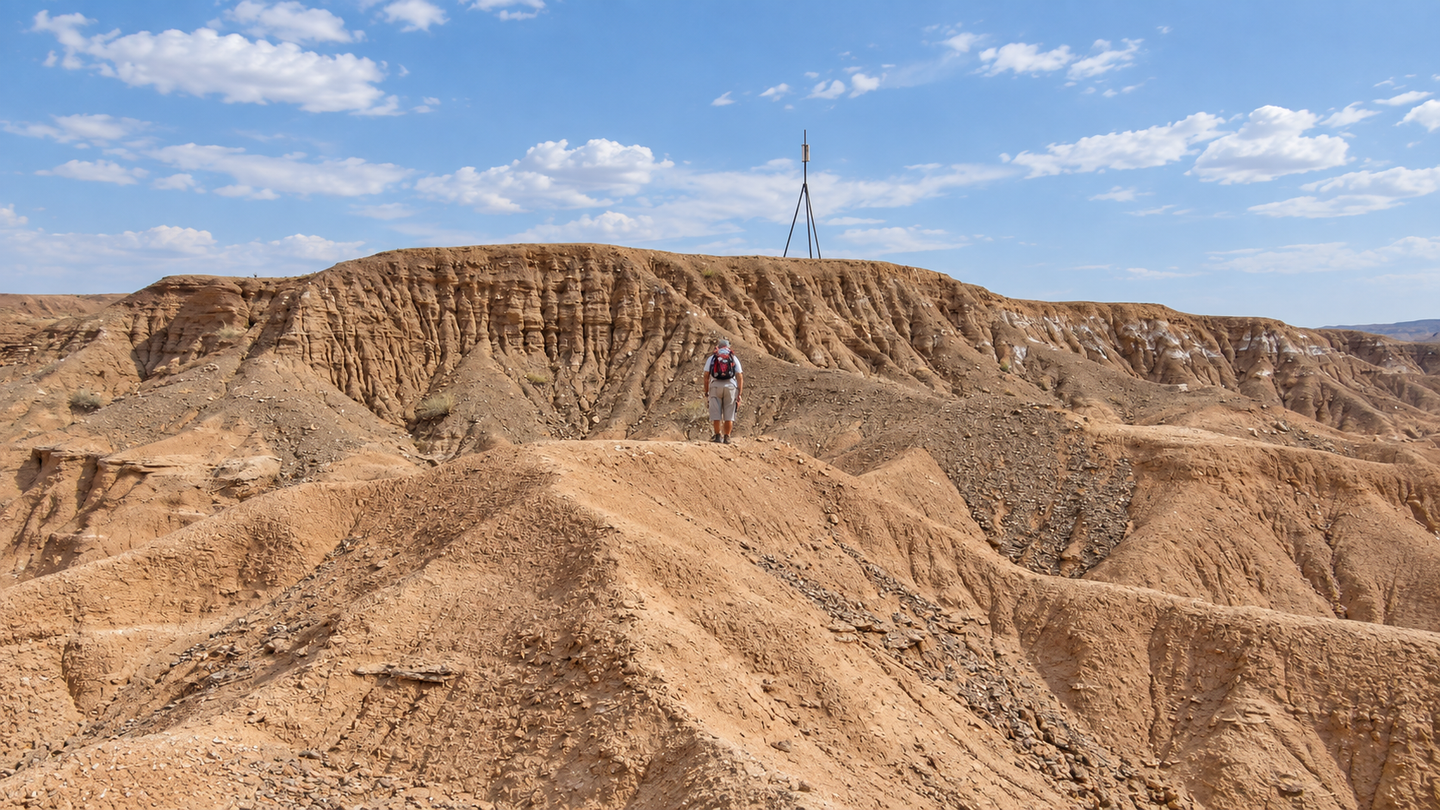
Field photos of the Khugenetsavkhlant badlands in the Eastern Gobi Desert of Mongolia, which is where Tamirkhan balcarceli was discovered. (CREDIT: Michael Novacek/©AMNH).
- A remarkably complete fossil of a newly identified mammal, Tamirkhan balcarceli, shows that zhelestids belonged with zalambdalestoids rather than representing early relatives of modern placental mammals.
- The fossil combines the distinctive rounded teeth previously used to classify zhelestids with a skull and long, slender hind limbs that reveal a very different evolutionary relationship.
- The discovery highlights the dangers of reconstructing entire extinct animals from teeth alone because similar dental adaptations can evolve independently in unrelated lineages.
A small fossil from the windswept Gobi Desert is forcing scientists to rethink a long chapter in the story of mammal evolution. For decades, researchers believed a group of ancient mammals called zhelestids were early relatives of modern placental animals. That idea now appears to be wrong
The newly described species, Tamirkhan balcarceli, offers the clearest picture yet of what these mysterious mammals actually looked like. More importantly, it reveals that zhelestids belonged to a completely different branch of the mammal family tree. The finding overturns nearly 40 years of assumptions based largely on fossil teeth.
“This discovery illustrates why fieldwork remains indispensable to understanding life’s history,” said lead author Andres Giallombardo of the American Museum of Natural History. “It was the thrill of a career to find a new species so completely preserved that also solves a longstanding scientific problem.”
A Fossil That Changes A Longstanding Debate
Zhelestids have puzzled scientists since the 1980s. Most of what was known about them came from isolated teeth scattered across Central Asia. Those teeth looked unusual. Instead of the sharp points seen in many early mammals, they were rounded and flat.
This shape suggested a plant-based diet. It also made the animals seem similar to later hoofed mammals, such as deer or cows. Based on that similarity, many researchers believed zhelestids were early placental mammals, part of the group that includes humans today.
But teeth can tell only part of the story.
“Molecular models based on living animals can predict the past, but fossils provide the evidence needed to test those predictions,” said coauthor Paul Velazco of Arcadia University.
The new fossil provides that missing evidence. It includes not only teeth, but also parts of the skull and limbs. For the first time, scientists could examine the entire anatomy of a zhelestid relative in one specimen.
More Like A Shrew Than A Hoofed Mammal
The results were surprising. While the teeth match those of known zhelestids, the rest of the body does not resemble early hoofed mammals at all. Instead, it shares key features with a group of small, insect-eating mammals called zalambdalestoids.
These animals were more like fast-moving, ground-dwelling creatures than plant-grazing herbivores. They had long limbs, narrow bodies, and specialized teeth for a mixed diet.
“Tamirkhan’s hind legs are long and slender with distinctive ankles, traits that are unmistakably zalambdalestoid,” said coauthor Shawn Zack of the University of Arizona.
The fossil also shows long, ever-growing front teeth, another trait common in that group. Together, these features make it clear that zhelestids were not early placental mammals. They were part of a separate lineage that evolved similar teeth on its own.
Teeth Can Be Misleading
The discovery highlights a key lesson in paleontology. Teeth often preserve well, so they are widely used to identify ancient species. But they do not always reflect the full picture.
“More than 200 years ago, French naturalist Georges Cuvier famously argued that a single tooth could allow scientists to predict the anatomy of an entire animal,” said coauthor Maureen O’Leary of Stony Brook University. “While teeth remain among the most informative fossils available, this work demonstrates that teeth cannot always tell us how the whole animal looked.”
In this case, the rounded teeth of zhelestids evolved independently. This process, known as convergent evolution, occurs when unrelated species develop similar traits because they adapt to similar environments or diets.
The teeth suggested a plant-eating lifestyle, and that part may still be true. But the rest of the body shows the animal followed a very different evolutionary path.
A Small Animal In A Giant World
The newly described species was small, measuring about six to seven inches from head to tail. Its long hind legs gave it a slightly rabbit-like appearance, which has led some paleontologists to informally call similar animals “Cretaceous rabbits.”
Despite the nickname, the resemblance is only skin deep. These animals were not related to modern rabbits. Instead, they were fast-moving mammals that likely relied on speed to survive in a landscape dominated by dinosaurs.
Their long legs and specialized ankles suggest they could run quickly and navigate uneven terrain. This ability would have helped them escape predators and search for food in a competitive environment.
Life In The Gobi Desert Millions Of Years Ago
The fossil was found in eastern Mongolia, in a region known for its rich deposits of Cretaceous fossils. This area has produced some of the most complete mammal specimens from the age of dinosaurs.
“The Gobi is one of the only places where we routinely recover such remarkably complete Cretaceous mammals,” said coauthor Michael Novacek of the American Museum of Natural History. “These extraordinary fossils continue to transform our understanding of mammalian evolution.”
During the Late Cretaceous, this region likely featured river systems, floodplains, and seasonal vegetation. Such an environment would have supported a wide range of food sources, including insects, seeds, and plant material.
The mixed diet suggested by the fossil’s teeth fits well with this setting. It likely fed on whatever resources were available, a strategy that may have helped it survive changing conditions.
Rethinking Early Mammal Diversity
The findings also reshape how scientists view mammal diversity during the Cretaceous period. Some earlier theories suggested that mammals had already evolved into a wide range of forms, including early versions of modern groups.
This fossil suggests a more limited range of body types. Many mammals may have shared similar shapes, with most variation appearing in their teeth and diets rather than their overall anatomy.
This means that major differences in body structure likely evolved later, after the extinction of the dinosaurs.
The study also challenges the idea that placental mammals were already widespread during the Cretaceous. While genetic studies have suggested an early origin, fossil evidence now paints a more complex picture.
Solving A Decades-Old Mystery
For nearly 40 years, zhelestids remained one of paleontology’s lingering puzzles. Without complete fossils, scientists could only guess how these animals fit into the broader story of evolution.
The discovery of Tamirkhan balcarceli provides a clear answer. It connects the distinctive teeth of zhelestids with the body structure of zalambdalestoids, placing them firmly within a known group.
This resolution shows the power of a single well-preserved fossil. It can confirm or overturn ideas that have stood for decades.
It also underscores the importance of continued fieldwork. Even in regions that have been studied for years, new discoveries can still reshape scientific understanding.
A New Tool For Understanding Evolution
The research team used a large database known as MorphoBank to analyze the fossil’s evolutionary relationships. This platform includes detailed data on many fossil species, allowing scientists to compare traits across a wide range of animals.
By combining this tool with the new fossil, researchers were able to build a more complete picture of early mammal evolution.
The results show that some traits, such as plant-like teeth, evolved multiple times in different groups. This suggests that diet may have driven early changes more strongly than body structure.
Practical Implications Of The Research
This discovery changes how scientists study early mammals. It shows that relying on a single type of fossil, such as teeth, can lead to misleading conclusions. Future research will likely place greater emphasis on complete specimens and broader anatomical analysis.
The findings also refine the timeline of mammal evolution. By showing that certain groups were not early placental mammals, the study helps clarify when modern mammal lineages began to emerge. This improves our understanding of how mammals evolved after the age of dinosaurs.
For evolutionary biology, the research highlights the role of convergent evolution. It demonstrates that similar traits can arise in unrelated species, which can complicate the reconstruction of evolutionary history. Recognizing this pattern will help scientists interpret other fossil groups more accurately.
More broadly, the study underscores the value of continued exploration. Fossils like this one provide direct evidence of the past, offering insights that cannot be gained from models alone. As new discoveries emerge, they will continue to refine our understanding of life’s history and the forces that shaped it.
Dig deeper into Cretaceous mammal evolution
These resources explore zalambdalestoids, zhelestids, exceptionally preserved Gobi mammals and the continuing debate over the early history of placental mammals.
A new large zalambdalestid mammal from the Gobi Desert and formal stratigraphic description of the Upper Cretaceous Zos Formation: Describes another exceptionally informative zalambdalestid from Mongolia and examines the Cretaceous rocks preserving this important mammal fauna. (Cretaceous Research, 2026)
New Early Cretaceous zalambdalestid stem placental mammal from Mongolia and evolution of Zalambdalestidae: Examines the anatomy and evolutionary relationships of an earlier Mongolian zalambdalestid, helping place the group within the broader history of eutherian mammals. (Journal of Vertebrate Paleontology, 2024)
Phylogenetic analysis, taxonomic revision, and dental ontogeny of the Cretaceous Zhelestidae (Mammalia: Eutheria): Provides a major pre-Tamirkhan analysis of zhelestid anatomy and phylogeny, illustrating the uncertainty that surrounded the group when evidence consisted largely of teeth. (Zoological Journal of the Linnean Society, 2012)
Research findings are available online in the journal Nature.
The original story "A six-inch fossil just rewrote a major chapter of mammal evolution" is published in The Brighter Side of News.
Related Stories
- New PACA mapping tool tracks fossil locations back through millions of years
- Ancient fossil may reveal first-ever 'right-handedness' in the animal kingdom
- 518-million-year-old fossil reveals where spider fangs came from
Like these kind of feel good stories? Get The Brighter Side of News' newsletter.
Hannah Shavit-Weiner
Medical & Health Writer
Hannah Shavit-Weiner is a Los Angeles–based medical and health journalist for The Brighter Side of News, an online publication focused on uplifting, transformative stories from around the globe. Having published articles on AOL.com, MSN and Yahoo News, Hannah covers a broad spectrum of topics—from medical breakthroughs and health information to animal science. With a talent for making complex science clear and compelling, she connects readers to the advancements shaping a brighter, more hopeful future.