Little red dots may hold the secret to the universe’s first black holes
The black hole inside QSO1 grew to about 50 million solar masses in the early universe. A new model tests whether it could have started before the first stars.
 Johns Hopkins University Writer: Hannah Robbins

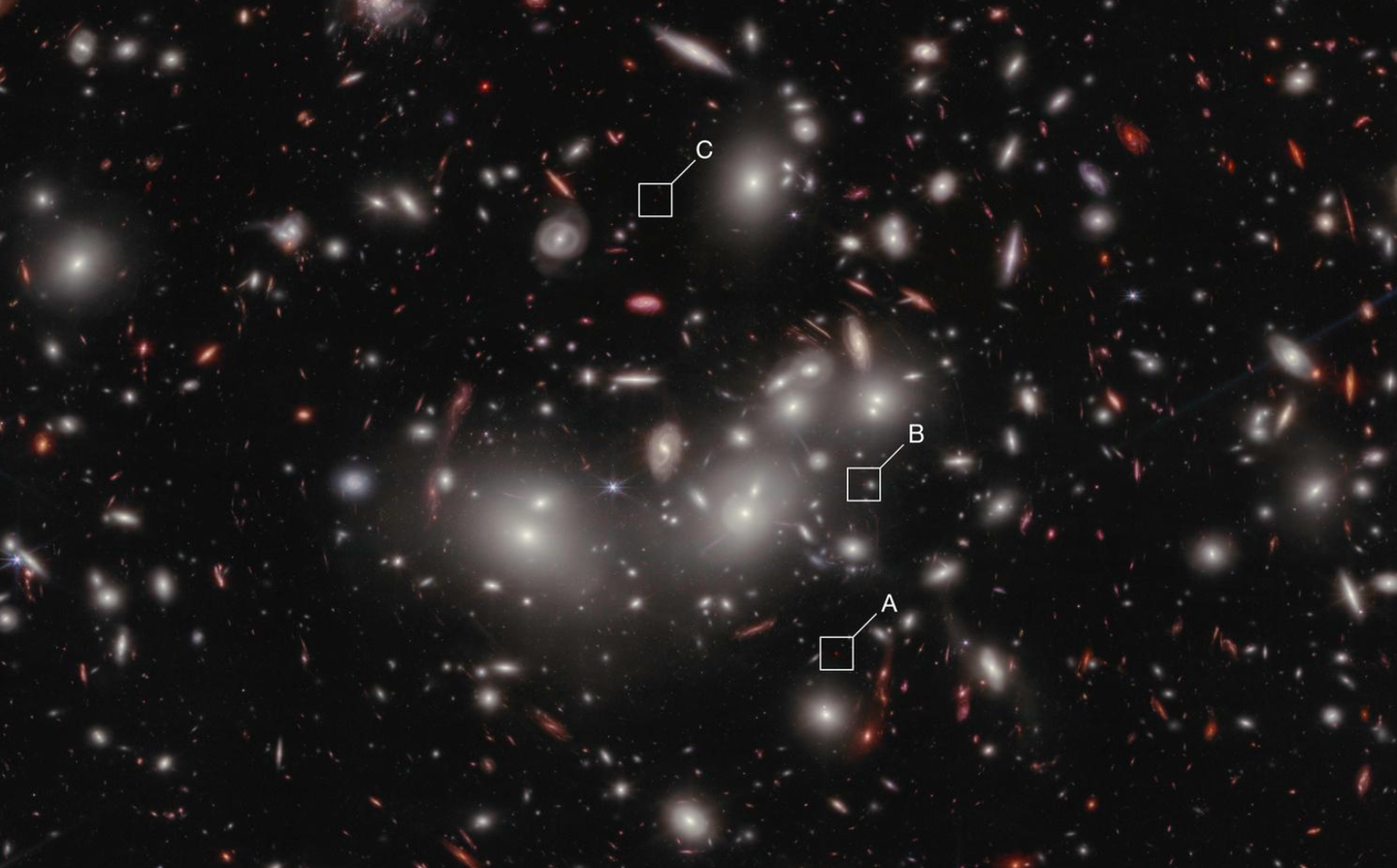
Pandora’s Cluster (Abell 2744), a massive galaxy cluster whose gravitational pull magnifies light from distant objects, including Abell2744-QSO1, an unusually compact and distant source from the early universe. (CREDIT: NASA, ESA, CSA, Lukas Furtak (Ben-Gurion University); Image Processing: Alyssa Pagan (STScI))
- QSO1 held a black hole about 50 million times the Sun’s mass when the universe was only about 700 million years old.
- Of three primordial scenarios tested, a smaller black hole that grew by drawing in gas best fits the object’s measured properties.
- The study identifies a possible origin for QSO1. Its age, mass and chemistry still leave room for other explanations.
A speck of red light in a James Webb Space Telescope image contains an unlikely giant. The object, known as QSO1, held a black hole about 50 million times the mass of the Sun when the universe was only about 700 million years old. Its surroundings contain unusually few heavy elements. Together, those clues raise a question about what was there before the black hole grew.
Researchers at Johns Hopkins University tested whether QSO1 could have begun as a primordial black hole, a hypothetical object formed before the first stars. Their study, published in Physical Review Letters, compares three ways such an object might have reached the mass astronomers infer today.
The most plausible of those routes begins with a smaller seed that draws in gas. It offers a way to explain how a black hole could grow quickly while forming few stars nearby. QSO1 belongs to a varied population of red objects, so one explanation need not account for every source.
The study examines a different aspect of the same puzzle as research on dense gas around early black holes. Light can reveal how gas behaves near a black hole. Reconstructing how that black hole formed requires tracing its growth much further back.
Why QSO1 stands out among Webb’s little red dots
The dots are compact sources with unusual colors and spectra. Some display broad emission features often associated with gas around an active black hole. Many also lack the strong X-ray signals astronomers might expect. A proposed black hole star illustrates one possibility: dense gas can change the light that escapes a feeding black hole.
Color alone tells astronomers little about the age of a black hole. To test its history, they need measurements that can rule out specific paths to its present state. That is where QSO1 offers something unusual: evidence about both the mass at its center and the material around it.
QSO1 gives astronomers an unusually detailed view because a foreground galaxy cluster bends and magnifies its light. A separate study in Nature used the motion of gas around QSO1 to estimate the black hole’s mass. That estimate is more directly tied to gravity than a mass inferred from the width of an unresolved emission line alone.
The gas around QSO1 contains roughly one percent of the Sun’s abundance of elements heavier than helium. The mass estimate also implies that the black hole is more than twice as massive as the stars in its host, based on the upper limit for stellar mass. That combination puts a strong constraint on models of early growth. Any explanation must build a giant while keeping the surrounding gas comparatively poor in the elements stars produce.
Primordial black holes face a test from the Big Bang’s afterglow
A black hole can form when a massive star dies. A primordial black hole, by contrast, could arise if an unusually dense patch of the early universe collapsed under its own gravity. The primordial idea offers more time for growth, but observations limit how massive or common the original seeds could have been.
The first scenario tested whether seeds could form at roughly the mass of QSO1’s black hole. Under the assumptions used in the study, producing many such giants would require density fluctuations large enough to alter the spectrum of the Big Bang afterglow. Measurements from the FIRAS instrument aboard NASA’s COBE satellite leave little room for that distortion.
The authors found that primordial seeds around 1,000 solar masses could still be viable in their model. Their limits apply to the birth mass, leaving room for later growth. Other proposed signatures, including those explored in research on a possible evaporating black hole, probe different masses and stages of evolution.
Mergers and gas offer different routes to a giant
The second scenario starts with lighter primordial black holes that merge repeatedly. That route can build heavier objects, but a merger can kick the remnant out of its surroundings. If the remnant escapes, it cannot take part in another round of growth there. A successful chain needs enough seeds close together and a gravitational well deep enough to keep the products.
Growth by mergers also has a timing problem. Each new generation depends on the previous one forming and surviving. In a young universe, a chain that works in principle can still take too long to build a black hole as massive as the one in QSO1.
The difficulty grows when trying to explain how common the dots appear to be. Even if a rare environment could produce one giant through mergers, the same conditions would have to recur often enough to explain a substantial population. Studies of candidate pairs give astronomers a separate way to investigate mergers in the early universe.
The third scenario gives a roughly 1,000-solar-mass seed a supply of gas. The model allows bursts of rapid inflow and accounts for gas that escapes. It also tracks how gas can break into clumps that form stars. Too much star formation would enrich the surroundings with heavy elements, erasing a feature that makes QSO1 unusual. With limited fragmentation, a growing seed can reproduce the inferred mass and chemistry. The flow of surrounding gas remains a major uncertainty.
Other red dots can help put the model to work
Gas accretion explains the observations most readily among the three primordial scenarios. Other explanations can start with a black hole made after the first stars, or with the collapse of a large gas cloud in a young galaxy. Both can produce a growing black hole. A low abundance of heavy elements points to limited chemical enrichment and can occur under more than one formation history. Models of direct collapse therefore remain relevant when comparing origins.
Valerio De Luca and Loris Del Grosso are among the authors of the modeling study. The Johns Hopkins team plans to apply its approach to more of the roughly 100 cataloged dots it has identified for follow-up. More measurements of gas motion, chemistry and stellar mass would show whether QSO1 is an outlier or part of a group with similar properties. Nearby companions may matter too, since close pairs offer clues to the environments in which some of these objects grow.
A wider sample would also help separate features of the black holes from features of the gas that hides them. In QSO1, recent infrared observations have added another piece of evidence about that gas, but explaining the spectrum and explaining the mass remain distinct challenges.
QSO1 dates to an era when stars already existed, so its age alone cannot establish a primordial origin. Stronger evidence could come from a black hole observed before the first stars formed, or one with a mass too low to be explained by stellar collapse. Until then, the value of QSO1 is the set of measurements it gives competing models to explain together.
Dig deeper into little red dots and early black holes
Where the red rise stops
A preprint uses new Webb observations to test what could produce QSO1’s infrared light. (arXiv, November 2026)
A direct black-hole mass measurement in a little red dot at high redshift
Astronomers used the motion of gas to weigh the black hole in QSO1 and set an upper limit on the host’s stellar mass. (Nature, May 2026)
Newfound Galaxy Class May Indicate Early Black Hole Growth, Webb Finds
NASA explains how Webb revealed the little red dots and why their light poses a puzzle. (NASA, January 2025)
Constraints on Primordial Black Holes
A review surveys observations that limit the abundance of primordial black holes across a wide range of masses. (arXiv, February 2020)
The Cosmic Microwave Background Spectrum from the Full COBE/FIRAS Data Set
The FIRAS team reports the precision measurements that help constrain distortions in the Big Bang’s afterglow. (arXiv, May 1996)
Research findings are available online in the journal Physical Review Letters.
The original story "Little red dots may hold the secret to the universe’s first black holes" is published in The Brighter Side of News.
Related Stories
- Supercomputer simulations may finally explain Webb’s mysterious Little Red Dots
- JWST’s mysterious ‘little red dots’ may hide early black holes inside tiny galaxies
- NASA’s Webb telescope may have solved the mystery of the universe’s 'little red dots'
Like these kind of feel good stories? Get The Brighter Side of News' newsletter.
Joseph Shavit
Writer, Editor-At-Large and Publisher
Joseph Shavit, based in Los Angeles, is a seasoned science journalist, editor and co-founder of The Brighter Side of News, where he transforms complex discoveries into clear, engaging stories for general readers. With vast experience at major media companies like The Los Angeles Times, Times Mirror and Tribune Publishing, he writes with both authority and curiosity. His writing focuses on space science, planetary science, quantum mechanics, geology. Known for linking breakthroughs to real-world markets, he highlights how research transitions into products and industries that shape daily life.