Physicist proposes laser light could transfer energy to a gravitational wave
A million-kilometer effective light path could reveal tiny frequency shifts, but the experiment would not alone prove gravitons exist.
 HZDR Writer: Simon Schmitt

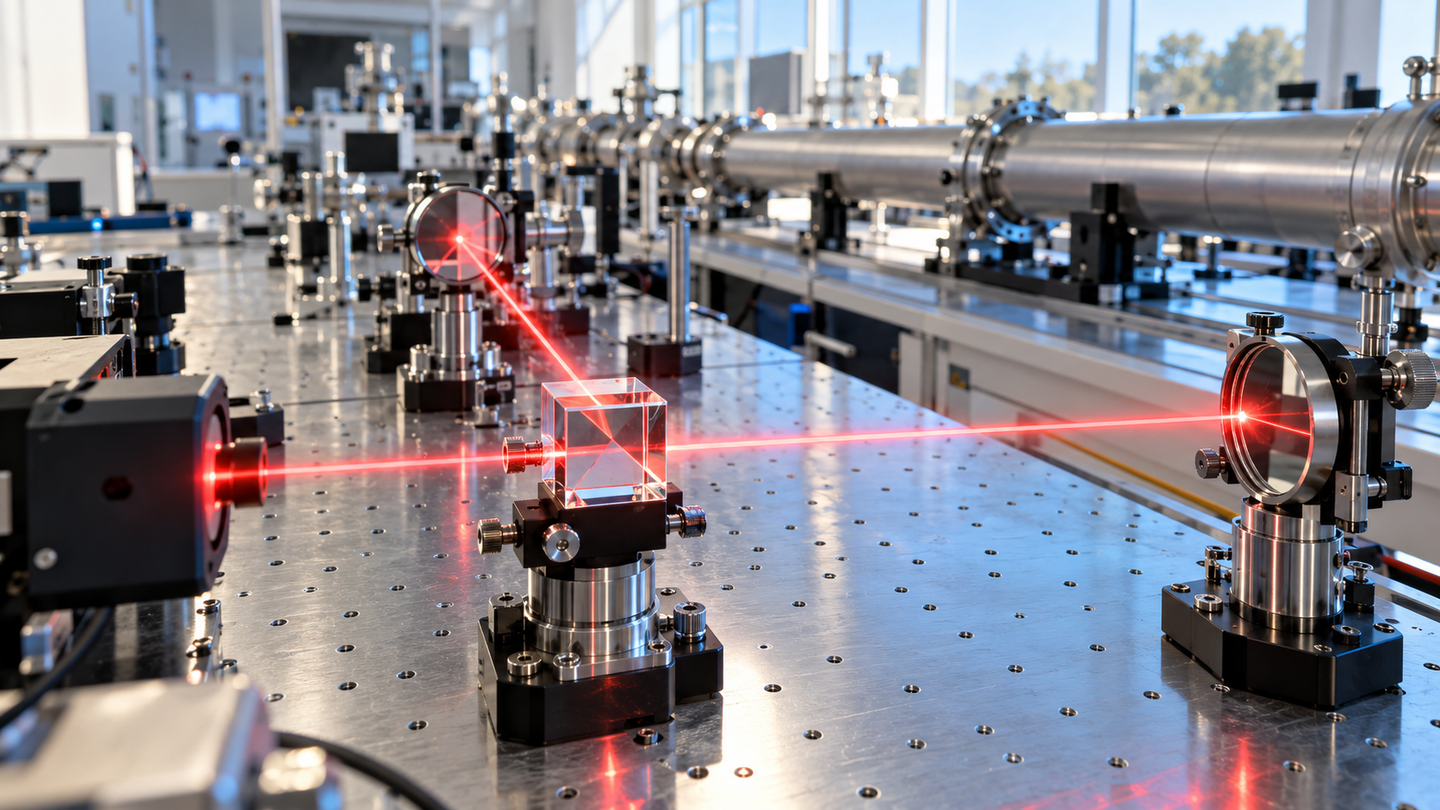
A proposed laser interferometer could measure energy exchanged with gravitational waves, offering a possible test of quantum gravity. (CREDIT: Shutterstock)
- A theoretical proposal would use laser light to exchange tiny amounts of energy with a passing gravitational wave.
- Repeated reflections could give light an effective million-kilometer path, allowing minute frequency shifts to build into a measurable interference signal.
- The experiment has not been demonstrated, and observing the predicted energy transfer would not by itself prove gravitons exist.
A laser pulse could do more than reveal a gravitational wave passing through a detector. Under a proposed experiment, it could give the wave a tiny amount of energy, or take some away. The resulting change in light would offer a way to examine that exchange.
Ralf Schützhold, a theoretical physicist at Helmholtz-Zentrum Dresden-Rossendorf and Technische Universität Dresden, developed the concept. His paper, published in Physical Review Letters, describes an interferometer designed to measure the effect. It remains a theoretical proposal, with demanding experimental requirements.
“Gravity affects everything, including light,” Schützhold said. That familiar interaction is the starting point for an attempt to move from detecting gravitational waves toward actively changing their energy.
The idea also touches a deeper question: whether gravity obeys quantum rules. But the paper draws a firm distinction between measuring an energy exchange and proving that gravitational energy comes in discrete packets called gravitons.
Working with a wave that already exists
Gravitational waves are traveling distortions of spacetime. Black hole mergers and neutron star collisions can generate them, and LIGO directly detected a gravitational wave for the first time in 2015. Those observations established a way to study powerful events far beyond Earth.
Producing detectable gravitational radiation in a laboratory is much harder. Gravity’s weakness makes even the emission of a single hypothetical graviton extraordinarily difficult with ordinary moving masses. Schützhold therefore considers light interacting with a gravitational wave that already exists.
In the quantum description assumed by the paper, each graviton carries an energy determined by the wave’s frequency. A light pulse could transfer energy to that wave through stimulated emission, or gain energy through absorption.
“It would make the gravitational wave a tiny bit more intense,” Schützhold said of the emission process. The light would lose the same amount of energy. In the reverse process, the gravitational wave would supply energy to the light.
The exchange changes the light’s frequency by an extremely small amount. Detecting that change, rather than measuring a visibly stronger gravitational wave, is the proposed route to an experimental signal.
Two light pulses take different routes
The experiment begins by splitting a laser pulse into two pulses that initially travel in perpendicular directions. A passing gravitational wave affects the energy exchange differently along those directions. Mirrors then redirect the pulses so that each travels along the other direction.
Timing matters. Ideally, the change in direction occurs at the appropriate point in the gravitational wave’s cycle. That allows one pulse to gain energy while the other loses it, rather than having successive portions of the interaction cancel.
The design resembles a Mach-Zehnder or Sagnac interferometer, devices that compare light traveling along different paths. Here, however, the pulses do not immediately recombine after interacting with the gravitational wave.
Instead, both enter a further optical path. Their slightly different frequencies gradually produce a difference in phase, or position within their oscillation cycles. When the pulses finally overlap, that accumulated difference changes their interference pattern.
This separates the brief interaction with the gravitational wave from the longer period used to read its consequences. The latter stage could continue after the wave has passed.
A million-kilometer journey inside a smaller instrument
The proposal’s scale is substantial. Schützhold considers an effective optical path of roughly one million kilometers, achieved through repeated reflections rather than a physical structure spanning that distance. Around a million reflections between mirrors separated on kilometer scales would provide the required order of magnitude.
For visible or near-infrared light, the calculation gives a lasting frequency shift on the order of one ten-millionth of a hertz. After a few seconds of propagation, that could produce a phase difference around one ten-millionth of a radian.
The example uses millijoule-scale pulses containing roughly 10 quadrillion photons. Combining a large photon number with the long accumulation path could make the tiny effect measurable under the paper’s assumptions.
These estimates do not amount to a completed instrument. Maintaining the necessary optical performance through so many reflections would be a major challenge. Imperfect timing with the incoming gravitational wave would also reduce the effect.
Schützhold suggests a train of pulses could ease that timing problem. Measurements coordinated with LIGO could help connect the proposed energy-exchange signal with an independently detected gravitational wave.
Entangled light offers a harder extension
Ordinary coherent laser pulses are one starting point. More unusual quantum states of light could improve the precision of the phase measurement. The paper examines a highly entangled state called a NOON state.
In that state, the photons occupy a superposition in which all are in one interferometer arm or all are in the other. This can offer better phase sensitivity than a conventional coherent pulse. Preparing and measuring such states, however, would be considerably more difficult.
Their potential role extends beyond sensitivity. Under the assumed quantum description and energy conservation, opposite energy exchanges would link the light to gravitational-field states with different energies.
The overlap between those gravitational states would affect how clearly the light interferes. In idealized examples, the experiment could distinguish a coherent gravitational-field state from certain nonclassical or thermal states. That interpretation would require excluding other causes of lost coherence.
What a successful measurement would establish
The paper explicitly states that measuring an energy shift equal to a graviton’s predicted energy would not prove quantization. An observed shift would support the proposed interaction, while leaving further questions about gravity’s quantum nature.
A missing signal would also require careful interpretation. If another detector recorded the gravitational wave, an adequately sensitive experiment could test why the expected exchange failed to appear. Such a result could challenge assumptions, rather than automatically disprove every graviton-based theory.
“It can take several decades from initial idea to experiment,” Schützhold said. His proposal identifies a possible measurement and the conditions it would require. Turning those calculations into reliable observations remains the next, substantial step.
Dig deeper into gravitational waves and quantum gravity
These studies explore proposed graviton measurements, energy exchange with matter, and demonstrated quantum improvements to gravitational-wave detectors.
Stimulated absorption of single gravitons: First light on quantum gravity: This paper outlines proposed tests using quantum resonators and stimulated graviton absorption to investigate gravity at the quantum level. (Annals of Physics, 2026)
Detecting kHz gravitons from a neutron star merger with a multi-mode resonant mass detector: A theoretical detector design considers how multiple mechanical modes could make individual absorption processes easier to measure. (Classical and Quantum Gravity, 2025)
Detecting single gravitons with quantum sensing: This proposal examines quantum sensing of energy changes in cooled resonators interacting with gravitational waves. (Nature Communications, 2024)
Broadband Quantum Enhancement of the LIGO Detectors with Frequency-Dependent Squeezing: An experimental study shows how specially prepared light reduces quantum noise in operating gravitational-wave detectors. (Physical Review X, 2023)
Energy transfer between gravitational waves and quantum matter: This theoretical analysis examines energy exchange with systems including ultracold matter and derives bounds relevant to possible experiments. (Physical Review D, 2023)
Research findings are available online in the journal Physical Review Letters.
The original story "Physicist proposes laser light could transfer energy to a gravitational wave" is published in The Brighter Side of News.
Related Stories
- Scientists find a new way to search for gravitational waves using the Moon
- New prototype quantum sensor expedites search for dark matter and gravitational waves
- Gravitational wave detectors can now tune themselves using black holes
Like these kind of feel good stories? Get The Brighter Side of News' newsletter.
Joseph Shavit
Writer, Editor-At-Large and Publisher
Joseph Shavit, based in Los Angeles, is a seasoned science journalist, editor and co-founder of The Brighter Side of News, where he transforms complex discoveries into clear, engaging stories for general readers. With vast experience at major media companies like The Los Angeles Times, Times Mirror and Tribune Publishing, he writes with both authority and curiosity. His writing focuses on space science, planetary science, quantum mechanics, geology. Known for linking breakthroughs to real-world markets, he highlights how research transitions into products and industries that shape daily life.