Physicists finally discover the elusive glueball, a particle made entirely of nuclear force
A strange decay pattern once weakened the glueball case for f0(1710. New models and experiments turned that problem into supporting evidence.

 Edited By: Shy Cohen

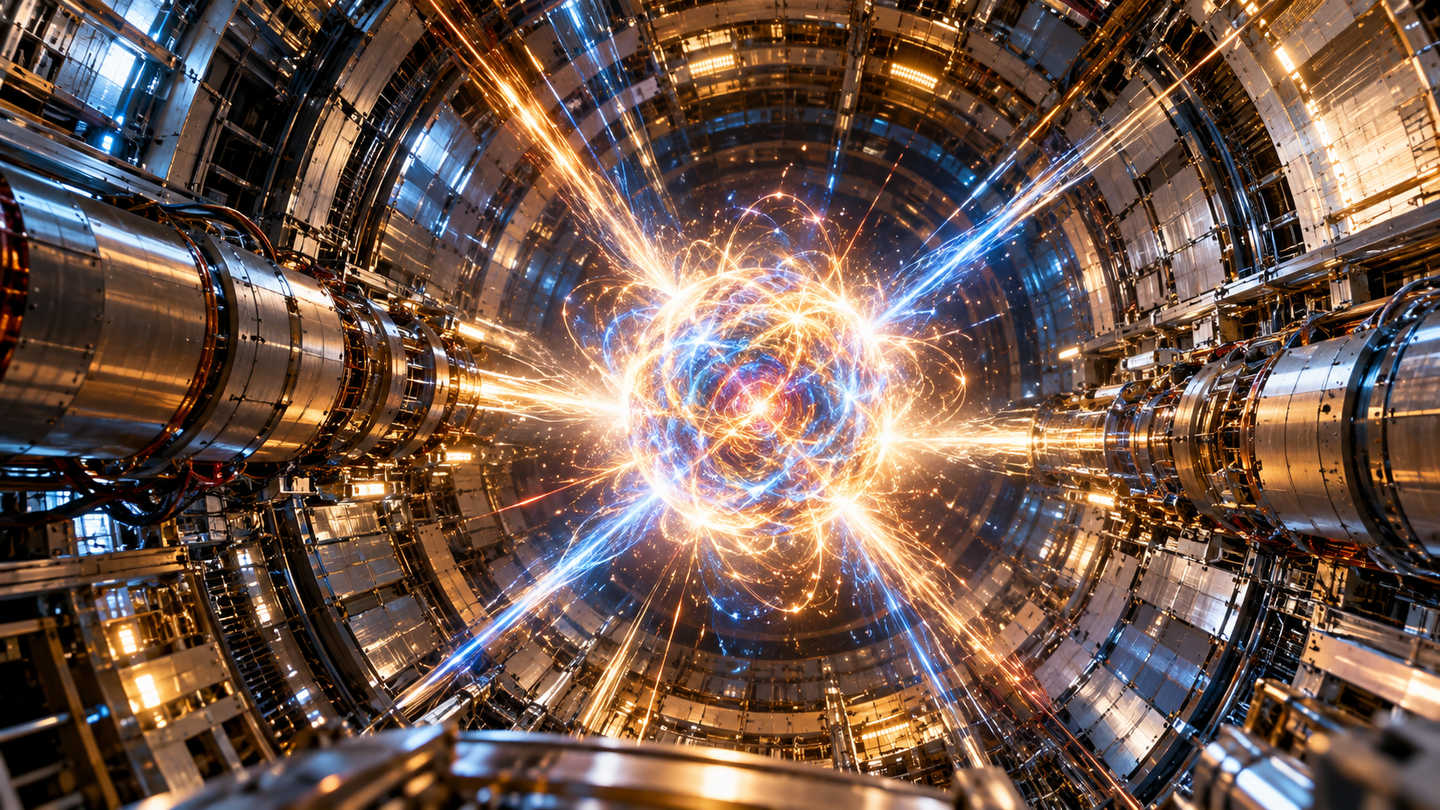
Theory and later experiments keep f0(1710) among the strongest candidates for a particle built largely from gluons. (CREDIT: Shutterstock)
- A holographic QCD calculation found that the decay pattern of the scalar meson f0(1710) closely matches what could be expected from a glueball, a hypothetical particle built mainly from gluons.
- The model explained why f0(1710) decays unusually often into kaons and eta mesons, behavior that had previously complicated its interpretation as a glueball.
- Later experiments strengthened the case that f0(1710) contains substantial gluonic content, but recent lattice studies show that identifying any scalar resonance as a predominantly pure glueball remains unsettled.
Ordinary matter is built from particles such as quarks and electrons, but quantum chromodynamics predicts something far stranger: particles constructed largely from the force that binds quarks together.
Known as glueballs, these hypothetical objects would be made primarily from gluons, the carriers of the strong nuclear force. Physicists have searched for them for decades, but no scalar candidate has achieved universal acceptance because glueballs can mix with ordinary quark-antiquark particles and disappear almost immediately through decay.
One influential theoretical result from researchers at TU Wien offered a particularly strong case for a resonance called f0(1710). Their calculations showed that its unusual decay pattern could arise naturally if the particle contains a large glueball component.
Published in Physical Review Letters, the work did not prove that f0(1710) is a glueball. Subsequent experiments have added evidence in its favor, while newer lattice calculations continue to underline how difficult a definitive identification remains.
Why gluons can bind themselves together
Protons and neutrons contain quarks held together by the strong interaction. That force is transmitted by gluons, which differ fundamentally from the photons that transmit electromagnetism.
Photons carry no electric charge and therefore do not directly interact with one another in the same way charged particles do. Gluons, however, carry what physicists call color charge. As a result, they interact with other gluons.
Quantum chromodynamics therefore permits gluons to form bound states without valence quarks. Murray Gell-Mann and Harald Fritzsch discussed such objects in the early 1970s, initially calling them gluonium. The name glueball eventually became standard.
Lattice QCD calculations generally place the lightest pure-gauge scalar glueball in the neighborhood of 1.6 to 1.8 gigaelectronvolts. Unfortunately, several ordinary-looking meson resonances also occupy that mass range, including f0(1500) and f0(1710).
The difficulty is that a real physical state may not be purely one thing or another. A glueball can mix with quark-antiquark configurations, making its experimental signature far less obvious than a new isolated peak.
A strange decay pattern created a problem
For years, f0(1500) and f0(1710) competed as leading scalar glueball candidates. Their decay behavior, however, differs substantially.
A simple picture of a glueball might suggest that its gluons should not care strongly about which light quark flavor eventually appears during decay. That expectation made f0(1710) troublesome because it decays strongly into kaons, which contain strange quarks, rather than displaying a simple flavor-independent pattern.
TU Wien physicists Frederic Brünner and Anton Rebhan approached the problem using the Witten-Sakai-Sugimoto model, a holographic description of low-energy quantum chromodynamics. The framework connects certain strongly interacting quantum theories with a higher-dimensional gravitational theory.
Their central question was whether giving realistic masses to pseudoscalar mesons could alter a glueball's predicted decay pattern enough to reproduce the behavior of f0(1710).
The answer was yes. Their calculations found that scalar glueball decays into heavier kaons and eta mesons could be substantially enhanced rather than suppressed.
Higher-dimensional gravity matched the decay data
The researchers extended earlier calculations in which the holographic model treated some light mesons as effectively massless. Once finite meson masses were incorporated, the predicted branching ratios changed sharply.
For f0(1710), the resulting ratios agreed surprisingly well with available measurements. In particular, the model reproduced its preference for kaon-containing final states far better than the simpler flavor-symmetric calculation.
The same approach performed poorly for f0(1500). Its experimentally observed decay pattern, especially its prominent multipion behavior, did not match the model's expected scalar glueball decays nearly as well.
The result therefore favored f0(1710) as the stronger candidate within this particular theoretical framework.
It also generated testable predictions. Brünner and Rebhan calculated other decay channels involving multiple particles and expected experiments such as BESIII and measurements at CERN to provide increasingly precise tests.
Later experiments strengthened part of the case
More data eventually arrived. BESIII studies of radiative J/psi decays became particularly important because those decays create a gluon-rich environment where glueball production should be favored.
A major 2022 BESIII analysis placed a very low upper limit on the decay of f0(1710) into eta and eta-prime compared with its decay into pions. That result was compatible with glueball-based predictions and added support to the idea that f0(1710) contains substantial gluonic material.
BESIII researchers have also reported that f0(1710) is produced much more strongly than f0(1500) in radiative J/psi decays. Its production rate is closer to lattice-QCD expectations for a scalar glueball.
None of this establishes that f0(1710) is composed purely of gluons. Mixing remains one of the central problems, and different theoretical frameworks can assign different proportions of glueball and quark-antiquark content to the same observed resonance.
The glueball mystery remains open
The scientific picture has become more complicated rather than simply converging on one answer.
A 2025 review of modern lattice calculations emphasized that simulations including dynamical quarks and realistic meson mixing remain challenging. Exploratory lattice work has even suggested that no scalar state below about 2 GeV can yet be securely described as predominantly glueball.
That does not erase the evidence favoring f0(1710). It instead changes the question from whether scientists have found a perfectly pure glueball to how much gluonic content is mixed into experimentally observed particles.
A confirmed glueball would offer a striking demonstration of one of quantum chromodynamics' most unusual predictions. Unlike ordinary hadrons, most of its mass would emerge from the self-interaction of the strong force itself rather than from conventional valence quarks.
The theoretical work on f0(1710) helped show that its unusual decay into strange particles was not necessarily evidence against a glueball interpretation. More than a decade later, that insight remains part of an evolving case, but the final identification of the scalar glueball is still waiting for experiments and theory to converge.
Dig deeper into glueballs and f0(1710)
These recent studies and reviews show how experimental and theoretical evidence surrounding scalar glueballs has evolved since the original f0(1710) calculation.
Mass creation by the strong interaction: Glueballs - status and perspectives: A current review summarizes glueball theory, lattice predictions and the experimental difficulty of distinguishing gluonic states from ordinary mesons. (Journal of Subatomic Particles and Cosmology, 2026)
Update on Glueballs: This lattice-QCD overview explains why glueballs remain difficult to isolate and discusses recent evidence that scalar states below about 2 GeV may be strongly mixed. (Proceedings of Science, 2025)
The B0 → J/ψ f0(1370,1500,1710) decays: an opportunity for scalar glueball hunting: The study explores how B-meson decays could distinguish different mixing scenarios involving f0(1500) and f0(1710). (European Physical Journal C, 2024)
Partial wave analysis of J/ψ → γηη′: BESIII measurements placed a strong limit on an f0(1710) decay channel, providing additional evidence consistent with a large glueball component. (Physical Review D, 2022)
Highlights of light meson spectroscopy at the BESIII experiment: This review describes BESIII evidence that f0(1710) is produced strongly in gluon-rich J/psi decays and remains a major scalar glueball candidate. (National Science Review, 2021)
Research findings are available online in the journal Physical Review Letters.
The original story "Physicists finally discover the elusive glueball, a particle made entirely of nuclear force" is published in The Brighter Side of News.
Related Stories
- 50-year hunt for glueballs closes in on mysterious X(2370) particle
- Quantum computer simulates how stored energy can become new particles
- CERN physicists recreate matter from the early universe using ‘Little Big Bangs’
Like these kind of feel good stories? Get The Brighter Side of News' newsletter.
Joseph Shavit
Writer, Editor-At-Large and Publisher
Joseph Shavit, based in Los Angeles, is a seasoned science journalist, editor and co-founder of The Brighter Side of News, where he transforms complex discoveries into clear, engaging stories for general readers. With vast experience at major media companies like The Los Angeles Times, Times Mirror and Tribune Publishing, he writes with both authority and curiosity. His writing focuses on space science, planetary science, quantum mechanics, geology. Known for linking breakthroughs to real-world markets, he highlights how research transitions into products and industries that shape daily life.