Stellar destruction reveals a universal rule for black hole jet formation
Stellar disruptions reveal a shared jet-launching threshold that appears to span millions-fold differences in black hole mass.
 IAS Writer: Lee Sandberg

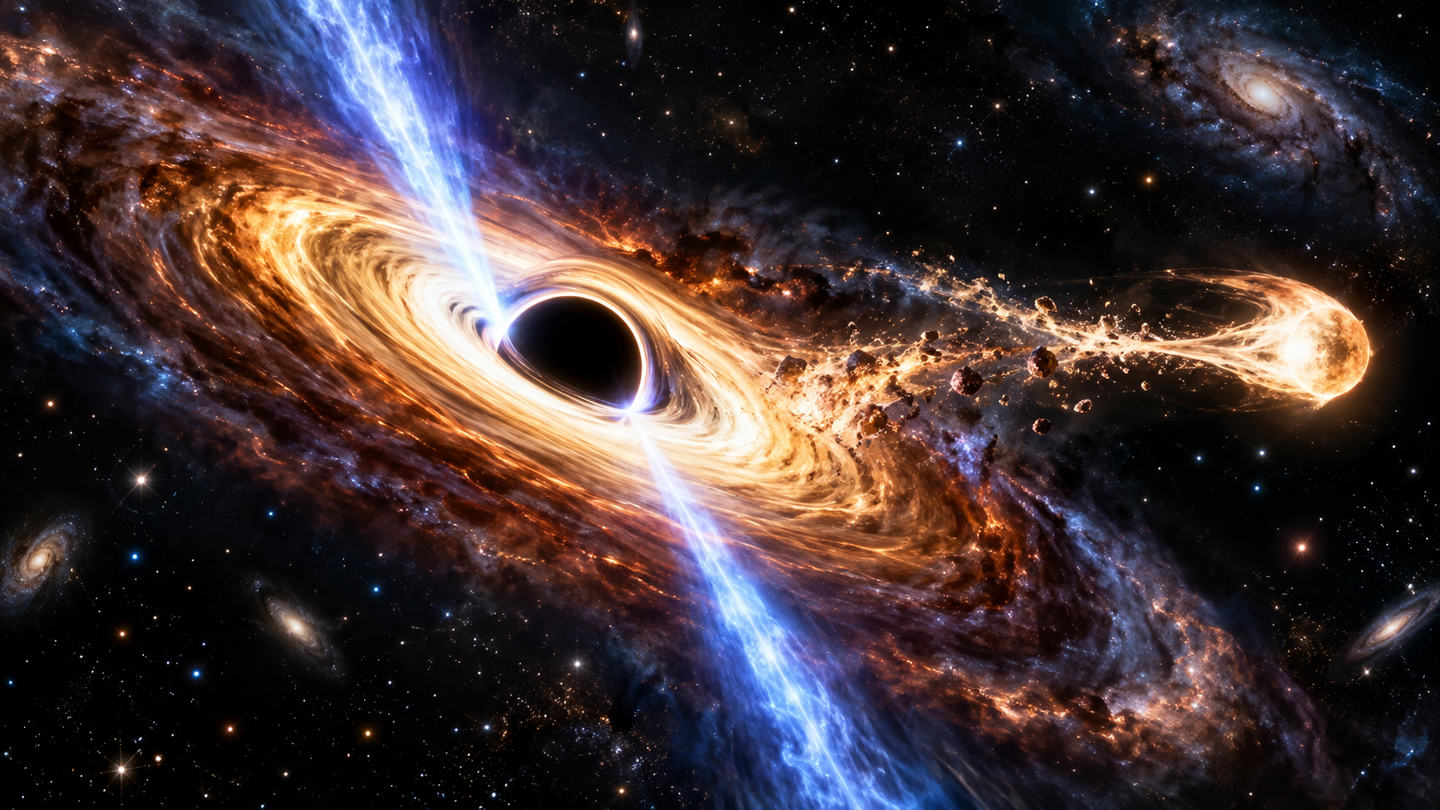
Supermassive and stellar black holes may launch compact jets at the same critical feeding rate near 2% of the Eddington limit. (CREDIT: Shutterstock)
- Supermassive black holes appear to launch delayed radio jets when their feeding rate falls to about 2% of the Eddington limit, matching a threshold already measured around stellar-mass black holes.
- The team reconstructed 11 radio outflows from 10 well-observed tidal disruption events, revealing separate high-accretion and low-accretion phases associated with different kinds of outflows.
- The result supports the idea that black hole feeding and jet formation obey the same underlying physics across a mass range spanning roughly seven orders of magnitude.
Black holes weighing millions of Suns and objects only about 10 times the Sun’s mass appear to obey the same rule when they launch certain powerful jets.
The connection emerged from observations of supermassive black holes caught consuming the remains of shredded stars. By following those systems over several years, astronomers found that delayed radio outflows switched on when the feeding rate fell to roughly 2% of a fundamental limit known as the Eddington rate.
That threshold is remarkably similar to one already associated with jet formation around much smaller stellar-mass black holes.
Andrew Mummery of the Institute for Advanced Study and Adelle Goodwin of Curtin University led the international collaboration. Their study, “A universal critical accretion rate for black hole jet formation,” was published in Nature Astronomy.
Stellar destruction turned slow evolution into a fast experiment
Astronomers have long suspected that black holes follow similar accretion physics regardless of their mass. Testing that idea directly has been difficult because supermassive black holes in active galaxies can take thousands or millions of years to move through meaningful changes in their feeding states.
Tidal disruption events offer an unusual shortcut. They occur when a star ventures close enough to a supermassive black hole for tidal forces to tear it apart. Some stellar material escapes, while part of the debris forms an accretion flow around the black hole.
That new disk evolves far faster than the enormous disks surrounding ordinary active galactic nuclei. Changes that would otherwise be impossible to watch within a human lifetime can unfold over months or years.
“We really wanted to figure out this massive puzzle,” Mummery said. “Why do some supermassive black holes blast out radio jets right after shredding a star, while others just sit there looking completely dormant, only to suddenly fire up their jets months or even years later?”
The team realized that the delayed behavior might resemble the well-studied state changes of stellar-mass black holes in X-ray binary systems.
Twenty stellar disruptions narrowed to 10 key systems
The researchers assembled 20 tidal disruption events with publicly available optical, ultraviolet, X-ray and radio observations.
Radio measurements allowed them to estimate when an outflow had actually been launched, rather than simply when its radiation became detectable. Optical, ultraviolet and X-ray data were then modeled with time-dependent relativistic accretion-disk calculations to estimate how quickly the black hole was consuming material at that moment.
Not every event provided enough information. Three lacked adequate late-time optical or ultraviolet measurements, while eight others could not reliably constrain the disk during the relevant outflow-launch period.
That left 10 tidal disruption systems containing 11 radio flares with sufficiently strong constraints. Although modest, the sample is comparable in size to some modern studies of state transitions in stellar-mass black hole binaries.
The resulting distribution did not cluster around one feeding rate. Instead, the radio outflows separated into two distinct groups.
Jets appear at two very different feeding stages
Prompt radio outflows occurred while the black holes were feeding at roughly the Eddington rate or above it.
The Eddington limit marks the point where outward radiation pressure becomes strong enough to oppose the inward gravitational pull on surrounding material. Accretion can temporarily exceed this level, particularly during violent transient events.
At those high rates, the researchers interpret the radio-producing outflows primarily as winds associated with super-Eddington accretion.
The delayed flares behaved differently. They appeared hundreds to thousands of days after the stellar disruption, when the modeled feeding rates had declined dramatically.
Every well-constrained delayed event was consistent with launching near roughly 2% of the Eddington accretion rate. At that stage, the evidence points toward the formation of a compact radio jet associated with a change in the inner accretion flow.
The distinction also appeared in the radio light curves. Prompt events generally brightened more gradually, while delayed flares often rose much more steeply, consistent with continuing energy injection from a compact jet.
A familiar threshold appears around much larger black holes
The 2% figure is important because stellar-mass black holes already show a similar transition.
Black holes in X-ray binary systems can alternate between different accretion states. As an outburst fades, the source can shift from a softer X-ray state into a low-hard state accompanied by a compact radio-emitting jet.
Earlier measurements placed this transition at roughly 1% to 4% of the Eddington luminosity, with an average near 2%.
The new observations suggest that supermassive black holes behave similarly despite being millions of times heavier. The underlying threshold therefore appears largely independent of black hole mass.
Astronomers had already found broader evidence for common behavior through the “fundamental plane” of black hole activity, a relationship connecting black hole mass with radio and X-ray emission. The new work goes further by identifying a particular transition associated with jet formation.
It does not mean every detail of black hole accretion is identical across all scales. Instead, the evidence suggests that one important trigger for compact jets remains remarkably similar.
Simulations reproduced how often the outflows appear
The researchers also tested whether the proposed framework could explain tidal disruption events without detected radio outflows.
They simulated one million tidal disruption disks drawn from an observationally constrained black hole population. For each, they calculated whether the disk became super-Eddington and how long it would take to decline to 2% of the Eddington rate.
About 42% were predicted to enter a super-Eddington phase, close to current estimates that roughly 30% to 50% of tidal disruption events produce prompt radio emission.
Roughly 40% were predicted to pass through the 2% threshold within an observable window of approximately 200 days to seven years. Observations independently suggest delayed radio flares occur in about 40% of tidal disruption events.
Those agreements strengthen the proposed connection, although the authors acknowledge uncertainties in outflow velocities, disk modeling and radio-launch estimates.
Astronomers may now know when to watch
A predictable jet threshold could make future observations more efficient.
Once astronomers estimate how quickly a tidal disruption disk is fading, they may be able to forecast when it approaches the critical low-accretion state and schedule radio, X-ray and other observations accordingly.
That capability could become increasingly useful as new surveys discover thousands more stellar disruptions. Facilities including the Vera C. Rubin Observatory and next-generation radio instruments such as the Square Kilometre Array are expected to greatly expand the available samples.
The broader result reaches beyond tidal disruption events. It supports a deceptively simple idea: although black holes span enormous differences in mass, some of the physics governing how they feed and launch jets may remain the same.
Dig deeper into black hole jets and tidal disruption events
These resources explore the observational foundations behind accretion-state changes, radio outflows and scale-invariant black hole behavior.
Do X-ray binary spectral state transition luminosities vary?: This study found that soft-to-hard state transitions in X-ray binaries generally occur at about 1% to 4% of the Eddington rate, with a mean near 2%. (Astronomy & Astrophysics, 2003)
Towards a unified model for black hole X-ray binary jets: This influential framework connected changes in accretion state with the appearance, disappearance and evolution of jets around stellar-mass black holes. (Monthly Notices of the Royal Astronomical Society, 2004)
A Fundamental Plane of black hole activity: Radio luminosity, X-ray luminosity and black hole mass were shown to follow a common relation across stellar-mass and supermassive systems. (Monthly Notices of the Royal Astronomical Society, 2003)
Radio Properties of Tidal Disruption Events: This review examines the wide range of radio jets and outflows observed after stars are disrupted by supermassive black holes. (Space Science Reviews, 2020)
Ubiquitous Late Radio Emission from Tidal Disruption Events: Long-term observations revealed unexpectedly common radio brightening hundreds to thousands of days after stellar disruption events. (The Astrophysical Journal, 2024)
Research findings are available online in the journal Nature Astronomy.
The original story "Stellar destruction reveals a universal rule for black hole jet formation" is published in The Brighter Side of News.
Related Stories
- Black hole 'hair' could reveal hidden matter after two black holes collide
- Astronomers confirm Einstein’s gravity by viewing light from behind a supermassive black hole
- The universe may contain a staggering 40 quintillion black holes
Like these kind of feel good stories? Get The Brighter Side of News' newsletter.
Joseph Shavit
Writer, Editor-At-Large and Publisher
Joseph Shavit, based in Los Angeles, is a seasoned science journalist, editor and co-founder of The Brighter Side of News, where he transforms complex discoveries into clear, engaging stories for general readers. With vast experience at major media companies like The Los Angeles Times, Times Mirror and Tribune Publishing, he writes with both authority and curiosity. His writing focuses on space science, planetary science, quantum mechanics, geology. Known for linking breakthroughs to real-world markets, he highlights how research transitions into products and industries that shape daily life.