Cosmic plasma was supposed to rule out dark photons. Simulations say otherwise
Nonlinear plasma effects could reopen 10 orders of magnitude in mass for one of physics’ leading dark matter candidates.

 Edited By: Joseph Shavit

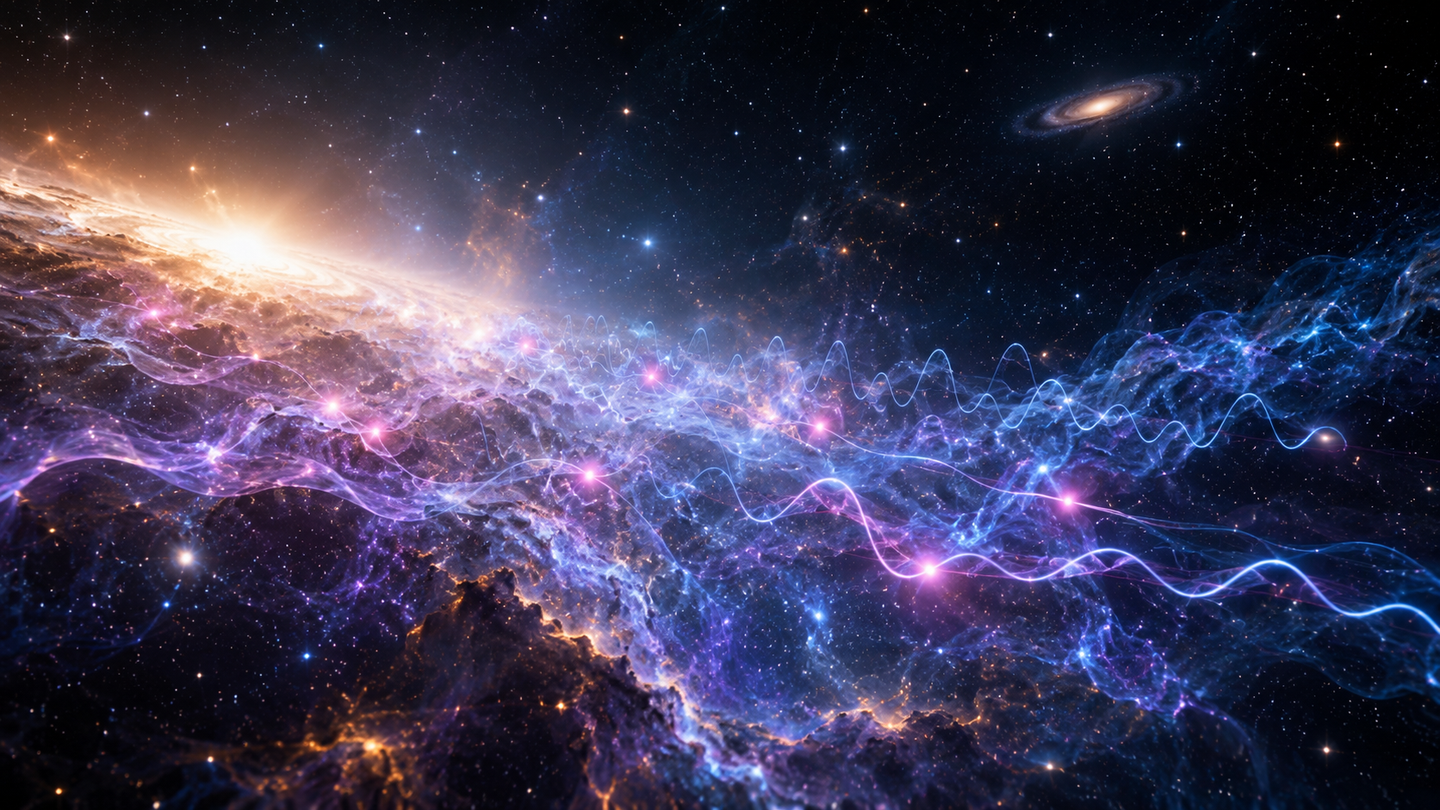
Dark photon dark matter gets new room to hide after plasma simulations overturn powerful early-universe limits. (CREDIT: Shutterstock)
- A major limit on dark photon dark matter may be far weaker because early-universe plasma stops absorbing energy much sooner than expected.
- Computer simulations show that plasma becomes unstable as energy builds, disrupting the resonance that was supposed to produce substantial heating.
- The result reopens about 10 orders of magnitude in dark photon mass for experiments and may force physicists to reconsider similar limits in other astrophysical environments.
For years, one of the strongest cosmological arguments against dark photon dark matter rested on a simple idea: if dark photons converted into ordinary light in the early universe, they should have heated cosmic plasma enough to leave measurable traces.
That assumption may not hold.
A team from Perimeter Institute and the University of Maryland reports that the conversion process can trigger powerful nonlinear effects in plasma. Those effects quickly disrupt the resonance that drives energy transfer, shutting the process down before much heating occurs.
The result weakens some of the strongest cosmological limits on dark photon dark matter across about 10 orders of magnitude in mass, from roughly 10⁻¹⁴ to 10⁻⁴ electron volts.
A constraint built on linear physics
One candidate is the dark photon, a hypothetical light boson that can interact weakly with the electromagnetic current through kinetic mixing. That interaction has made dark photons targets for laboratory, astrophysical and cosmological searches.
For about 15 years, early-universe calculations often treated dark photon conversion as a linear process. As the universe cooled, the plasma frequency could match the dark photon mass. At that resonance, dark photon energy was expected to convert efficiently and heat the plasma.
“The treatment for the last 15 years is a linear treatment. If you use that approximation, you can compute the amount of energy transfer, and it's very large,” says Huang. “And I realized it's not possible.”
Junwu Huang and Mohamad Shalaby of Perimeter Institute worked with Anson Hook at the University of Maryland to examine what happens as energy starts building inside the plasma.
Plasma instability changes the picture
Dark photons can drive Langmuir waves, collective oscillations of electrons in a plasma. Under the linear picture, those oscillations can keep growing while resonance continues.
As the oscillating electric field strengthens, the collective electron motion approaches the electrons’ random thermal motion. At that point, perturbation theory breaks down and nonlinear plasma effects become important.
“What we realized is that, as you are converting energy into the Standard Model plasma, the plasma actually goes crazy,” Huang explains.
“There are a lot of nonlinearities in the system, and these nonlinearities basically shut off the energy conversion after a tiny amount of energy is converted.”
One important effect comes from the ponderomotive force, which pushes electrons and ions toward regions where wave amplitudes are lower. That changes local particle density and therefore the plasma frequency.
Once the plasma frequency varies across the system, the conditions needed for resonant conversion no longer hold uniformly.
The process also excites higher-wave-number Langmuir modes and ion acoustic waves. Those density variations further disturb the resonance and stop sustained energy transfer.
Simulations show energy transfer stalling
To test the nonlinear behavior, the team used particle-in-cell simulations adapted from the SHARP code. These simulations follow plasma particles and electromagnetic fields together.
The researchers studied exact resonant conversion and a faster version of the Landau-Zener transition, which represents the system passing through resonance as conditions change.
At first, energy moved into low-wave-number Langmuir waves as linear theory predicted. But once nonlinear effects became important, energy shifted into other modes and electron thermal motion.
In the slower-growth regime, the resonant process began to stall when accumulated electron motion approached the electron thermal speed. The total transferred energy was about the initial thermal energy of the electrons.
In the faster-growth regime, Langmuir waves heated electrons substantially, but ion responses and other nonlinear effects still caused the growth to saturate.
The Landau-Zener simulations showed even stronger suppression. Nonlinearity nearly eliminated the resonance, and in one case electron kinetic energy changed by less than a factor of two despite conditions that linear theory would have treated as highly efficient.
The final simulated state contained Langmuir and ion acoustic waves, with electrons about 30 times hotter than ions. That configuration remained stable through the longest simulations and continued to block renewed energy transfer.
Cosmological limits become much weaker
Previous cosmological constraints relied on much larger energy injection. Limits based on spectral distortions, for example, required energy equal to about 10⁻⁴ of the total radiation energy density to enter the ordinary plasma.
The new work argues that the plasma becomes nonlinear after no more than about 10⁻⁸ of the radiation energy density has been injected.
Across dark photon masses from 10⁻¹⁴ to 10⁻⁴ eV, the researchers conclude that limits on the kinetic-mixing parameter are weakened by at least a factor of 3,000.
Dark photon dark matter is not unconstrained. Nonresonant heating can still transfer energy into ordinary matter, but that process is much weaker. The paper calculates updated limits from early-universe observations and later periods, including the dark ages and the Lyman-alpha forest.
Some post-recombination limits remain tentative, and the authors leave a more detailed treatment of nonresonant heating during recombination for future work.
Practical implications of the research
The biggest consequence is experimental. Parameter space once treated as ruled out may now be open to direct searches for dark photon dark matter.
“By calculating the early universe plasma correctly, experiments will probe new parameter spaces and potentially actually see something,” explains Shalaby.
The work also raises a broader warning for searches involving light particles and plasmas. Similar conversion arguments appear in astrophysical environments, including neutron star and white dwarf magnetospheres.
“This is a test case in cosmology. A lot of astrophysical systems have also been used to look for similar effects, and we need to rethink all of them,” Huang says. “Linear approximations, which are easy to compute, might have nothing to do with how a neutron star magnetosphere or a white dwarf magnetosphere actually behave.”
For Shalaby, the result shows why particle physics and plasma physics need to meet when the problem demands both.
“It's truly interdisciplinary. It's the interaction between plasma physics and particle physics,” says Shalaby. “And this will directly impact people who do experiments.”
Dig deeper into dark photon dark matter
Together, these sources show how dark photons could arise as dark matter, where theory still allows them to exist, and how increasingly sensitive experiments are trying to detect them.
Experimental targets for dark photon dark matter
This theoretical analysis identifies viable regions where ultralight dark photons could constitute dark matter while remaining consistent with early-universe physics. It also helps clarify which parts of parameter space are especially important for direct searches. (Physical Review D, 2025)
New Technologies for Axion and Dark Photon Searches
This review examines recent progress in detecting light dark matter, including dark photons, with tools drawn from quantum sensing, microwave engineering and precision measurement. It offers a broad view of how new technologies are expanding the range experiments can probe. (Annual Review of Nuclear and Particle Science, 2025)
Dark photon dark matter from flattened axion potentials
Using numerical simulations, the authors study an early-universe mechanism in which axion dynamics can generate dark photons efficiently enough for them to account for a significant share of dark matter. The work helps explain why ultralight dark photons remain strong theoretical candidates. (Journal of High Energy Physics, 2025)
First Search for Dark Photon Dark Matter with a MADMAX Prototype
The MADMAX Collaboration searched directly for dark photon dark matter near 80 microelectron volts with a dielectric haloscope prototype. The experiment strengthened limits on photon mixing in that mass range and demonstrated a practical route for future searches. (Physical Review Letters, 2025)
First Scan Search for Dark Photon Dark Matter with a Tunable Superconducting Radio-Frequency Cavity
This experiment used a tunable superconducting radio-frequency cavity to look for the extremely weak electromagnetic signal expected from dark photon dark matter. It shows how precision cavity techniques are being applied to ultralight dark matter searches. (Physical Review Letters, 2024)
Research findings are available online in the journal Physical Review Letters.
The original story "Cosmic plasma was supposed to rule out dark photons. Simulations say otherwise" is published in The Brighter Side of News.
Related Stories
- Entangled photons survive a 38 mile ride through fiber-optic cable strung above Maryland streets
- Dark matter is made up of dark photons which fills the space between galaxies
- University of Ottawa scientists produce quantum entanglement using sunlight
Like these kind of feel good stories? Get The Brighter Side of News' newsletter.
Joshua Shavit
Writer and Editor
Joshua Shavit is a NorCal-based science and technology writer with a passion for exploring the breakthroughs shaping the future. As a co-founder of The Brighter Side of News, he focuses on positive and transformative advancements in technology, physics, engineering, robotics, and astronomy. Having published articles on AOL.com, MSN, Yahoo News, and Ground News, Joshua's work highlights the innovators behind the ideas, bringing readers closer to the people driving progress.