Quantum breakthrough uses anyons to achieve universal computing power
Scientists demonstrate universal quantum computing using non-Abelian anyons, offering a path to more reliable machines.
 University of Chicago Writer: Paul Dailing

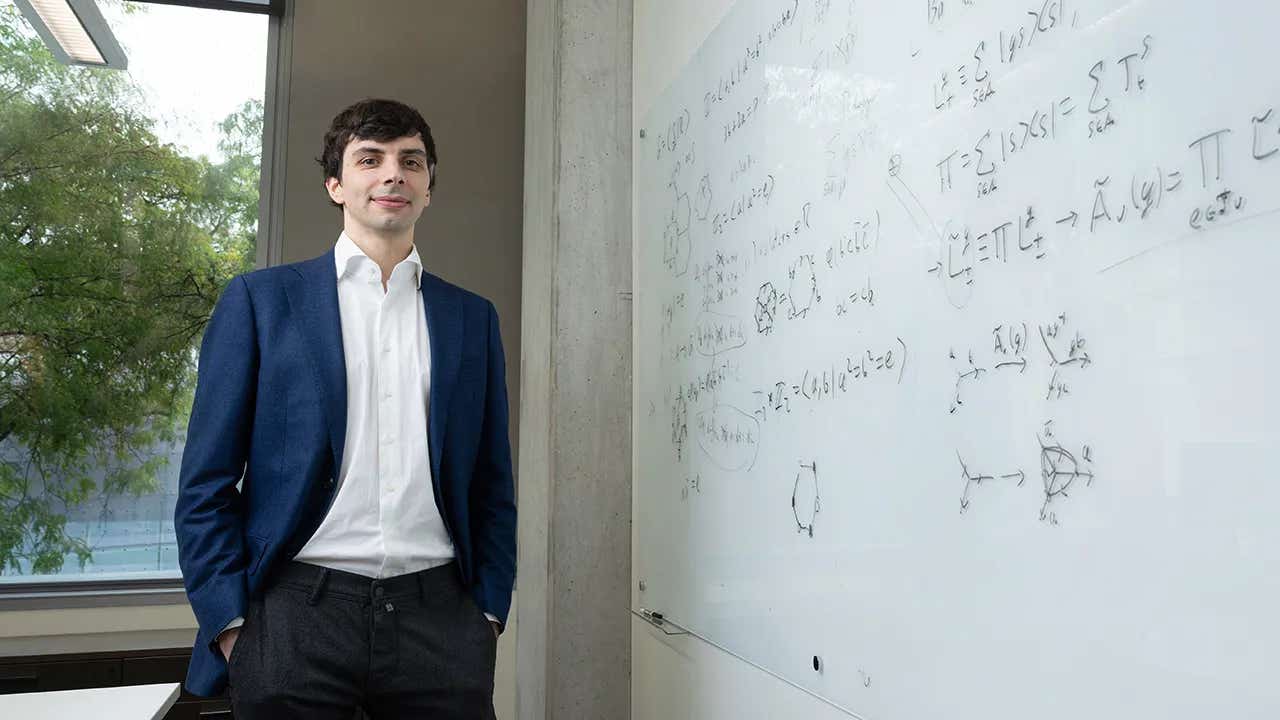
Asst. Prof. Ruben Verresen shows a new way to give a quantum computer the flexibility of current computers, harnessing the capabilities of exotic quantum particles called non-Abelian anyons. (CREDIT: Jason Smith)
- Researchers demonstrated a universal quantum computing method using non-Abelian anyons, allowing a system to perform any quantum calculation through braiding and fusion.
- Built on Quantinuum’s 54-qubit H2 trapped-ion processor, the approach uses topological qutrits to protect information from local disturbances and reduce errors.
- The breakthrough could eliminate costly magic-state preparation, offering a potential path toward more scalable, reliable, and resource-efficient quantum computers.
Quantum computers promise to solve problems that overwhelm today’s machines. Yet one barrier has slowed progress for years. These systems struggle to run every type of calculation while keeping errors under control. Now, physicists report a breakthrough that could bring both goals within reach.
In a study, a team from the University of Chicago Pritzker School of Molecular Engineering, Harvard University, Stony Brook University, and Quantinuum demonstrated a new way to build a fully flexible quantum computing system. The method relies on unusual entities known as non-Abelian anyons, which behave unlike any ordinary particles.
A Different Kind Of Quantum Building Block
Conventional quantum computers store information in qubits. Each qubit can hold a zero, a one, or a mix of both. However, qubits are fragile. Even small disturbances can disrupt them and introduce errors.
The new approach uses non-Abelian anyons instead. These are not particles in the usual sense. Scientists create them by linking many qubits into a shared quantum state. The result behaves like a new type of particle with unique rules.
Ruben Verresen, assistant professor at the University of Chicago, described the concept. “We demonstrated a so-called universal gate set, meaning that if you store information in these emergent versions of quarks, and you move them around, you can do any quantum computation you might want to do.”
These anyons store information across many qubits at once. This spreads out the data and protects it from local disruptions.
Why Flexibility Has Been Hard To Achieve
A useful quantum computer must perform any operation, not just a limited set. Engineers call this ability universality. Achieving it has been difficult, especially when systems also aim to reduce errors.
Most current designs rely on error correction. They spread information across many qubits and use extra steps to fix mistakes. However, these methods often lack the full set of operations needed for general computing.
To fill that gap, engineers use “magic states.” These special states allow additional operations but require complex preparation. Producing them consumes a large number of qubits and time.
Henrik Dreyer of Quantinuum explained the challenge. “Non-Abelian codes are a dark horse in the race to quantum error correction,” he said. “In this work we show the first universal gate set in a non-Abelian code, which demonstrates that fault-tolerant computations can in principle be done without resorting to magic state distillation or cultivation, which are the most expensive operations in standard quantum error correction codes.”
When Braiding Alone Was Not Enough
Earlier work showed that anyons could perform some quantum operations through a process called braiding. This involves moving one anyon around another. The order of these movements matters and changes the system’s state.
In 2024, researchers created anyons based on a mathematical symmetry called D4. That experiment proved that these exotic states could exist in quantum hardware. However, braiding alone could not produce every needed operation.
Verresen noted the limitation. “In that work, we didn’t demonstrate that those emergent forces were enough to do quantum computation,” he said. “That particular universe we created was not powerful enough.”
Adding Fusion Changes Everything
The new study introduces a second tool called fusion. In this process, two anyons combine and produce a measurable outcome. That result reveals information about their shared state.
The team used a different symmetry structure, called S3, which describes the rotations and reflections of a triangle. They built this system on Quantinuum’s H2 trapped-ion processor using 54 qubits.
Instead of standard qubits, they encoded information in qutrits, which can hold three states. This allowed more complex behavior and richer operations.
By combining braiding and fusion, the researchers demonstrated three essential operations. One came from braiding, while two came from fusion measurements. Together, these operations form a universal gate set.
This means the system can, in principle, perform any quantum algorithm.
A New Way To Handle Errors
Error correction remains one of the biggest challenges in quantum computing. Traditional methods require large overhead and complicated procedures.
Non-Abelian anyons offer a different path. Because information is stored across the system, it is less sensitive to small disturbances. This built-in protection reduces the need for constant correction.
The team also showed that they could create a magic state directly through topological operations. This avoids the expensive distillation process used in other systems.
For now, the study serves as a proof of principle. The researchers tested individual building blocks rather than a full error-correcting system. Still, the results suggest that combining these techniques could lead to more stable quantum machines.
From Theory To Experiment
The idea of using both braiding and fusion dates back more than two decades. In 2003, Carlos Mochon proposed that these operations could enable universal computation.
Turning that theory into reality required years of progress in both mathematics and hardware. Advances in trapped-ion systems made it possible to control dozens of qubits with high precision.
Graduate researchers Anasuya Lyons and Chiu Fan Bowen Lo helped lead the work. They reflected on the journey from theory to experiment. “It is gratifying to see ideas we have spent our PhD work thinking about realized in the lab, and it has been made possible by remarkable advances in quantum hardware over the past few years.”
A Glimpse Of Future Quantum Machines
The study marks an important step toward general-purpose quantum computing. By showing that non-Abelian anyons can perform a full set of operations, the researchers provide a new blueprint for building these machines.
The approach also offers insight into fundamental physics. These systems behave like small, self-contained worlds with their own rules. Studying them could reveal new properties of matter and information.
The next step involves combining this method with full error correction. If successful, it could lead to scalable and reliable quantum computers.
Practical Implications Of The Research
This research could reshape the future of computing. By enabling universal operations with fewer resources, it may reduce the cost and complexity of quantum systems. This makes large-scale machines more feasible.
In practical terms, improved quantum computers could accelerate drug discovery, materials science, and climate modeling. Problems that take years today could be solved much faster.
The method may also improve reliability. Systems that resist errors naturally could require less maintenance and fewer corrections. This would make quantum devices more practical for real-world use.
For researchers, the work opens new directions. It suggests that topological systems, once seen as theoretical, can serve as real platforms for computation. This could inspire new designs and experiments.
Over time, these advances may lead to machines that transform industries and scientific research. The ability to perform any quantum calculation reliably would mark a major milestone in technology.
Research findings are available online in the journal Nature.
The original story "Quantum breakthrough uses anyons to achieve universal computing power" is published in The Brighter Side of News.
Related Stories
- Scientific breakthrough brings quantum entanglement to existing telecom networks
- Scientists observe ‘negative time’ for the first time in a quantum experiment
- Quantum bath keeps distant qubits entangled without human control
Like these kind of feel good stories? Get The Brighter Side of News' newsletter.
Shy Cohen
Writer