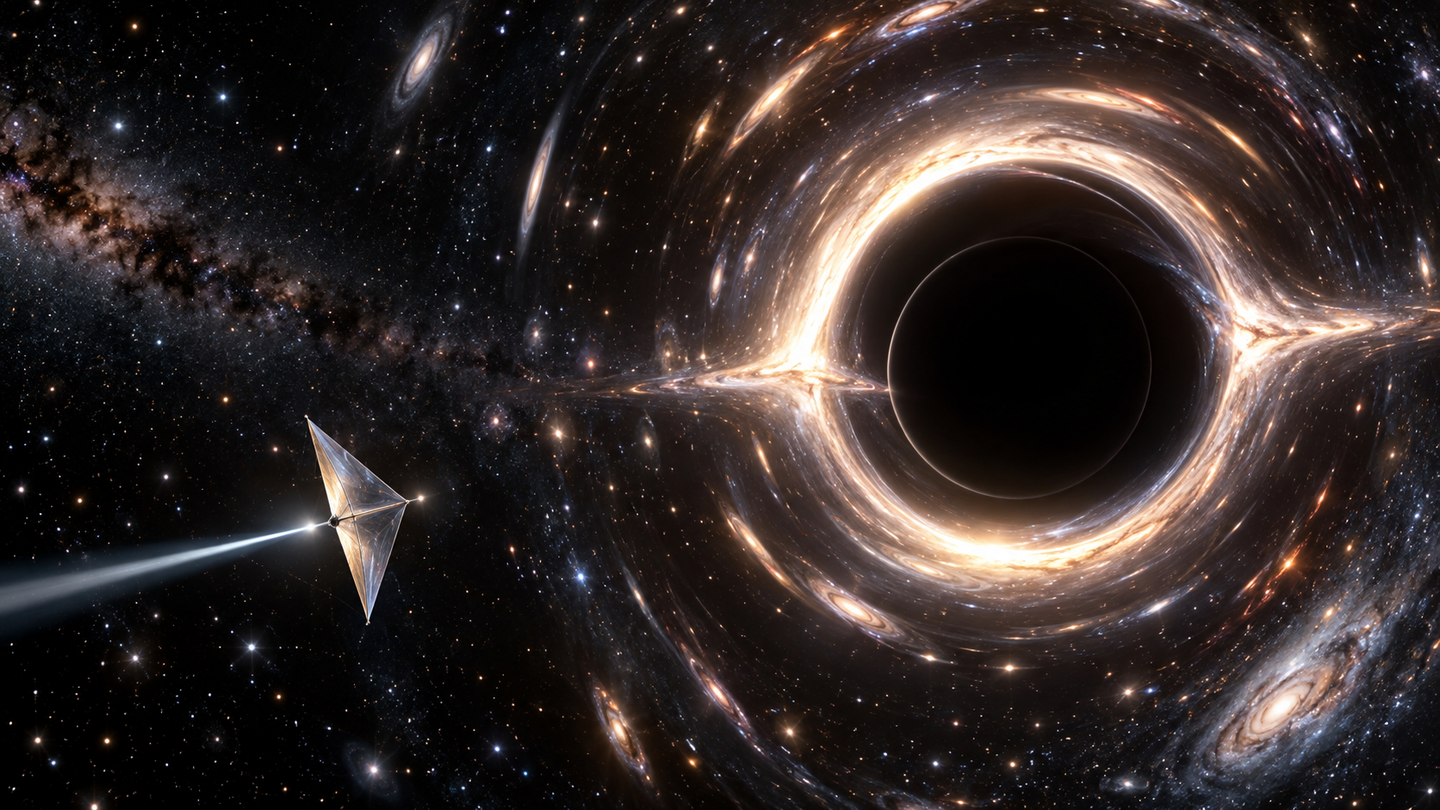
New cosmology model finds that dark matter doesn’t exist
A University of Ottawa physicist says weakening natural forces could explain a universe made entirely from ordinary matter.
 Edited By: Joshua Shavit

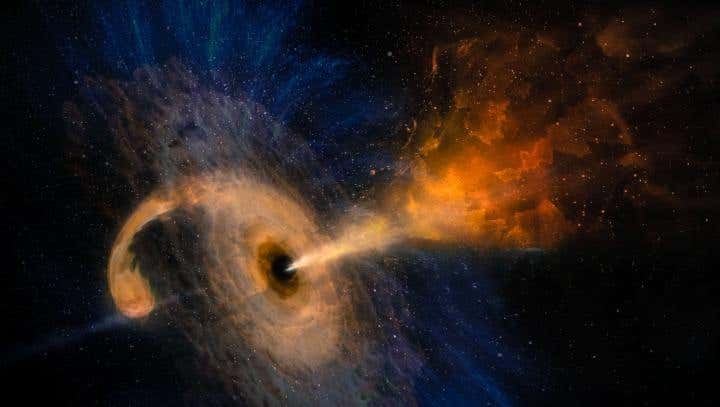
A new cosmology model describes a universe without dark matter while matching key measurements of galaxy spacing and ancient light. (CREDIT: Shutterstock)
- A proposed cosmology model argues that the universe may contain ordinary matter alone, without dark matter or dark energy.
- The model matched key measurements tied to galaxy spacing and the cosmic microwave background, despite using a very different cosmic timeline.
- The idea remains unproven and needs broader testing against observations such as primordial element abundances and the full microwave background pattern.
The universe may be missing two of its most famous ingredients. A University of Ottawa physicist argues that dark matter and dark energy are unnecessary if nature’s forces weaken over cosmic time and light loses energy across immense distances.
Rajendra Gupta, a physics professor in the university’s Faculty of Science, tested that claim against two major cosmic yardsticks. His model reproduced measurements linked to the early universe and the large-scale spacing of galaxies.
The work challenges the standard cosmological model. That model assigns roughly 27% of the universe to dark matter, less than 5% to ordinary matter, and most of the remainder to dark energy.
Gupta’s alternative, called the CCC+TL model, combines covarying coupling constants with “tired light.” The first idea allows fundamental forces to weaken as the universe ages. The second proposes that light loses energy while traveling enormous distances.
A universe built without invisible matter
Dark matter does not emit, absorb, or reflect light. Astronomers infer its presence from gravity, particularly the movements of galaxies and the formation of large cosmic structures.
The CCC+TL model takes another route. It changes how cosmic expansion, redshift, distance, and the strength of natural forces are calculated. In Gupta’s framework, weakening forces drive accelerated expansion rather than dark energy.
“The study's findings confirm that our previous work (“JWST early Universe observations and ΛCDM cosmology”) about the age of the universe being 26.7billionyears has allowed us to discover that the universe does not require dark matter to exist,” Gupta said. “In standard cosmology, the accelerated expansion of the universe is said to be caused by dark energy but is in fact due to the weakening forces of nature as it expands, not due to dark energy.”
His model also gives the universe an age of 26.7 billion years, nearly twice the generally accepted 13.8 billion years. That longer timeline was previously proposed to explain surprisingly mature galaxies observed by the James Webb Space Telescope less than 500 million years after the Big Bang.
Those galaxies appear to have masses and structures resembling systems that had billions of years to develop. Their angular sizes are also about one order of magnitude smaller than expected. Some astronomers have adjusted galaxy-formation models, while others have questioned whether new physics is needed.
Testing the model with a cosmic ruler
A cosmological model must reproduce more than galaxy ages. Gupta tested CCC+TL against baryon acoustic oscillations, or BAOs, which act as a standard ruler across the universe.
BAOs began as sound waves in the hot mixture of matter and radiation before atoms formed. Their imprint appears in the cosmic microwave background, the leftover radiation from the early universe. Related patterns later appeared in the distribution of galaxies.
Gupta analyzed angular BAO measurements from pairs of galaxies at redshifts between 0.11 and 0.65. The data came from studies using hundreds of thousands of luminous red galaxies divided into narrow redshift ranges.
The CCC+TL model produced a weighted average BAO scale of 151.0, plus or minus 5.1 megaparsecs. A calculation using the standard model produced 145.2, plus or minus 5.0 megaparsecs.
The values agree within their 95% confidence ranges.
Gupta also tested the result’s sensitivity to changes in the model’s two fitted parameters. The BAO scale shifted only modestly compared with uncertainties in the observed galaxy angles.
The same angle, a different history
The model reproduced the observed angular size of the sound horizon in the cosmic microwave background. Planck measurements place that angle at about 0.60 degrees.
CCC+TL reached the same angle through a dramatically different physical picture. Its calculated sound-horizon distance was 15.5 megaparsecs, while its angular-diameter distance was 1.49 gigaparsecs.
Both distances differ sharply from standard cosmology. In Gupta’s calculation, the expanding-universe component of the last-scattering redshift is 166, compared with 1,089 in the standard model. That lets sound travel longer before the cosmic plasma becomes transparent.
Because the sound horizon and angular-diameter distance increase by roughly similar factors, the model preserves the observed angle.
The model’s critical density is also only 3.1% of the standard model’s value. Gupta argues that this lower density can be supplied entirely by baryonic matter, the ordinary matter that makes stars, planets, gas, and dust.
“There are several papers that question the existence of dark matter, but mine is the first one, to my knowledge, that eliminates its cosmological existence while being consistent with key cosmological observations that we have had time to confirm,” Gupta said.
Important tests still remain
The analysis does not establish that dark matter has been disproved. It shows that one alternative model can reproduce selected BAO and cosmic microwave background measurements without including it.
Gupta acknowledged that CCC+TL is more complex than the standard model and requires careful calculations. It has not yet been fitted to the full microwave background anisotropy spectrum.
Other major tests remain. The paper identifies Big Bang nucleosynthesis, which concerns the formation of the first light elements, as a key challenge. Dedicated computer codes for the microwave background and primordial element abundances still need development.
The model also depends on two effects that scientists have not directly detected: a tired-light contribution to redshift and a coordinated variation in several coupling constants.
Possible tests could use gravitationally lensed images of the same distant object. Light following different paths would leave the object at different times and travel different distances. Precise redshift measurements might separate expansion-related redshift from any tired-light effect.
Researchers would also need an observation capable of detecting the shared function controlling the changing constants. No measurement has yet confirmed it.
Practical implications of the research
The immediate value of the work lies in giving cosmologists a specific alternative that can be tested against precision data. It does not replace the standard model, but it sets numerical targets for future comparisons.
If CCC+TL continues matching observations, it could alter how scientists interpret galaxy formation, cosmic age, redshift, and the universe’s matter budget. It could also change the meaning of some early James Webb Space Telescope results by giving galaxies more time to develop.
Failure on broader tests would be equally useful. Comparisons with the full microwave background spectrum, primordial element abundances, and redshift-drift measurements could expose where the model breaks down.
For now, the study narrows the question. A universe without dark matter is not established, but Gupta’s calculations argue that the idea can be tested rather than dismissed on assumption alone.
Research findings are available online in The Astrophysical Journal.
The original story "New cosmology model finds that dark matter doesn't exist" is published in The Brighter Side of News.
Related Stories
- Dark matter may be naturally tuned to a hidden fifth dimension
- Strange gravitational waves may reveal dark matter near merging black holes
- Mirror universe where time runs backwards could help explain dark matter, antimatter and neutrinos
Like these kind of feel good stories? Get The Brighter Side of News' newsletter.
Joseph Shavit
Writer, Editor-At-Large and Publisher
Joseph Shavit, based in Los Angeles, is a seasoned science journalist, editor and co-founder of The Brighter Side of News, where he transforms complex discoveries into clear, engaging stories for general readers. With vast experience at major media companies like The Los Angeles Times, Times Mirror and Tribune Publishing, he writes with both authority and curiosity. His writing focuses on space science, planetary science, quantum mechanics, geology. Known for linking breakthroughs to real-world markets, he highlights how research transitions into products and industries that shape daily life.