Researchers explain mysterious cause of 6,000-kilometer cloud wall on Venus
Venus’ 6,000-kilometer cloud front appears to form through a huge hydraulic jump in its sulfuric acid atmosphere.

 Edited By: Joseph Shavit

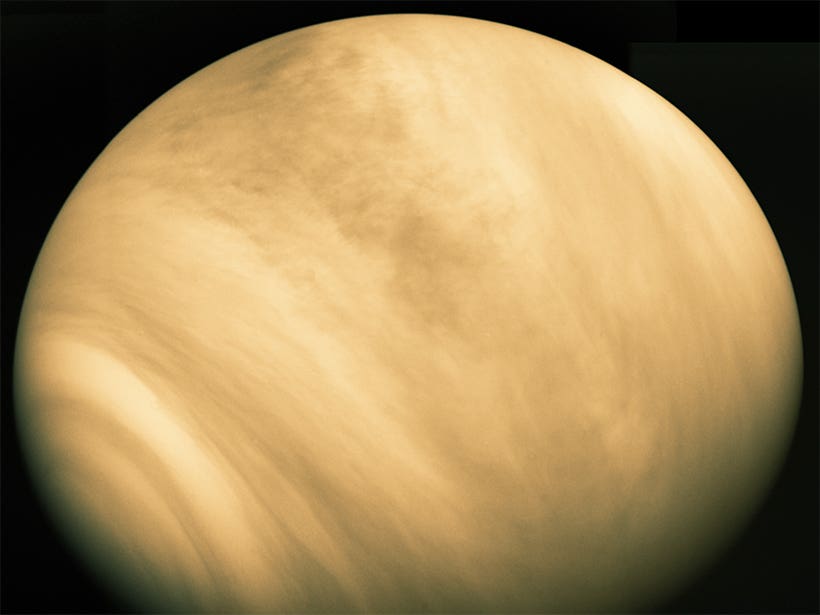
Scientists say Venus’ giant cloud front comes from a hydraulic jump, revealing a new driver of its fast-moving atmosphere. (CREDIT: NASA)
A sharply defined cloud front on Venus, stretching about 6,000 kilometers across, has puzzled planetary scientists since Japan’s Akatsuki spacecraft spotted it sweeping around the planet’s equator. The feature looked too large, too persistent, and too strange to fit neatly into existing models of Venusian weather.
Now a team that included the University of Tokyo says it has pinned down the cause: the largest known hydraulic jump in the solar system.
That phrase may sound exotic, but the basic effect is familiar. It happens when a fast, shallow flow suddenly slows and deepens. In a kitchen sink, you can watch water spread thinly from the faucet before it abruptly thickens into a raised ring. On Venus, researchers say, something similar happens in the atmosphere. However, it occurs on a planetary scale and inside a world wrapped in sulfuric acid clouds.
“We identified the phenomena, but for years we couldn’t understand it,” said Professor Takeshi Imamura of the University of Tokyo’s Graduate School of Frontier Sciences. “However, thanks to this research, we’re now able to show that this cloud disruption is caused by the largest known hydraulic jump in the solar system.”
A planet where clouds rarely let up
Venus is permanently covered by thick clouds, making it an unusually rich place to study atmospheric behavior. While Earth’s clouds come and go, Venus stays blanketed. This creates a more continuous record of how winds, waves, and chemistry interact.
One of the planet’s best-known oddities is atmospheric superrotation. Its clouds race around the planet about 60 times faster than Venus itself rotates. Scientists now know superrotation is not unique to Venus, because similar behavior appears in other places, including Mars, the sun, and Earth’s upper atmosphere. Even so, Venus remains one of the clearest examples.
Then came the Akatsuki observations in 2016. Images revealed a massive disturbance in the lower cloud region, moving westward with a crisp leading edge. The cloud band sometimes circled the equator for days at a time. Existing atmospheric models did not predict such a feature, especially one with such a striking shape and persistence.
That gap left a basic question hanging over Venusian meteorology: what could create such a huge, repeatable front in the first place?
The new analysis points to a planetary-scale Kelvin wave, an eastward-moving atmospheric wave in the lower to middle cloud region. According to the researchers, that wave can become unstable because of the background static stability structure of Venus’ atmosphere. When that happens, the flow suddenly changes character.
Where the cloud wall comes from
The jump begins when wind speed, as viewed from the atmospheric wave, abruptly drops. At the same time, a strong localized updraft forms along the front. That rising motion lifts sulfuric acid vapor higher into the atmosphere, where it condenses into droplets.
Those droplets then form the long cloud line seen by Akatsuki.
In other words, the cloud front is not just a passive marker drifting in the sky. It is a visible product of a sharp atmospheric transition, one that links horizontal wave motion with strong vertical transport.
“Venus has three distinct cloud layers, and the dynamics of the lower and middle layers are not so well understood,” Imamura said. “Our discovery of a hydraulic jump on Venus connecting a very large-scale horizontal process with a strong localized vertical wave is unexpected, as in fluid dynamics these are usually disconnected.”
That combination helps explain why the front stood out so much in spacecraft images. The hydraulic jump generates the updraft. The updraft promotes sulfuric acid condensation. As a result, the resulting cloud formation traces the disturbance as a giant line across the planet.
The researchers also say the clouds do not simply respond to the jump, they help support it. The newly formed clouds alter the atmosphere’s static stability, which in turn makes the hydraulic jump easier to sustain. That back-and-forth between cloud formation and atmospheric motion had not been recognized before as a fundamental process in Venus’ atmosphere.
Simulating a puzzle that old models missed
To test the idea, the team used a fluid dynamic model to simulate how the atmospheric flow behaves. They also used a microphysical box model to follow the behavior of a parcel of air moving through Venus’ atmosphere. Together, those tools reproduced the same kind of cloud disturbance observed around the planet. This included finer undulating details in its shape.
That was important, because the cloud front had remained stubbornly difficult to explain.
The researchers say the hydraulic jump also does more than build clouds. It appears to help maintain superrotation itself. The westward momentum carried by the Kelvin wave is transferred to the mean atmospheric flow through the jump. This adds to the process that keeps Venus’ atmosphere moving so quickly.
That matters because superrotation has long been one of the central unsolved issues in Venus science. The new work does not solve every part of that problem, but it adds a process that older climate-style simulations did not include.
“Up until now, we used a global circulation model (GCM) for Venus that is similar to Earth’s, but this model doesn’t include the hydraulic jump which we have now identified,” Imamura explained. “Our next step will be to test this discovery within a more inclusive climate model that includes other atmospheric processes. We will face some challenges due to the huge amount of processing power required to run such simulations. Even with modern supercomputers, it isn’t easy.”
The study also points to a weakness in relying too heavily on Earth-based assumptions when building models for other worlds. Venus may share some atmospheric principles with Earth. However, its constant cloud cover, different chemistry, and extreme circulation patterns can produce behavior that standard models miss.
Not just a Venus story
Although this appears to be the first time a hydraulic jump of this scale has been identified on another planet, the researchers say the underlying physics may not be unique to Venus.
Imamura said Mars’ atmosphere may, under some conditions, also be capable of supporting a hydraulic jump.
That possibility broadens the importance of the work. If similar couplings between waves, vertical motion, and cloud or aerosol formation occur elsewhere, then atmospheric models for other planets may need to account for them more carefully. The same applies to future observations. Scientists may now have a clearer target when looking for large, organized disturbances in alien skies.
Venus, with its dense blanket of sulfuric acid clouds, offered the clearest case first.
Practical implications of the research
This finding could improve how scientists model weather and climate on Venus and, potentially, on other planets. By identifying a process that existing large-scale models missed, the work gives future studies a more complete way to simulate cloud behavior, vertical air motion, and the transfer of momentum through an atmosphere.
That has practical value for planetary missions. Better atmospheric models can help researchers interpret spacecraft observations more accurately and prepare for future exploration.
The authors also suggest that understanding these processes on Venus may help scientists refine models for Mars and for planetary atmospheres more broadly. This is especially true where clouds or aerosols interact strongly with winds and wave motion.
Research findings are available online in the Journal of Geophysical Research Planets.
The original story "Researchers explain mysterious cause of 6,000-kilometer cloud wall on Venus" is published in The Brighter Side of News.
Related Stories
- Scientists find evidence of a massive lava tube hiding on Venus
- Could humans build floating cities on Venus?
- Venus's clouds contain massive reservoirs of water and iron
Like these kind of feel good stories? Get The Brighter Side of News' newsletter.
Joshua Shavit
Writer and Editor
Joshua Shavit is a NorCal-based science and technology writer with a passion for exploring the breakthroughs shaping the future. As a co-founder of The Brighter Side of News, he focuses on positive and transformative advancements in technology, physics, engineering, robotics, and astronomy. Having published articles on AOL.com, MSN, Yahoo News, and Ground News, Joshua's work highlights the innovators behind the ideas, bringing readers closer to the people driving progress.