Massive DNA study discovers far more insects in California than scientists previously thought
Researchers analyzed more than 1 million specimens to map California insect diversity. Their findings suggest roughly one-third of the state’s insect fauna remains outside the survey, with distinct communities across different habitats.
 NHM Writer: Tyler Hayden

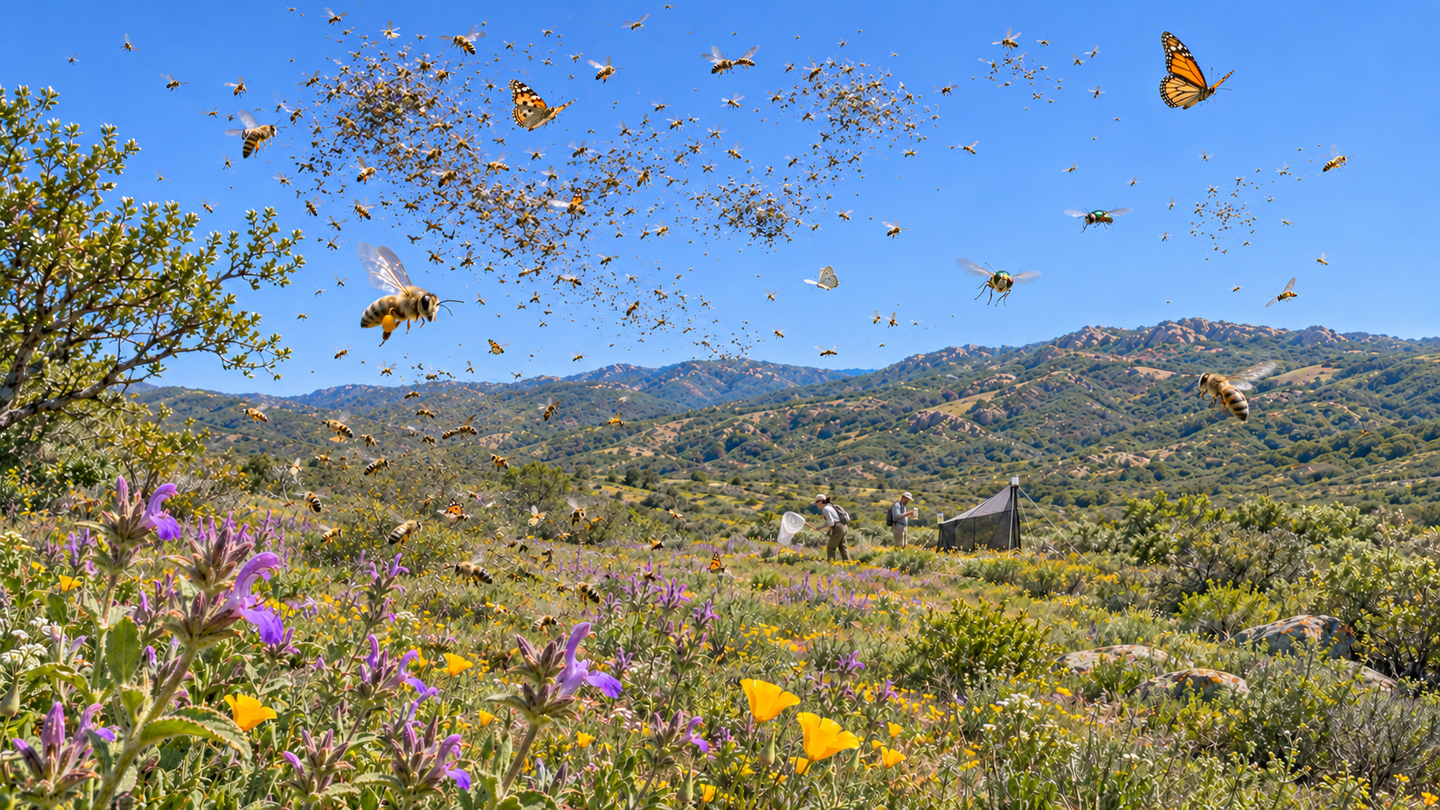
Bees, butterflies and other insects fill the air above California wildflowers as researchers collect specimens in the distance. AI-generated illustration inspired by the statewide insect diversity survey. (CREDIT: The Brighter Side of News)
- Researchers analyzed more than 1 million insect specimens and recorded 42,305 distinct DNA barcode groups across California.
- Statistical estimates suggest the state supports about 61,000 insect species, with roughly one-third still missing from the survey.
- Different locations supported sharply different insect communities, highlighting the need to protect a wide range of habitats.
California’s mountains, deserts and coastal landscapes hold an extraordinary variety of insects, and a massive DNA survey suggests much remains undocumented. Researchers estimate the state supports about 61,000 insect species, considerably more than their extensive sampling has captured so far.
The team analyzed more than 1 million specimens through the California Insect Barcoding Initiative, a statewide collaboration involving museums, universities and government scientists. Published in Ecography, the study establishes a foundation for tracking insect communities and bringing overlooked species into conservation planning.
Led by researchers at the Natural History Museum of Los Angeles County, the project recorded 42,305 distinct DNA barcode groups. Those groups serve as stand-ins for species. Statistical analysis suggests the survey captured roughly 65% to 69% of California’s insect fauna, leaving a substantial share unsampled.
That distinction matters: Scientists did not collect 61,000 species or formally name tens of thousands of new ones. They estimated how many species remain beyond their samples. The findings add a regional perspective to research suggesting Earth’s insect diversity may be much greater than previously thought.
Reading California insect diversity through DNA
Identifying tiny insects by appearance can demand specialized knowledge and considerable time. DNA barcoding offers another route. Researchers sequence a short stretch of genetic material, then compare it with other records. The approach helps separate insects that look similar and organizes specimens that lack reliable species names.
For this study, researchers grouped sequences using Barcode Index Numbers, or BINs, in the Barcode of Life Datasystem. A BIN identifies a genetic cluster that often corresponds to a species. However, these clusters do not always match species boundaries perfectly. Physical examination and additional genetic evidence remain important for confirming identities.
The original research on the BIN system explains how these persistent identifiers connect specimens with their genetic records. California’s project also preserves physical specimens, allowing specialists to revisit identifications. A sequence can flag an intriguing insect, while its preserved body provides evidence for further study.
The initiative forms part of the California All-Taxa Biodiversity Inventory, a broader effort to document the state’s life. Participating institutions include UC Berkeley, UC Riverside, the California Department of Food and Agriculture, the San Diego Natural History Museum and the California Academy of Sciences.
A statewide search with several collecting methods
Most field sampling took place from 2022 through 2024. Researchers combined continuous monitoring at 72 Observatory Sites with varied collecting methods at 454 additional locations. Together, these approaches covered every major EPA Level III ecoregion in California, although collecting intensity varied substantially among regions.
Observatory Sites used tentlike Malaise traps that intercept insects as they move through vegetation. These traps provided repeated samples, helping researchers compare communities across places and seasons. Volunteers maintained many traps, making sustained collecting possible across a landscape far larger than museum crews could regularly visit alone.
Other expeditions used nets, lights, ground traps and leaf-litter sampling to reach insects that Malaise traps often miss. About 14% of the recorded barcode groups appeared only through these additional methods. That finding shows why relying on a single trap design would leave important gaps in the inventory.
The project ultimately attempted sequencing for 1,030,728 specimens; 892,274 produced sequences meeting BIN requirements. Its public dataset links genetic information with collection records. These records complement research on how human activity shapes local insect communities, while creating a baseline for future comparisons.
Tiny flies and wasps dominate the count
Flies accounted for the largest share of recorded diversity, with 16,181 barcode groups. The order containing wasps, bees and ants followed with 13,966. Together, these two groups represented more than 70% of the total, showing how strongly small, easily overlooked insects contribute to the state’s biodiversity.
Beetles contributed another 4,234 groups, followed by butterflies and moths with 3,126. True bugs and their relatives added 2,934. The distribution differed sharply from existing California records in the Global Biodiversity Information Facility, where beetles held the largest share and flies appeared far less diverse.
These differences reflect both overlooked diversity and collecting choices. Malaise traps supplied more than 90% of sequenced specimens, favoring insects those traps can catch. Even so, the results demonstrate how a broad genetic inventory can reveal diversity beyond familiar groups such as California’s native bees.
Nearly 79% of barcode groups had fewer than 10 sequenced individuals. Low counts in this survey do not automatically mean a species is endangered or scarce everywhere. They can also reflect seasonal activity, location or collection methods. The study’s abstract emphasizes that its estimates remain provisional.
Different habitats hold different communities
California’s insect communities changed markedly between locations and ecoregions. Sites within the same ecoregion generally resembled each other more than distant sites did. However, even those neighboring communities differed strongly, suggesting that protecting a few especially rich locations would leave substantial diversity outside conservation boundaries.
Preliminary maps placed peaks in potential species richness in the Southern California Mountains and the Mojave Basin and Range. Researchers built these maps by combining collection locations with vegetation types and ecoregions. The maps indicate potential distributions, rather than confirming that every predicted species occupies every mapped location.
Uneven sampling adds uncertainty. Southern coastal California received relatively intensive attention, while the Central Valley and parts of northeastern California had less coverage. Agricultural development and private land ownership complicated access in the Central Valley. An apparently less diverse region may therefore reflect missing observations rather than genuinely fewer species.
That limitation matters for California’s 30x30 conservation effort. Insect records could help planners assess which habitats deserve closer study alongside existing wildlife and plant maps. Related UC Riverside research on urbanization and native bees also illustrates why local habitat differences deserve attention.
Practical implications for protecting overlooked life
The immediate benefit is a reference system that future surveys can reuse. Researchers can return to sites, collect comparable samples and investigate changes in which insects appear. Repeated monitoring could help distinguish seasonal variation from longer shifts associated with warming, land use or habitat restoration.
The inventory itself does not measure a statewide population decline. Instead, it establishes information needed to detect future changes. Even the 17 best-sampled Observatory Sites had estimated sampling completeness averaging only about 53%, underscoring how much repeat collecting could still reveal. That distinction matters because broader research on agricultural intensification and climate change identifies pressures on insects that a single biodiversity inventory cannot independently quantify.
The stakes extend beyond the insects themselves. A recent review of insects’ relationships with wildlife describes roles in food webs, shelter and sanitation. Understanding which insects live where therefore offers a clearer view of the ecological relationships that conservation seeks to preserve.
California’s emerging catalog remains unfinished, but it gives researchers a practical starting point. Each additional specimen can sharpen an identification, expand a known range or reveal another missing piece. Protecting that diversity begins with recognizing how much life even a well-studied state has yet to document.
Dig deeper into insect biodiversity and DNA barcoding
These resources explore insects’ ecological roles, hidden species diversity and the tools used to document it. Entries appear from newest to oldest.
Insect declines threaten wildlife far beyond insect world
This research overview explains how insects support wildlife through food, shelter, sanitation and other relationships. (UK Centre for Ecology & Hydrology, September 2026)
There may be 3 times as many insect species than previously thought
Researchers describe a separate analysis estimating 14 million to 20 million insect species worldwide. (Cornell University, June 2026)
Insect pollinators need more higher-quality habitats to help farmers
This interview explores how the amount and quality of natural habitat influence pollinator conservation on farmland. (University of Washington, September 2025)
Agricultural intensification and climate change are rapidly decreasing insect biodiversity
This perspective examines how farming practices, habitat loss and climate change threaten insect diversity. (Proceedings of the National Academy of Sciences, January 2021)
A DNA-Based Registry for All Animal Species: The Barcode Index Number (BIN) System
The foundational paper explains the genetic clustering system used to organize species-level barcode records. (PLOS ONE, July 2013)
Research findings are available online in the journal Ecography.
The original story "Massive DNA study discovers far more insects in California than scientists previously thought" is published in The Brighter Side of News.
Related Stories
- Earth may be home to 3x more insect species than scientists thought
- Fossil insect wings reveal a Jurassic world already buzzing with ultrasound communication
- Taylor Swift inspires scientists to name a new genus of Australian insects
Like these kind of feel good stories? Get The Brighter Side of News' newsletter.
Rebecca Shavit
Writer
Based in Los Angeles, Rebecca Shavit is a dedicated science and technology journalist who writes for The Brighter Side of News, an online publication committed to highlighting positive and transformative stories from around the world. Having published articles on MSN, AOL News, and Yahoo News, Rebecca's reporting spans a wide range of topics, from cutting-edge medical breakthroughs to historical discoveries and innovations. With a keen ability to translate complex concepts into engaging and accessible stories, she makes science and innovation relatable to a broad audience.