3.5 billion-year-old rock in India may hold evidence of early microbial life
Zircon dating, carbon isotopes and Raman analysis strengthen the case for ancient microbial mats in the Singhbhum Craton.

 Edited By: Joseph Shavit

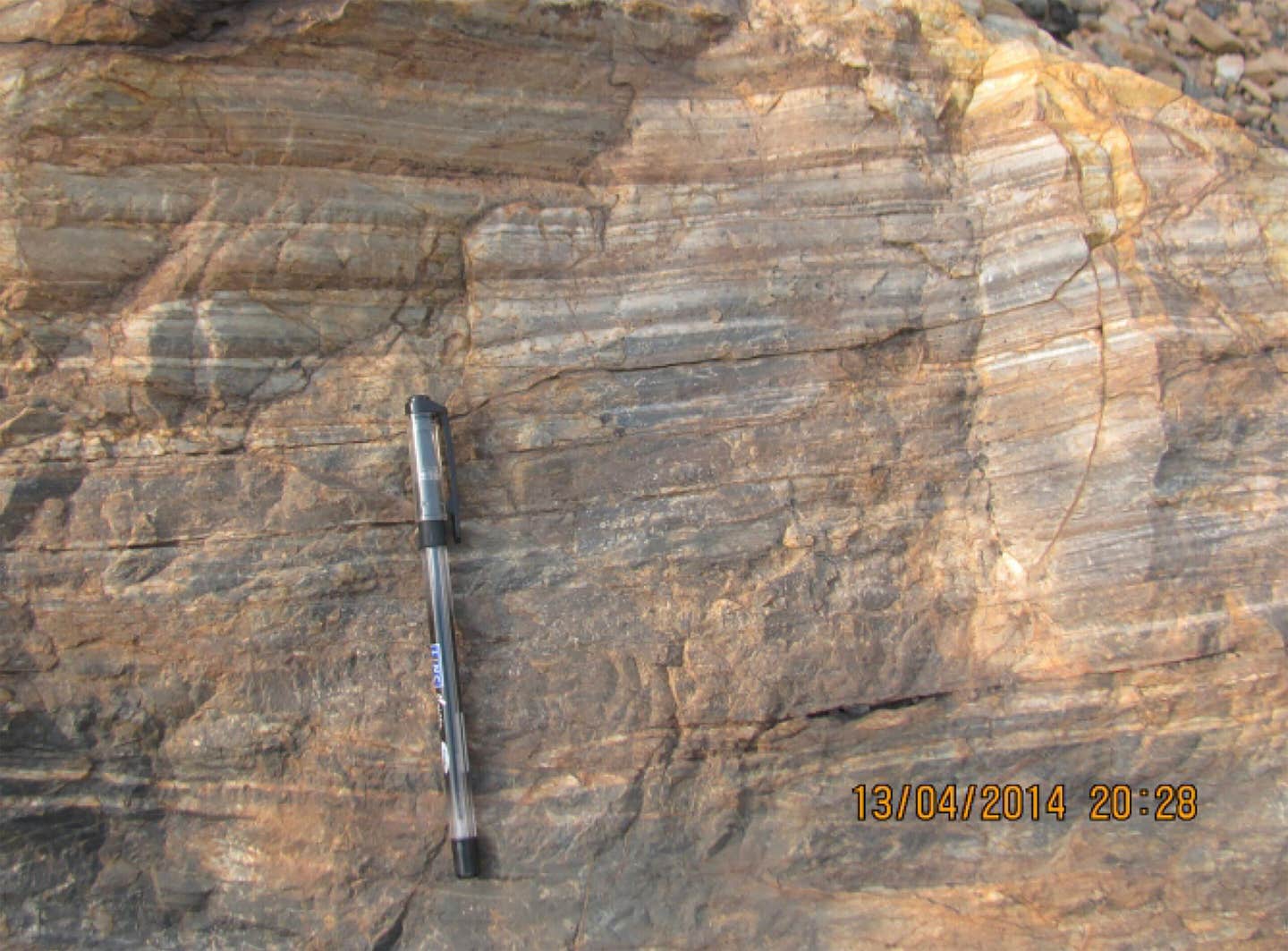
Outcrop photo of carbonaceous chert. 3.5-billion-year-old chert in India preserves carbon and layered structures that researchers link to early microbial life. (CREDIT: Chaudhuri et al., PNAS)
- A 3.5-billion-year-old rock formation in eastern India may preserve chemical and layered traces of some of Earth’s earliest microbial communities.
- Carbon isotope measurements, microscopic layers and the structure of preserved organic material all point toward a biological origin.
- The claim still needs independent testing, but the rock could give scientists a better-dated record of when early microbial ecosystems were already established.
A 3.5 billion-year-old band of black-and-white rock in eastern India may preserve traces of some of Earth’s earliest microbial communities. The key clues are not fossils with recognizable shapes, but thin carbon-rich layers, ancient zircons and chemical signatures locked inside chert.
The rock comes from the Singhbhum Craton. In a study published in the Proceedings of the National Academy of Sciences, the team describes a carbon-rich chert from the Bhitardari area that dates to about 3.497 billion years ago.
That age matters because evidence for life this far back is difficult to verify. Earth formed about 4.5 billion years ago, but its oldest rocks have endured heat, deformation and chemical alteration. Those changes can create structures or carbon signatures that resemble biological remains.
“Preservation of Paleoarchean microbial mats is rare due to subsequent deformation and metamorphism. Thus, careful identification is required as abiotic processes may generate ‘biomarker-like’ signatures,” geologist Trisrota Chaudhuri of the Geological Survey of India said.
Carbon layers point toward ancient microbial mats
The Bhitardari chert contains repeating microscopic layers rich in either silica or carbonaceous material. The researchers interpret those alternating bands as microbial mat-like laminations. Microbial mats are layered communities of microorganisms that can build up on sediment surfaces.
The carbon is especially important. Biological carbon-fixing processes often favor carbon-12 over the heavier carbon-13 isotope. That preference can leave organic material with a distinct isotopic signature.
After chemical treatment, the researchers measured a carbon isotope value of about −30.9 per mille in the carbonaceous material. They say that value falls within the range commonly associated with Archean organic carbon and is consistent with biological carbon fixation.
The team also used Raman spectroscopy to examine how ordered the carbon structure had become. Matrix-hosted carbon remained relatively disordered, which is characteristic of metamorphosed kerogen rather than fully transformed graphite.
Kerogen is a solid mixture of organic compounds preserved in sedimentary rock. Its survival matters because extreme heating can erase or heavily alter biological chemical signals.
Heat altered the rock, but not all carbon equally
Raman measurements indicate the matrix carbon reached an average peak temperature of about 338 degrees Celsius. That is consistent with lower greenschist-facies metamorphism.
Carbon inside later quartz veins told a different story. Those flakes were more graphitic and recorded roughly 528 to 639 degrees Celsius.
That contrast helped the researchers separate two episodes in the rock’s history. The less ordered carbon remained trapped in the chert matrix, while later fluids and deformation promoted stronger graphitization along veins.
The team also tested surface and deeper portions of the sample to check whether polishing had artificially damaged the carbon structure. The measurements closely overlapped, suggesting the disorder was an original feature of the carbonaceous material rather than a preparation artifact.
“Collectively, the Raman data indicate preservation of syngenetic, poorly ordered Archean kerogen within the siliceous matrix, subsequently overprinted by localized hydrothermal graphitization along veins,” the study states.
Tiny zircons provide a direct clock
Dating rocks that may contain ancient life is often complicated because the biological material itself cannot be dated directly. Here, the team recovered zircon crystals only about 40 to 60 micrometers long from the chert.
Four concordant zircons produced ages of 3.471, 3.492, 3.498 and 3.510 billion years. Together, they yielded a weighted mean age of 3.497 billion years, with an uncertainty of 5 million years.
The zircons also showed features consistent with a magmatic origin. Their shapes, internal zoning and association with tuffaceous sediments led the team to interpret them as volcanic material deposited while the chert formed.
That interpretation links the carbon-bearing layers to a specific depositional age rather than only to a nearby rock unit. The authors describe the sample as, to their knowledge, the oldest directly dated rock with a confirmed biosignature.
Still, that conclusion will likely draw close scrutiny. Ancient-life claims often depend on whether the dated minerals truly formed at the same time as the sediment and whether later geological activity could have altered the apparent biological signal.
A volcanic marine setting for early life
The chert sits within a sequence that also contains banded iron formation, volcanic tuff, phyllite, quartzite and conglomerate. The researchers interpret that combination as evidence of a volcanically active marine basin influenced by hydrothermal activity.
Such an environment contained silica-rich, iron-rich and oxygen-poor water. Hydrothermal fluids could have supplied reduced chemicals and nutrients while rapid silica precipitation helped entomb organic material.
The Bhitardari rocks also resemble other ancient carbon-bearing cherts from South Africa and Western Australia. Those sites have produced some of the most debated evidence for early microbial ecosystems.
The carbon isotope results add another line of evidence. The researchers note that different microbial carbon-fixing pathways create different isotope patterns. Their measured value is most consistent with biological processes, including pathways related to the Calvin cycle and acetyl-CoA carbon fixation.
The nitrogen isotope measurement was not reliable enough to interpret because the sample contained too little nitrogen.
Practical implications of the research
The Bhitardari chert gives researchers a rare chance to connect a possible biosignature directly with a dated volcanic and sedimentary setting. That could help refine the timeline for when microbial ecosystems were already established on Earth.
The multiproxy approach may also offer a stronger way to test other disputed ancient-life claims. Combining direct zircon dating, carbon isotopes, rock structure and Raman measurements can help separate original organic matter from later geological overprinting.
Independent work will still be important. Future studies can test whether the zircons truly date chert deposition, examine nearby layers for additional microscopic or chemical traces, and determine whether the biological interpretation holds across the wider rock sequence.
If those tests support the current findings, the Singhbhum Craton would preserve a particularly well-dated window into microbial life nearly 3.5 billion years ago, when volcanic activity, iron-rich seawater and rapid silica deposition shaped some of Earth’s earliest habitable environments.
Dig deeper into early life and Archean microbial ecosystems
These resources examine how scientists identify early life in ancient rocks, test whether biosignatures are truly biological, and reconstruct microbial ecosystems from Earth’s first billion years.
Biosignatures and tests of biogenicity in the early rock record
This 2026 review examines the main types of Archean biosignatures, including microfossils, stromatolites, isotopes and organic matter, while emphasizing how metamorphism and abiotic processes can mimic evidence of life. (The Archean Earth, 2026)
Insights from early life in the 3.45-Ga Kitty’s Gap Chert for the search for elusive life in the Universe
Researchers analyzed 3.45-billion-year-old volcanic sediments from Western Australia to assess ancient microfossils and the difficulty of proving that microscopic structures and chemical traces are both biological and original to the rock. (Nature Astronomy, 2025)
Co-evolution of early Earth environments and microbial life
This review combines geological, geochemical and evolutionary evidence to examine how early microbial life developed alongside major changes in Earth’s oceans, atmosphere and surface chemistry. (Nature Reviews Microbiology, 2024)
Aspects of the biological carbon cycle in a ca. 3.42-billion-year-old marine ecosystem
Analysis of the ancient Buck Reef Chert found evidence for multiple microbial carbon-processing pathways, suggesting that relatively diverse biological carbon cycling was already operating about 3.42 billion years ago. (Precambrian Research, 2024)
Signatures of early microbial life from the Archean (4 to 2.5 Ga) eon
This comprehensive review evaluates carbonaceous matter, microbial mats, stromatolites, microfossils and isotope signatures across the Archean record, while distinguishing stronger evidence from controversial claims of extremely ancient life. (Earth-Science Reviews, 2020)
Research findings are available online in the journal PNAS.
The original story "3.5 billion-year-old rock in India may hold evidence of early microbial life" is published in The Brighter Side of News.
Related Stories
- Ancient fossils suggest complex life got its start on an oxygenated seafloor
- AI uncovers Earth's earliest life from 3.3 billion years ago
- Life depended on a rare metal for survival - billions of years ago
Like these kind of feel good stories? Get The Brighter Side of News' newsletter.
Joshua Shavit
Writer and Editor
Joshua Shavit is a NorCal-based science and technology writer with a passion for exploring the breakthroughs shaping the future. As a co-founder of The Brighter Side of News, he focuses on positive and transformative advancements in technology, physics, engineering, robotics, and astronomy. Having published articles on AOL.com, MSN, Yahoo News, and Ground News, Joshua's work highlights the innovators behind the ideas, bringing readers closer to the people driving progress.