
Scientists create a molecular Archimedes screw that turns electric current into rotation and back again
Researchers built a single-molecule rotor inspired by the Archimedes screw. Its rotation can increase electrical conduction by up to a hundredfold.

 Editor: Joseph Shavit

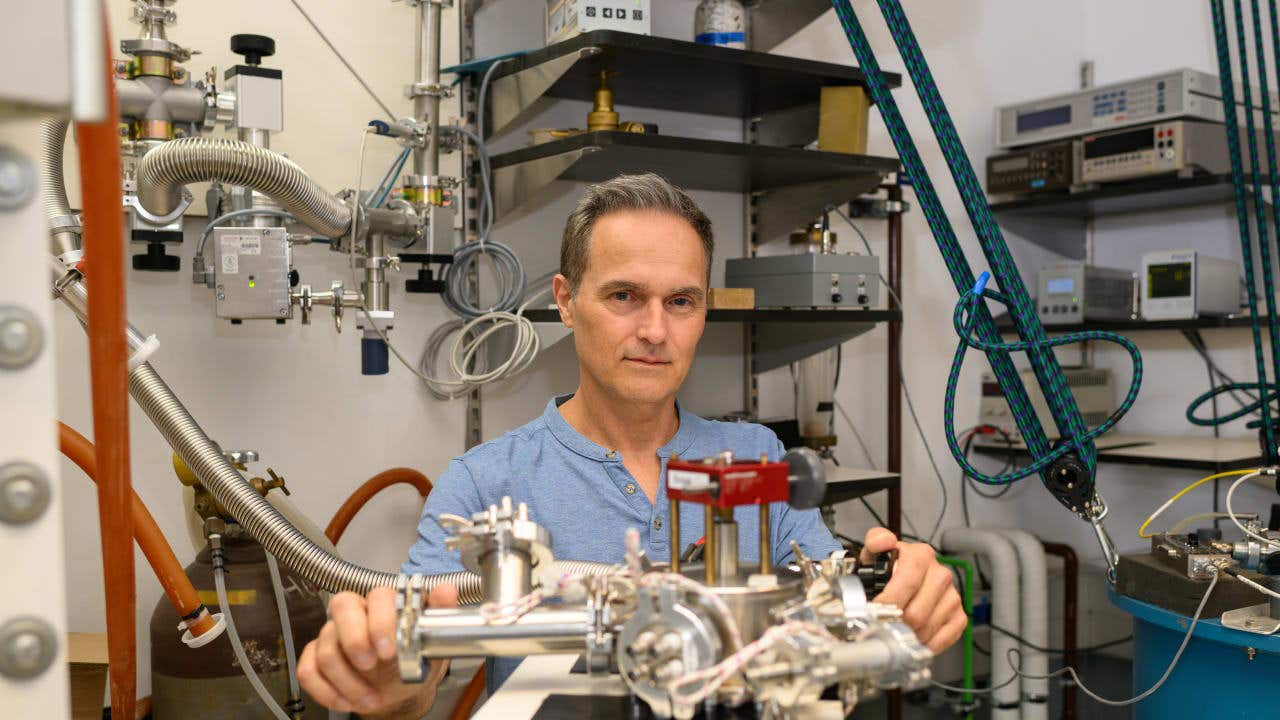
Prof. Oren Tal. A molecular Archimedes screw spins under electric current and boosts conductivity by up to 100 times in a cryogenic experiment. (CREDIT: Weizmann Institute of Science)
More than 2,000 years after the Archimedes screw began lifting water, a single molecule has recreated its central idea at a scale almost impossible to see. Researchers at the Weizmann Institute of Science and their international collaborators built a helical molecular rotor that spins when an electric current passes through it.
The movement does something unexpected. As the molecule rotates, it opens more conductive configurations for electrons, causing the current to rise by as much as a hundredfold. The result is a two-way relationship: electricity drives the motion, and the motion improves the flow of electricity.
The study, published in Nature, describes a prototype for a new class of torque-driven molecular machines. It does not present a finished nanoscale motor or a commercial technology. Instead, it shows that a single molecule can act at once as an electrically driven rotor and as a moving electrical switch.
The project brought together experimental physics, synthetic chemistry and quantum-mechanical modeling. Collaborators in Germany, Denmark and China helped make the custom molecules and explain how current-generated forces could produce both rotation and the conductance increase.
A two-way machine at molecular scale
The researchers suspended one helical organic molecule between two gold electrodes inside a super-cooled vacuum chamber. The molecule was roughly a million times narrower than the width of a human hair, so connecting it to an electrical circuit required a remarkably precise setup.
The team began with a thin gold wire and broke it under extreme conditions, producing two atomically sharp tips. By bringing those tips within a fraction of a nanometer, the researchers created a gap that a single molecule could bridge. Similar nanoscale materials research depends on controlling connections that are only a few atoms wide.
When the scientists applied a voltage, the current did not remain smooth. It rose and fell in cyclical jumps. The order of those jumps showed that the molecule was rotating in one direction rather than simply vibrating randomly.
Reversing the direction of the current reversed the sequence of jumps. That result indicated that the molecule also reversed its direction of rotation, giving the machine a form of electrical steering.
From stop-and-go motion to a current surge
The most striking change appeared when the researchers increased the voltage beyond a particular threshold. The current suddenly increased by up to a hundred times, a much larger response than the small stepwise changes seen at lower voltages.
The team’s calculations suggest that the molecule changes how it moves at this point. Instead of rotating through separate, sequential jumps, it begins to turn continuously. That smooth motion lets the molecule reach physical arrangements that conduct electricity more efficiently than the configurations available when it is standing still.
In other words, the current does not simply push a rotor while the electrical properties remain fixed. The rotation changes the rotor’s electrical landscape. The finding adds to research on motion-sensitive electronics, where mechanical behavior and electronic signals are measured together.
“We also discovered that the threshold at which the current starts to increase sharply can be controlled by stretching or compressing the molecule, much like changing the angle of the blades in a turbine,” Oren Tal shared with The Brighter Side of News.
That mechanical control is important because the rotor’s behavior can be adjusted without changing its chemical identity. Moving the gold electrodes by less than 0.1 nanometer changed the distance between them and altered the voltage at which the current began to surge.
A different kind of molecular motor
Earlier electrically powered molecular motors generally used a stop-and-go strategy. Bursts of energy pushed a molecule into a higher-energy state, and the molecule’s return to a lower-energy state favored movement in one direction. The process resembles a microscopic ratchet, where a series of separate steps produces net rotation.
The new machine works differently. According to Tal, the current itself transfers momentum directly to the molecule. The moving electrons exert torque, the turning effect of a force, and the asymmetric helical structure converts that torque into directional rotation.
The distinction matters because it links the machine’s motion to the same current that measures its operation. A molecular sensor might detect a chemical or physical change through its electrical response, but this rotor actively changes the response as it moves.
The molecule’s handed, or chiral, shape also helps establish a preferred direction. When the voltage polarity changes, the direction of rotation changes with it. The researchers observed a fully directional response in the tested operating regime, rather than a mixture of clockwise and counterclockwise motion.
What the experiment does and does not show
The experiment demonstrates a physical mechanism, not a working component that can be installed in ordinary electronics. The molecule operated at 4.2 kelvin, about minus 269 degrees Celsius, just above absolute zero. Such extreme cooling suppresses thermal vibrations that would otherwise overwhelm the small electrical and mechanical signals.
The researchers also worked with one molecule connected between carefully prepared electrodes. A practical device would need many rotors, reliable electrical connections and a controlled orientation so that their movements added together instead of canceling out.
Tal said the team hopes to test the torque-driven effect at room temperature and examine a wider range of helical molecules. Those experiments could reveal how molecular shape affects rotation speed, force transfer and the size of the conductance increase. The work joins a broader effort to make nanoscale devices that combine several functions in a very small space.
Possible applications include molecular pumps, nanoscale switches and highly sensitive sensors. The researchers have also suggested optical control using circularly polarized light, or electrical control based on spin-polarized currents. Each idea remains a future direction rather than a demonstrated product.
An old machine with a new future
The Archimedes screw is useful because its geometry turns rotation into the movement of material. A spiral blade can lift water, move grain or transfer other bulk substances. In reverse, flowing water can turn the screw and generate electricity, giving the same basic structure two directions of operation.
The molecular rotor follows that same logic, but the transported quantity is not water. Electrons provide the force that turns the helical molecule, and the moving molecule changes how readily those electrons pass. The scale is different, yet the central idea remains recognizable: flow and rotation reinforce each other.
The immediate importance of the work is therefore conceptual. It gives nanotechnology a new way to couple mechanical motion and electrical conduction inside one molecular machine. Whether large arrays of such rotors can operate together, at useful temperatures and with a practical output, is the question that will determine whether the ancient screw has truly found a place in future electronics.
Historical milestones and applications of the Archimedes screw
The device is traditionally associated with Archimedes, who is believed to have described or improved a water-lifting screw in the third century BCE. Its spiral blade trapped water in a channel and moved it upward as the shaft turned, making it useful for irrigation and drainage.
Ancient engineers used related screw mechanisms to remove water from mines, wetlands and the holds of ships. Over time, the same principle was adapted to move grain, sand, gravel and other materials that were difficult to lift with buckets or solid conveyors.
The screw later gained a second major role when engineers reversed its operation. Flowing water could turn the spiral, allowing an Archimedean screw turbine to produce hydroelectric power at sites where conventional turbines were poorly suited to shallow or slow-moving water. Modern designs can also be gentler on fish than some high-speed turbine systems.
Today, Archimedes screws appear in wastewater treatment, flood control, irrigation, small hydropower stations and industrial material handling. The new molecular version extends that history into electronics, where a helical structure no longer lifts water or spins in a river. Instead, it uses the movement of electrons to turn a rotor and then uses that rotation to reshape the current.
Research findings are available online in the journal Nature.
The original story "Scientists create a molecular Archimedes screw that turns electric current into rotation and back again" is published in The Brighter Side of News.
Related Stories
- Is interstellar object 3I/ATLAS an alien probe? Harvard physicist sparks debate
- Scientists link dark energy to alien life in the multiverse
- Scientists propose simple new way to spot alien life in the universe
Like these kind of feel good stories? Get The Brighter Side of News' newsletter.
Joshua Shavit
Writer and Editor
Joshua Shavit is a NorCal-based science and technology writer with a passion for exploring the breakthroughs shaping the future. As a co-founder of The Brighter Side of News, he focuses on positive and transformative advancements in technology, physics, engineering, robotics, and astronomy. Having published articles on AOL.com, MSN, Yahoo News, and Ground News, Joshua's work highlights the innovators behind the ideas, bringing readers closer to the people driving progress.