How long could you survive in our solar system without a spacesuit?
Mars looks familiar, but its thin air makes it immediately dangerous. Titan and the clouds of Venus offer a surprising contrast. Here’s what pressure, oxygen and temperature mean for survival across the solar system.

 Editor: Joshua Shavit

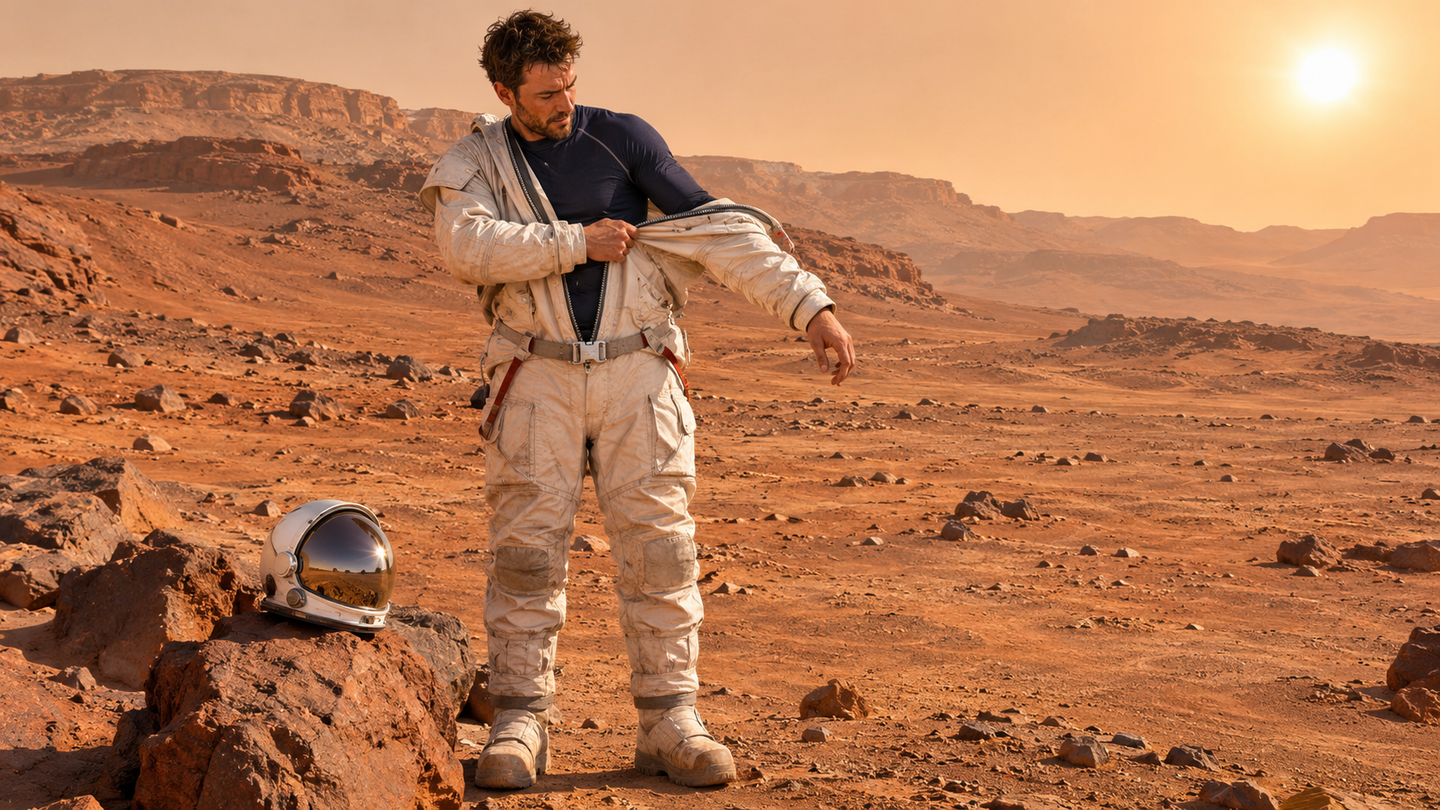
An artist’s rendering shows an astronaut peeling off his spacesuit on a sunlit Martian plain. (CREDIT: The Brighter Side of News)_
Here's a question for you. If you could travel anywhere in our solar system and step outside without a spacesuit, how long would you actually survive?
Would you freeze instantly? Would your blood boil? Would the pressure crush you? And is there anywhere beyond Earth where you could stand outside without wearing a pressure suit?
The answer might surprise you, because temperature isn't always your biggest problem. In many cases, you'd lose consciousness long before the temperature became an issue.
Human survival depends on a surprisingly delicate balance between atmospheric pressure, oxygen, temperature and the rate at which our bodies gain or lose heat. Change any one of those conditions significantly, and things can go wrong rather quickly.
Yet somewhere in our solar system, there's a world where you could theoretically walk around without a pressure suit. There's another where the very air you breathe could keep you floating above the clouds.
Neither is Mars.
Although, if I asked everyone in this room to choose a planet where they'd have the best chance of surviving outside Earth, I suspect quite a few of you would pick Mars.
It's a reasonable choice. Unfortunately, it wouldn't buy you much time.
Mars: A deceptively familiar world
Photographs from the Martian surface show rocky hills, dusty plains and landscapes that wouldn't look entirely out of place in some of Earth's deserts.
On a summer afternoon near the equator, temperatures can even reach a comfortable 20 degrees Celsius, or 68 degrees Fahrenheit.
Sounds rather pleasant, doesn't it?
Unfortunately, atmospheric pressure on Mars is less than 1 percent of Earth's. And there's a threshold in atmospheric science that helps explain why this is such a serious problem.
It's called the Armstrong limit.
Approximately 19 kilometers, or 12 miles, above Earth's surface, atmospheric pressure becomes so low that exposed water can boil at normal human body temperature.
Mars lies well beyond that threshold.
Without a pressure suit, moisture on your tongue and eyes could begin boiling, even though the surrounding environment might be relatively cold. Your body would begin swelling, and the lack of oxygen would quickly affect your brain.
Mars does have one particularly beautiful feature that distinguishes it from Earth. Its sunsets are blue. Fine atmospheric dust scatters sunlight in such a way that the sky immediately surrounding the setting sun takes on a blue glow.
NASA's Curiosity rover photographed one of these sunsets in 2015.
Unfortunately, you wouldn't have much time to appreciate it.
On Mars, you would likely remain conscious for approximately 10 to 15 seconds. Without emergency repressurization and oxygen, you could die within a few minutes.
The Moon: Why you wouldn't freeze instantly
Twelve people have walked on the Moon. We've seen astronauts bouncing across its surface, collecting rocks and driving vehicles. That familiarity might make the lunar environment seem somewhat less threatening.
Take away their spacesuits, however, and the situation changes dramatically.
We've all seen movies where someone gets exposed to the vacuum of space and immediately freezes solid. In reality, losing heat in a vacuum is more complicated than that.
Think about the thermos you might use to keep your coffee warm. Between its walls is a vacuum, which helps prevent heat from escaping. The absence of surrounding air limits the ways thermal energy can move from one place to another.
The same principle applies to your body in space.
On the Moon, surface temperatures reach approximately 120 degrees Celsius in sunlight and fall to minus 130 degrees at night. Despite those extremes, oxygen deprivation would cause you to lose consciousness long before you froze solid.
There's an important distinction here between how long you remain conscious and how long you might survive with emergency assistance.
On the Moon, you'd probably remain conscious for 10 to 15 seconds. Without rescue, continued exposure to the vacuum could become fatal within a few minutes.
We actually have some evidence of what happens to a human body under these conditions. It comes from an accident that occurred during NASA's early space program.
Mercury: When heat isn't your biggest problem
Mercury's daytime surface temperature can reach approximately 430 degrees Celsius, or 806 degrees Fahrenheit. That's considerably hotter than most household ovens.
Most people would probably assume that the heat would kill them first.
But Mercury has virtually no atmosphere. Stepping onto its surface without protection would expose your body to a near-perfect vacuum.
In December 1966, NASA engineer Jim LeBlanc was testing a spacesuit inside a vacuum chamber in Houston when a hose became disconnected. His suit lost pressure almost immediately.
LeBlanc remained conscious for approximately 14 seconds. His last memory before blacking out was the sensation of saliva bubbling on his tongue.
Fortunately, his colleagues quickly restored pressure inside the chamber. He regained consciousness and recovered.
What's particularly interesting about this incident is how different it was from the way Hollywood typically portrays exposure to space. Your body doesn't explode. Your blood doesn't suddenly boil throughout your circulatory system.
Instead, the immediate problem is oxygen deprivation.
Mercury also contains one of the more unexpected geographical features in our solar system. Despite being so close to the sun, there are deposits of water ice inside permanently shadowed craters near its poles.
A planet hot enough to melt lead in some locations contains frozen water in others.
On Mercury, you would likely lose consciousness within 10 to 15 seconds and die within a few minutes without rescue. Direct contact with extremely hot surfaces could cause serious injuries even sooner.
Strangely enough, traveling billions of kilometers in the opposite direction, toward one of the coldest worlds in our solar system, wouldn't significantly improve your prospects.
Pluto: Extreme cold, but a familiar danger
Although Pluto is no longer officially classified as a planet, leaving it out would mean overlooking one of the most fascinating landscapes in our solar system.
When NASA's New Horizons spacecraft flew past Pluto in 2015, it revealed an enormous heart-shaped plain of frozen nitrogen, mountains made of water ice and delicate layers of blue atmospheric haze.
At approximately minus 230 degrees Celsius, or minus 382 degrees Fahrenheit, water ice becomes as hard as rock.
Pluto does have an atmosphere, although its surface pressure is roughly one hundred-thousandth of Earth's. For practical purposes, you'd once again be exposed to a near-vacuum.
There's something rather beautiful about Pluto, though. The sun is so distant that midday there is comparable in brightness to Earth shortly after sunset.
Even at noon, the landscape exists in a kind of perpetual twilight.
Consider the contrast between Mercury and Pluto. One is hot enough to melt lead. The other is cold enough to turn nitrogen into solid ground.
Yet the immediate threat to human survival is essentially the same.
On Pluto, you'd probably remain conscious for around 10 to 15 seconds and survive only a few minutes without emergency assistance. Oxygen deprivation would incapacitate you long before your entire body froze.
At least all these destinations have something solid beneath your feet. The giant planets introduce a completely different problem.
Uranus: The coldest planetary atmosphere
Considering how much we know about our solar system, it's remarkable that only one spacecraft has ever visited Uranus.
Voyager 2 flew past the planet in 1986. Much of what we've observed up close comes from that single encounter.
Uranus holds the record for the coldest measured planetary atmosphere, with temperatures reaching minus 224 degrees Celsius, or approximately minus 371 degrees Fahrenheit.
Astronomers discovered something rather unpleasant in its upper clouds in 2018: hydrogen sulfide, the chemical responsible for the smell of rotten eggs.
Not exactly the sort of atmosphere you'd want to take a deep breath in.
But perhaps the most unsettling aspect of visiting Uranus is that there's nowhere to stand. The planet has no accessible solid surface.
Without protection, you'd descend through an atmosphere consisting primarily of hydrogen and helium. As you fell deeper, the surrounding pressure would increase, eventually reaching levels your body couldn't tolerate.
Unlike the vacuum of space, the surrounding gases would also draw heat away from your body.
On Uranus, you could lose consciousness within seconds to tens of seconds, depending on your altitude and exposure conditions. Without oxygen or rescue, survival would likely be limited to minutes or less.
Interestingly, Uranus isn't necessarily the most violent of the outer planets. That distinction, at least when it comes to wind speed, belongs to its more distant neighbor.
Neptune: Winds faster than sound
You might expect a planet receiving so little energy from the sun to be relatively quiet.
Neptune is anything but.
Voyager 2 reached the planet in 1989, three years after its encounter with Uranus. Neptune possesses the fastest planetary winds in our solar system, exceeding 2,000 kilometers per hour, or approximately 1,240 miles per hour.
That's faster than the speed of sound here on Earth.
Like Uranus, Neptune has no accessible solid surface or breathable atmosphere. Falling through its atmosphere would expose you to extreme temperatures, increasingly intense pressure and potentially violent turbulence.
Perhaps the most fascinating possibility lies deep beneath its clouds.
Laboratory experiments suggest that the enormous pressures inside Neptune and Uranus could transform carbon into diamonds. There may actually be diamonds falling through the interiors of these planets like rain.
Nobody has directly observed this phenomenon, but experiments suggest the physics could allow it.
Unfortunately, you wouldn't survive long enough to find out.
On Neptune, consciousness could last only seconds to tens of seconds. Death could follow within minutes or sooner, depending on atmospheric conditions and physical injuries.
Neptune's winds are extraordinary, but violent weather isn't restricted to the coldest regions of our solar system. One of the most beautiful planets we've ever photographed experiences storms larger than Earth itself.
Saturn: When a hurricane seems mild
Think about the strongest hurricane you've ever seen on television. Trees bending sideways, buildings losing their roofs, debris flying through the air.
Now consider that winds near Saturn's equator can reach approximately 1,800 kilometers per hour. That's around five times faster than the strongest hurricane winds recorded on Earth.
NASA's Cassini spacecraft observed enormous storms producing extraordinarily powerful lightning.
Oddly enough, despite its enormous size, Saturn's average density is lower than that of water.
On September 15, 2017, after spending 13 years studying the planet, NASA deliberately directed Cassini into Saturn's atmosphere. The spacecraft continued transmitting information during its final descent before disintegrating.
An unprotected human would face oxygen deprivation, extreme cold and increasingly hostile atmospheric conditions. There would be no solid ground to land on, either.
Those spectacular rings might make Saturn look inviting, but the planet beneath them is anything but peaceful.
On Saturn, you could lose consciousness within seconds to tens of seconds. Without protection, you would likely die within minutes or less as oxygen deprivation and increasingly hostile atmospheric conditions overwhelmed your body.
And as enormous as Saturn is, there's another planet whose size, gravity and atmospheric pressure make the prospect of falling into it particularly unsettling.
Jupiter: A fall with no landing
One of the more difficult things to appreciate about Jupiter is that those beautiful photographs don't really show a planetary surface. They show the tops of clouds.
Jupiter is more than 11 times wider than Earth and consists primarily of hydrogen and helium.
Near its cloud tops, you would weigh approximately two and a half times what you weigh here. The temperature would be around minus 145 degrees Celsius, or minus 229 degrees Fahrenheit.
There would also be nothing resembling breathable air.
And because Jupiter has no conventional solid surface, you'd continue falling into an atmosphere that becomes progressively hotter and denser.
NASA actually sent something into Jupiter in 1995. An atmospheric probe entered the planet at approximately 170,000 kilometers per hour before deploying a parachute and descending through the clouds.
For 58 minutes, it transmitted information back to Earth.
By the time communications ended, the temperature exceeded 150 degrees Celsius, and the atmospheric pressure was more than 20 times what we experience here.
The probe had descended only about 150 kilometers.
Much farther down, the pressure becomes so enormous that hydrogen begins behaving like liquid metal.
It's an environment almost impossible to relate to anything we encounter in everyday life.
On Jupiter, you'd likely lose consciousness within seconds to tens of seconds. Without rescue, survival would probably be limited to minutes or less. Increasing atmospheric pressure and temperature would make any continued descent fatal.
So far, none of these worlds has offered much hope for unprotected human survival. But orbiting Saturn is a world that changes the conversation considerably.
Titan: The first real possibility for extended survival
Saturn's largest moon, Titan, is a rather extraordinary place. Beneath its thick orange atmosphere are lakes of liquid methane, frozen landscapes and rain that falls more slowly than it does here on Earth.
In January 2005, the European Huygens spacecraft spent approximately two and a half hours descending through that orange haze. It eventually landed on a plain scattered with frozen pebbles, completing the most distant spacecraft landing in history.
But the most interesting thing about Titan, at least from the perspective of human survival, is its atmospheric pressure.
At the surface, it's approximately one and a half times Earth's. Your body could tolerate that pressure without a conventional pressure suit.
No boiling saliva. No sudden decompression.
For the first time, we're discussing a solid world beyond Earth where atmospheric pressure itself wouldn't immediately threaten your survival.
Of course, there are a couple of fairly significant complications. Titan's nitrogen-rich atmosphere contains no breathable oxygen, and its surface temperature is approximately minus 179 degrees Celsius, or minus 290 degrees Fahrenheit.
Unlike the vacuum of space, Titan's thick atmosphere would also draw heat away from your body rapidly.
Planetary scientist Chris McKay has suggested that humans could theoretically explore Titan using breathing equipment and sufficiently effective thermal protection rather than conventional pressure suits.
We're not talking about an ordinary winter coat here. The protection would have to withstand temperatures far beyond anything humans encounter naturally on Earth.
Still, the possibility is fascinating.
Picture yourself standing beneath an orange sky, looking across an enormous lake of liquid methane, wearing specialized thermal clothing and breathing equipment rather than a pressurized spacesuit.
Without any protection, you would likely lose consciousness within seconds to tens of seconds and die within minutes or less. With adequate thermal protection and a continuous supply of breathable air, however, you could theoretically survive for hours or longer without a pressure suit.
That's a considerable improvement over the other worlds we've discussed.
But what if we could find somewhere with tolerable atmospheric pressure, relatively comfortable temperatures and gravity similar to Earth's?
Remarkably, such a place exists on what might otherwise be considered the deadliest planet in our solar system.
Venus: From the worst environment to the surprising winner
If I told you that Venus might offer the best environment for human survival beyond Earth, you'd probably think I'd made a mistake.
After all, Venus has a reputation for being something of a planetary hell.
From a distance, it looks rather beautiful. It's almost the same size as Earth, wrapped in thick, pale yellow clouds that conceal virtually everything beneath them.
Standing on its surface would be an entirely different experience.
At approximately 465 degrees Celsius, or 869 degrees Fahrenheit, the surface is hot enough to melt lead. The atmosphere consists almost entirely of carbon dioxide and presses down with roughly 90 times Earth's atmospheric pressure.
That's comparable to being nearly a kilometer beneath the ocean.
You might expect the pressure to be your biggest concern. But the heat presents an immediate threat, partly because the atmosphere is so dense. It transfers thermal energy into your body far more efficiently than the air inside your kitchen oven.
We have some idea of how unforgiving this environment is because, in 1982, the Soviet Union managed to land a spacecraft there.
Venera 13 transmitted the first color photographs of the Venusian surface. Engineers expected it to survive for just 32 minutes.
It lasted two hours and seven minutes.
And that was a machine specifically engineered to withstand those conditions.
An unprotected human could become incapacitated within seconds. The combination of extreme heat, carbon dioxide exposure and enormous atmospheric pressure could make death exceptionally rapid, although no reliable estimate exists for the exact time.
So how could Venus possibly be the winner?
The answer lies about 50 to 55 kilometers above its surface.
At those altitudes, something remarkable happens. Atmospheric pressure approaches what we're experiencing in this room. Temperatures become considerably more manageable, and gravity is approximately 90 percent of Earth's.
NASA researchers have described this region as one of the most Earth-like environments anywhere in our solar system outside Earth itself.
There's an interesting bit of physics involved here, too.
Venus's atmosphere consists primarily of carbon dioxide, which is denser than the ordinary mixture of gases we breathe. Consequently, a sufficiently large balloon filled with breathable air could float through the Venusian atmosphere.
The very air keeping you alive could also keep you suspended above the planet.
NASA has explored this possibility through a mission concept called the High Altitude Venus Operational Concept, or HAVOC. It involves airships floating through the planet's atmosphere.
Think about what that would mean.
You could potentially stand on the platform of a floating habitat without wearing a conventional pressure suit. You wouldn't have to contend with Titan's extraordinary cold or Mars' dangerously low atmospheric pressure.
You'd still need breathing equipment and protection against sulfuric acid droplets in the clouds. But those are very different engineering challenges from maintaining an entirely pressurized environment around your body.
With a sufficiently protected floating habitat, humans could theoretically remain there for extended periods.
Days, months or potentially years, provided the habitat could continuously meet their needs.
On the surface of Venus, you could become incapacitated within seconds. In its upper atmosphere, without breathing equipment, you would still succumb to oxygen deprivation and carbon dioxide exposure. With breathable air, chemical protection and a floating platform, however, extended human survival could theoretically be possible without a conventional pressure suit.
That makes the upper atmosphere of Venus arguably the most promising environment beyond Earth for surviving without a pressure suit, even though its surface is among the least survivable.
The extraordinary privilege of living on Earth
What's particularly striking about all these environments is how poorly our intuition sometimes agrees with the physics.
Mars resembles a terrestrial desert, yet its atmosphere is dangerously thin. Titan has lakes and rain made of methane, yet its atmospheric pressure is something our bodies could tolerate. Venus has a surface capable of melting lead, but relatively comfortable pressures and temperatures exist high above it.
Of course, even here on Earth, human survival is restricted to a surprisingly narrow range of conditions.
Travel approximately 19 kilometers above the surface, beyond the Armstrong limit, and your body begins encountering some of the same problems it would experience on Mars.
Half of Earth's atmospheric mass lies below an altitude of just 5.5 kilometers.
That's not very much when you consider the size of our planet.
From the International Space Station, the atmosphere appears as little more than a faint blue line surrounding Earth. It's easy to overlook in photographs, yet that thin layer provides the pressure and oxygen our bodies depend upon.
Across our solar system, there are planets hot enough to melt lead, winds faster than sound, possible diamond rain and mountains made of water ice. There are lakes filled with liquid methane and clouds where breathable air could keep an entire habitat floating.
Some worlds have enough atmosphere to destroy machinery. Others have practically no atmosphere at all.
We rarely give our own atmosphere much thought. We walk outside, breathe, feel the wind against our skin and carry on with whatever we were doing.
Yet across all those extraordinary worlds, there's only one known place where you can open your front door, step outside and take a deep breath without thinking twice about it.
You're sitting on it right now.
Survival times across the solar system
Please remember that these are approximate physiological estimates, not precise countdowns. They describe sudden exposure without a spacesuit or comparable protection.
| World | Likely time conscious | Likely outcome without rescue |
| Mercury | About 10–15 seconds | Fatal within minutes; extreme surface heat adds injury risk |
| Venus, surface | Several seconds or less | Rapid incapacitation from heat, pressure and carbon dioxide |
| Earth | Indefinite under ordinary conditions | The only world in this comparison with naturally breathable air |
| Moon | About 10–15 seconds | Fatal within minutes from vacuum and oxygen deprivation |
| Mars | About 10–15 seconds | Fatal within minutes without oxygen and repressurization |
| Jupiter | Seconds to tens of seconds | Fatal within minutes as pressure and temperature rise |
| Saturn | Seconds to tens of seconds | Fatal within minutes from oxygen loss and atmospheric conditions |
| Uranus | Seconds to tens of seconds | Fatal within minutes or less as cold and pressure overwhelm the body |
| Neptune | Seconds to tens of seconds | Fatal within minutes or sooner, depending on descent and injuries |
| Titan | Seconds to tens of seconds | Fatal within minutes without oxygen and thermal protection; with both, survival could last hours or longer |
| Pluto | About 10–15 seconds | Fatal within minutes from vacuum and oxygen deprivation |
| Venus, upper atmosphere | Not applicable with a protected habitat | Extended survival could theoretically be possible with breathable air, chemical protection and thermal control |
The original story "How long could you survive in our solar system without a spacesuit?" is published in The Brighter Side of News.
Related Stories
- To the Moon and beyond: Artemis II and humanity's reach into space
- New CPR simulator could help save astronauts in space
- First x-rays captured in space mark breakthrough for astronaut health
Like these kind of feel good stories? Get The Brighter Side of News' newsletter.
Joseph Shavit
Writer, Editor-At-Large and Publisher
Joseph Shavit, based in Los Angeles, is a seasoned science journalist, editor and co-founder of The Brighter Side of News, where he transforms complex discoveries into clear, engaging stories for general readers. With vast experience at major media companies like The Los Angeles Times, Times Mirror and Tribune Publishing, he writes with both authority and curiosity. His writing focuses on space science, planetary science, quantum mechanics, geology. Known for linking breakthroughs to real-world markets, he highlights how research transitions into products and industries that shape daily life.