After 49 years in space Voyager 1 makes history reaching one light-day from Earth
Voyager 1 has reached one light-day from Earth, a milestone that highlights both the probe’s remarkable distance and its aging systems.

 Editor: Joshua Shavit

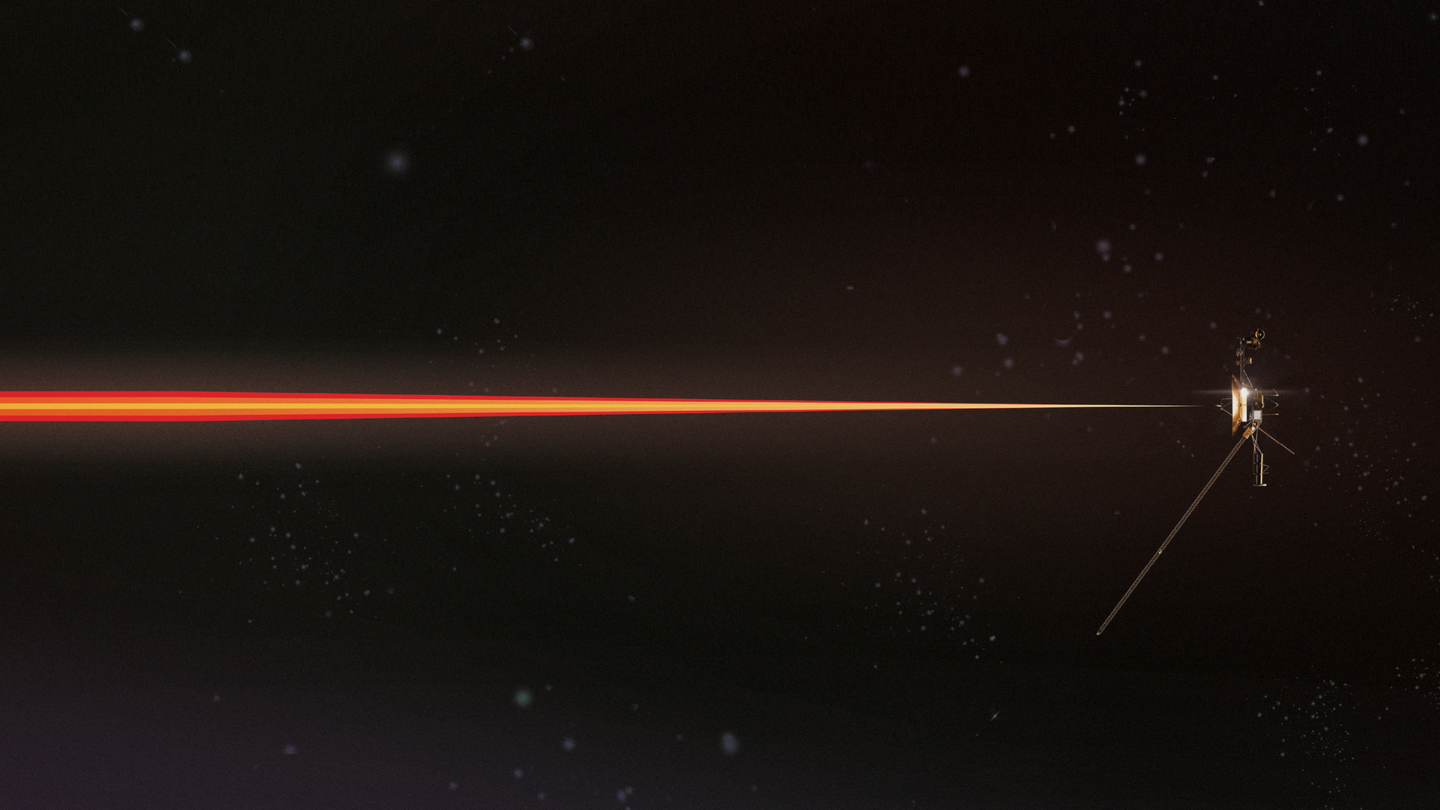
Voyager 1, depicted in this artist’s concept, reached one light-day from Earth on Nov. 18, 2026. (CREDIT: NASA/JPL-Caltech)
The Voyager 1 probe has traveled to a seemingly simple distance: 1 light-day from Earth. That happened at 2:16 a.m. Pacific Time on November 18 after the spacecraft had been flying beyond the Solar System for more than 49 years, making its signals take one whole day in either direction to traverse the gap.
A light-day is the distance that the light travels in 24 hours. On average, it equals 16.1 billion miles (25.9 billion kilometers). Although the spacecraft flies at 38,000 mph, the metric is determined based on the speed of light, representing the maximum possible rate of information transmission. For the sake of other deep-space exploration missions, even the signals flying as fast as physics allows might still require hours or days to cover the distance.
The achievement has been confirmed the next day as the scientists received the signal sent by the craft. The carrier wave used for transmitting the data and the calculations made based on it enabled the engineers at NASA's Jet Propulsion Lab (JPL), operated by the California Institute of Technology, to determine the spacecraft location and analyze the reason why the spacecraft stopped transmitting the science and engineering data on November 14.
Heliospheric measurements help to understand the kind of information that can be conveyed via a very weak signal.
Distance measured via delayed communication
Light serves as a way to describe the distances in cosmos as the distances measured by regular miles become incomprehensibly huge. In a vacuum, the light moves at 186,000 miles per second, enabling it to bridge the distance between the Earth and the Moon in about 1.3 seconds. The sunlight takes about four hours to get to Neptune from the Sun followed by a bit more than 20 hours to reach Voyager 1.
The delay influences all routine operations of the scientists. Any command sent today will not receive a reply until tomorrow morning at the earliest. Moreover, every reply sent in reply to the reply will have another delay.
While working with the signals transmitted by the spacecraft, the scientists track the solar wind and many other things at the moment when the Sun's influence is being mapped; but every decision that is made today depends on the information about the previous moments.
While the light-year equals about 5.88 trillion miles (9.46 trillion kilometers), one light-day makes up just the fraction of the distance to the next star. However, the distance gives one a good practical measure that converts communication delay in miles: Voyager 1 now is one day distance from its base. The delay plays the key role in exploring the interstellar space.
Mission transforming the understanding of the outer Solar System
The probe was launched from Cape Canaveral in the September. Just like its twin probe Voyager 2 launched a month earlier, Voyager 1 took advantage of rare alignment of the planets at the outer Solar System to get a gravity boost allowing to fly past Jupiter and Saturn.
These two probes were the first ones that were able to perform the close inspection of the two gas giants, delivering the images that changed the perception about the structure of the gas giants, their rings, and the composition of their satellites.
Among other things, at Jupiter, the probe discovered the existence of a tenuous ring and two new satellites – Thebe and Metis. At the same time, Voyager 1 saw that the satellite Io had active volcanoes, providing evidence that the processes could still be going there. Thus, this mission expanded the understanding of the nature of the planets by proving that small planets could also be alive and that the composition of the giant planets could be far more complex than what was seen with telescopes before.
Then, Voyager 1 went to the vicinity of Saturn and its satellite – Titan. The route of the spacecraft was purposefully planned to approach Titan as its thick atmosphere pushed it towards the north, out of the ecliptic plane of the Solar System. Later, Voyager 2 continued its mission to Uranus and Neptune while Voyager 1 began its extended mission to the boundary of the Solar System explored now using interstellar objects.
Into the interstellar space
In 2012, the Voyager 1 crossed the heliopause, the boundary at which the solar wind stops to exert an influence on the spacecraft and the interstellar medium takes the lead. NASA declared this event and announced the date of the crossing to be August 25, 2012 when the spacecraft was at the distance of 122 astronomical units (11 billion miles) from the Sun. That has made Voyager 1 the first man-made object reaching the interstellar space.
This border cannot be seen or even measured in any way. It can be only inferred from the changes in the charged particles and in the plasma waves recorded by the instruments carried by the probe. The data provided prove that the Sun influences the space even at distances much farther away from the planetary system.
Now, the Voyager 1 spacecraft continues to be a good target for studying the frontier area of space exploration. It is worth noting that the spacecraft cannot provide information about the whole interstellar medium because it measures just the space along the very narrow corridor. However, it shows what is happening with the solar magnetic field and with the particle flows emanating from it and changing with the increasing distance.
Engineering challenges of keeping a 49-year old spacecraft
Voyager 1 spacecraft was created for the short-time exploration and so the continuation of its work depends on the great efforts of the engineers and prudent management. It uses a radioisotope thermoelectric generator which transforms the energy produced from the decay of the plutonium into electricity. The process decreases each year the supply of electricity by about 4 watts.
Earlier this year, the engineers of Voyager 1 have switched off three instruments of the probe and substituted them by other low-power equipment. The decision has been a bit risky, but it was expected to keep the existing instruments of Voyager working until next summer when the 50th anniversary of the start of the mission happens. In many ways, the engineering challenges typical of similar spacecraft consist in maintaining the balance between the amount of power available, communications and performance of the instruments.
Also, the probe has faced clogged thrusters, problems in computer function, and occasional communications disruptions. The NASA Deep Space Network of large antennas in three spots on the Earth receives and transmits the data from the spacecraft.
The Voyager project manager at JPL, Suzanne Dodd, stated that her team keeps monitoring the health of the spacecraft on a daily basis and sending commands to the spacecraft weekly. Now each action with the spacecraft takes more time than some time ago, but maintaining the functionality of such devices requires special long-duration spacecraft engineering that is crucial for other missions in the future.
Message moving through space
Voyager 1 and Voyager 2 contain the Golden Records – gold-plated phonograph records containing the sounds and pictures picked to represent the Earth. It was meant to communicate something to aliens who would find it someday, but the encounter is still not expected anytime soon.
The mission gains the cultural meaning in addition to its scientific successes because the spacecraft has measured various parameters of the planet and the boundary of the heliosphere. Also, it bears a short message written by the people behind this spacecraft. It was reinforced by the famous Pale Blue Dot image made in 1990 showing the Earth in the sunbeam as just one tiny dot in the space.
Now, Voyager 1 continues to send signals. The current data failure may prove to be temporary or another symptom of the decreasing functional capacities of the spacecraft in its senility. However, the fact that the spacecraft reached the one-light-day distance makes it evident how huge the mission actually is. Each interaction with the device, built 49 years ago, now takes two days.
Five defining Voyager 1 discoveries and milestones
These five moments show how Voyager 1 changed planetary science long before it reached one light-day from Earth.
Entry into interstellar space: NASA determined that Voyager 1 crossed the heliopause and became the first human-made object to enter interstellar space, where it continues to sample the environment beyond the Sun’s protective bubble. (August 25, 2012)
Active volcanoes discovered on Io: Voyager 1 found the first evidence of active volcanism on a world beyond Earth, revealing that Jupiter’s moon Io is heated enough to support continuing eruptions. (March 1979)
Close encounter with Saturn and Titan: Voyager 1 returned detailed observations of Saturn and its rings, then flew close to Titan, whose atmosphere altered the spacecraft’s trajectory and sent it toward the outer edge of the solar system. (November 12, 1980)
Jupiter’s faint ring and new moons revealed: During its Jupiter encounter, Voyager 1 discovered a thin ring around the planet and identified two new moons, Thebe and Metis. (March 5, 1979)
The Pale Blue Dot photograph: From about 3.7 billion miles away, Voyager 1 photographed Earth as part of the first family portrait of the solar system, creating one of the most widely recognized images in space science. (February 14, 1990)
The original story "After 49 years in space Voyager 1 makes history reaching one light-day from Earth" is published in The Brighter Side of News.
Related Stories
- To the Moon and beyond: Artemis II and humanity's reach into space
- NASA's Juno celebrates 10 years with new infrared view of moon Ganymede
- NASA’s first nuclear-powered spacecraft is heading to Mars, and its bringing helicopters
Like these kind of feel good stories? Get The Brighter Side of News' newsletter.
Joseph Shavit
Writer, Editor-At-Large and Publisher
Joseph Shavit, based in Los Angeles, is a seasoned science journalist, editor and co-founder of The Brighter Side of News, where he transforms complex discoveries into clear, engaging stories for general readers. With vast experience at major media companies like The Los Angeles Times, Times Mirror and Tribune Publishing, he writes with both authority and curiosity. His writing focuses on space science, planetary science, quantum mechanics, geology. Known for linking breakthroughs to real-world markets, he highlights how research transitions into products and industries that shape daily life.