
Euclid finds record-distant quasar with a 360-million-solar-mass black hole
Euclid found a quasar just 630 million years after the Big Bang. Its massive black hole challenges explanations of early growth.
 Writer: Giovana Giardino (ESA)

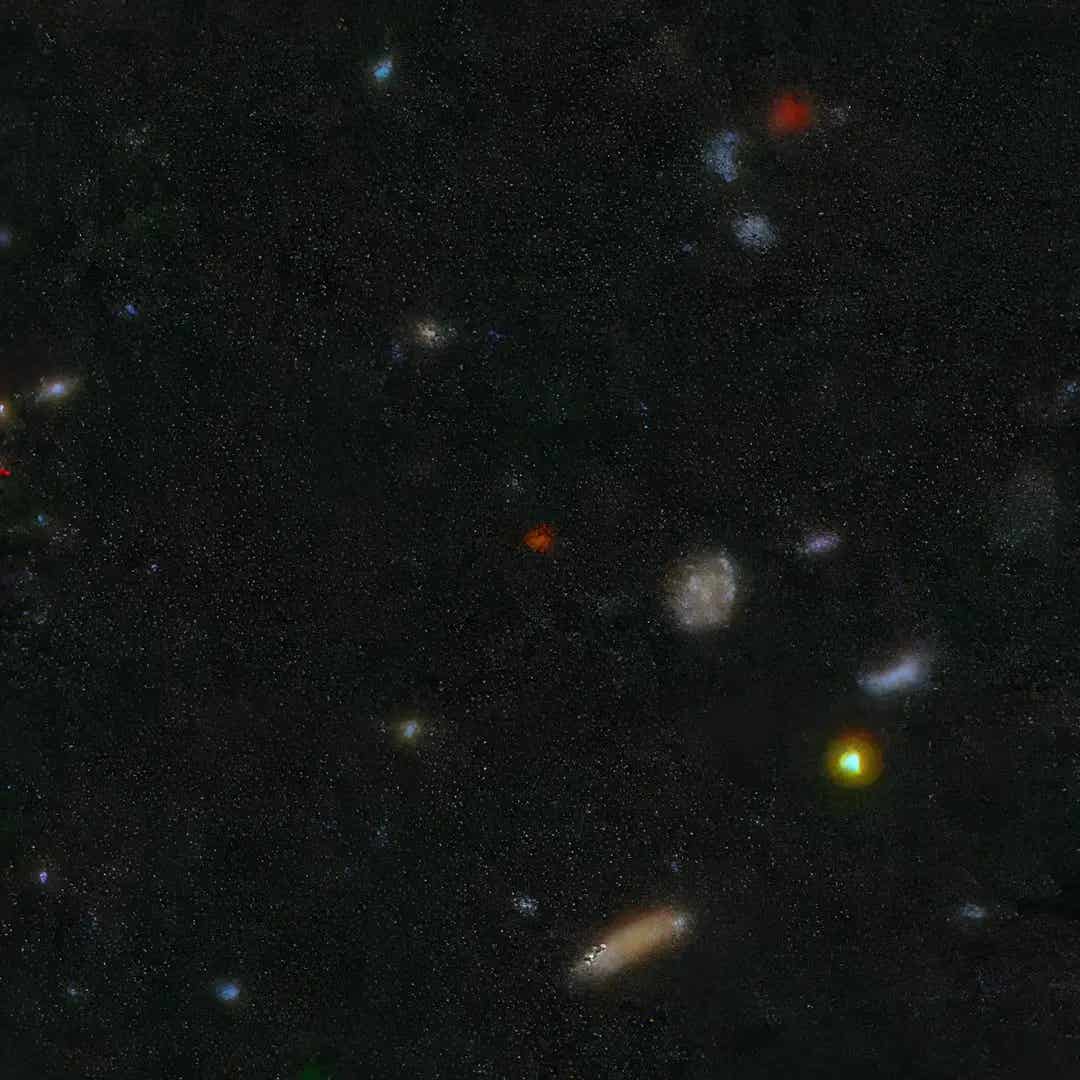
A record-distant quasar hosts a black hole of roughly 360 million solar masses, but its early growth pathway remains uncertain. (CREDIT: European Space Agency)
A black hole weighing roughly 360 million Suns was already powering a bright galactic core when the universe was only 630 million years old. The newly confirmed quasar, J1504+6252, extends the known quasar record beyond redshift eight. Its discovery gives astronomers less time to explain how such enormous black holes assembled.
The European Space Agency's Euclid telescope identified the object, nicknamed Dún Aonghasa, among millions of sources. Follow-up observations established its nature, with James Webb Space Telescope measurements revealing its central black hole. The findings appear in Astronomy & Astrophysics, adding another important object to Euclid's growing collection of ancient quasars.
Julien Wolf led the research while working at the Max Planck Institute for Astronomy, before moving to the European Southern Observatory. The team's discovery presents a challenge beyond distance alone: this enormous black hole appears to be feeding relatively slowly.
Finding a rare beacon in a vast survey
A quasar is a brilliant galactic nucleus powered by gas falling toward a supermassive black hole. The surrounding material releases energy as it accretes, allowing the nucleus to outshine its host galaxy. These luminous objects let astronomers investigate the early universe, but the most distant examples are exceptionally rare.
Euclid combines sensitive near-infrared imaging with broad sky coverage. That combination matters because finding rare sources requires searching enormous areas, while detecting their stretched light requires suitable wavelengths. The spacecraft launched in July 2023 and began its wide survey in February 2024.
Researchers identified Dún Aonghasa within 3,644 square degrees of survey data available in August 2025. Three independent selection methods flagged it as a candidate. Their combined initial redshift estimate, 8.13, closely matched the eventual spectroscopic result.
Euclid clearly detected the object in two near-infrared bands, while visible-light observations showed no significant signal. That contrast matched expectations for a very distant quasar whose shorter-wavelength light encounters absorbing hydrogen. However, selecting a promising source is only the first step toward confirming a quasar discovery.
The object appears as a small red point in the discovery image. That appearance alone does not reveal its enormous mass or age. The crucial information comes from combining the survey's colors with follow-up spectra, which separate the source's light into measurable features.
Four observatories establish the distance
The confirmation campaign began at the W. M. Keck Observatory on January 18, 2026. An 80-minute exposure produced a spectrum consistent with a distant quasar. It did not capture the sharp spectral break needed to establish the distance securely.
Hubble observations on May 12 detected that break near 1,120 nanometers. The Large Binocular Telescope Observatory independently confirmed the feature on May 15 and 16. Its usable exposures totaled more than 12 hours across two wavelength ranges.
Webb's Near Infrared Spectrograph supplied definitive confirmation on June 26. It detected characteristic emission lines, including features associated with hydrogen and magnesium. Such spectral fingerprints help distinguish quasars from other objects that can look similar in survey images.
The measured redshift was 8.129, with an uncertainty of 0.005. Redshift describes how cosmic expansion stretches light to longer wavelengths during its journey. This value places the observed quasar roughly 39 million years earlier than the previous record, tightening the available timeline for black hole growth.
Weighing a black hole from moving gas
Astronomers cannot place this black hole on a scale. Instead, they estimate its mass from the motion of nearby gas and the quasar's brightness. Broad emission lines reveal a range of gas velocities, providing information about the gravitational influence of the central black hole.
The hydrogen line had a width corresponding to approximately 3,160 kilometers per second. A magnesium line gave approximately 3,740 kilometers per second. Using several established methods, the team obtained central mass estimates ranging from about 214 million to 776 million solar masses.
Their preferred method gave approximately 360 million solar masses. The variation between methods matters: the headline figure is an estimate, rather than an exact measurement. Nevertheless, the calculations consistently indicate a substantial black hole at a very early cosmic time.
Its luminosity corresponds to about 26% of the Eddington limit, a standard benchmark balancing outward radiation pressure against inward gravity. Alternative calculations gave roughly 12% to 44%. This comparatively modest activity makes its earlier growth history particularly important, because the present feeding rate need not describe its past.
The Eddington ratio also describes luminosity relative to a theoretical benchmark, rather than the fraction of a black hole's capacity that it has used. It helps compare activity across objects of different masses. Translating that brightness into growth still depends on how efficiently accretion produces radiation.
The missing growth must have happened earlier
One formation scenario begins with black hole seeds left by the first stars, perhaps around 100 solar masses. Growing from that starting point to hundreds of millions of solar masses requires substantial fuel and time. The discovery strengthens the need to test alternative seed scenarios.
Under the team's assumptions, uninterrupted growth at the Eddington limit beginning at redshift 20 requires a seed around 100,000 solar masses. Interruptions would leave less time for accumulation and require an even larger starting point. These numbers describe a model-dependent calculation, not a direct observation of the original seed.
Possible routes include the direct collapse of large gas clouds or repeated collisions within dense star clusters. Smaller seeds might instead undergo episodes of unusually rapid accretion. Radiation and outflows can also disrupt the surrounding fuel supply, complicating a simple picture of steady growth.
The researchers additionally considered primordial black holes, hypothetical objects formed much earlier than stellar remnants. Such primordial seeds offer another possible starting point, but this discovery does not establish their existence. Several pathways remain compatible with an early massive black hole.
A larger sample could test the explanations
Euclid has announced 31 ancient quasars from roughly 18 months of observations, including 12 beyond redshift seven. Its planned six-year survey covers approximately 14,000 square degrees. That scale should help determine whether Dún Aonghasa is exceptional or part of a broader quasar population.
Predictions suggest the full survey could find roughly eight to 23 quasars beyond redshift eight. Those estimates depend on assumptions about their abundance and brightness. More discoveries would let researchers compare black hole masses and feeding rates instead of drawing broad conclusions from a single object.
Dún Aonghasa might be substantially brighter if it were feeding nearer the Eddington benchmark. Its modest current activity therefore leaves room for more luminous examples from the same era. Finding them would provide additional tests of proposed formation mechanisms.
Comparisons must also account for what the survey can detect. Brighter objects are easier to identify, so the discovered sample will not automatically represent every early black hole. Understanding those selection effects will help turn additional detections into reliable tests of competing explanations.
For now, the firm result is a massive, actively feeding black hole observed just 630 million years after the Big Bang. Its exact starting point remains unknown. The next challenge is to explain its early assembly while also accounting for the comparatively restrained activity astronomers see today.
Dig deeper into early black holes
These studies trace earlier quasar discoveries and explain competing models of black hole assembly.
- A Luminous Quasar at Redshift 7.642: Reports an earlier quasar distance record and examines the difficulty of assembling massive black holes during the universe’s first billion years. (The Astrophysical Journal Letters, January 2021)
- The Assembly of the First Massive Black Holes: Reviews proposed seed populations, rapid accretion and observations that could distinguish different growth pathways. (Annual Review of Astronomy and Astrophysics, August 2020)
- Pōniuā’ena: A Luminous z = 7.5 Quasar Hosting a 1.5 Billion Solar Mass Black Hole: Describes another early massive black hole and the growth requirements inferred from its measured properties. (The Astrophysical Journal Letters, July 2020)
- An 800-million-solar-mass black hole in a significantly neutral Universe at a redshift of 7.5: Connects an early quasar discovery with constraints on black hole seeds and intergalactic hydrogen. (Nature, December 2017)
- A luminous quasar at a redshift of z = 7.085: Presents a landmark infrared-selected quasar that opened a new observational window into early cosmic history. (Nature, June 2011)
Research findings are available online in the journal Astronomy and Astrophysics.
The original story "Euclid finds record-distant quasar with a 360-million-solar-mass black hole" is published in The Brighter Side of News.
Related Stories
- The early universe may have been heated by tiny primordial black holes
- Little red dots may hold the secret to the universe’s first black holes
- X-ray warning signs offer advance notice of black hole jet ejections
Like these kind of feel good stories? Get The Brighter Side of News' newsletter.
Joseph Shavit
Writer, Editor-At-Large and Publisher
Joseph Shavit, based in Los Angeles, is a seasoned science journalist, editor and co-founder of The Brighter Side of News, where he transforms complex discoveries into clear, engaging stories for general readers. With vast experience at major media companies like The Los Angeles Times, Times Mirror and Tribune Publishing, he writes with both authority and curiosity. His writing focuses on space science, planetary science, quantum mechanics, geology. Known for linking breakthroughs to real-world markets, he highlights how research transitions into products and industries that shape daily life.