Scientists discover the world’s first fully marine amphibian living 237 million years ago
Two 237-million-year-old fossils suggest Gerrothorax maritimus lived entirely at sea, with armor and gills offering clues to its unusual marine adaptation.
 UC Davis Writer: Kat Kerlin

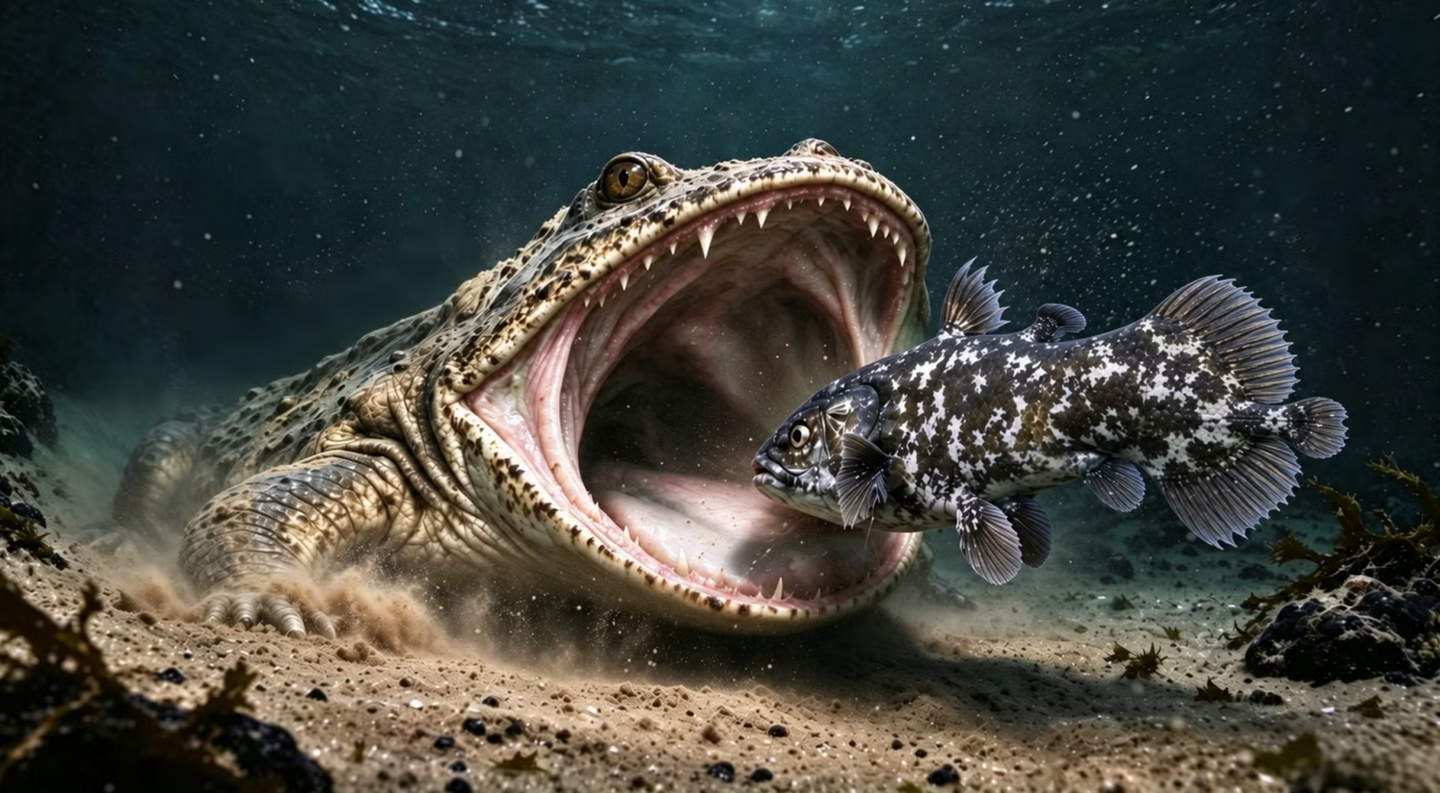
An illustrated rendering of Gerrothoroax maritumus, informed by newly discovered fossil evidence of the creature, which is the first fully marine amphibian on record. The rendering was partially created with AI assistance, which was used to adjust lighting, brightness, fish skin and amphibian skin. (CREDIT: Chen Geng/Guizhou University)
- Two Late Triassic skeletons from China provide evidence for the first known fully marine stem amphibian, Gerrothorax maritimus.
- Preserved limb bones, an offshore burial setting and strontium isotope measurements support a life spent at sea rather than transport from freshwater.
- Its armor and internal gills may explain how it handled seawater, but salt regulation and reproduction remain inferred or unknown.
A broad, armored amphibian appears to have made its home on an ancient seabed, far from the freshwater habitats associated with its living relatives. Two nearly complete skeletons from southwestern China suggest that Gerrothorax maritimus lived entirely at sea about 237 million years ago. The finding challenges the apparent absence of fully marine amphibians from both modern ecosystems and the fossil record.
The study, published in Nature Ecology & Evolution, brings together researchers from the University of California, Davis, Peking University and the Geological Museum of Guizhou. First author Lipin Diao and colleagues analyzed the fossils' anatomy, geological setting and chemical composition. Corresponding authors include UC Davis paleontologist Ryosuke Motani and Peking University's Da-yong Jiang.
The authors describe the species as the first known fully marine stem amphibian. That designation places it on an ancient branch of the amphibian evolutionary lineage, outside the living group of frogs, salamanders and caecilians. It does not mean that an ordinary modern salamander somehow adapted to ocean life.
A flattened body built for the bottom
Gerrothorax maritimus had a broad, flattened body protected by extensive bony armor. Its build contrasted with the elongated shape of a giant salamander, despite a comparable overall size. Small limbs and a heavy covering would have made movement outside water difficult.
The armor included numerous bony plates, called osteoderms, across the back. Additional elements protected the underside of the body. These structures gave the animal a physical design unlike the soft-skinned appearance familiar from most living amphibians.
Features of its skull and throat skeleton suggest a bottom-dwelling suction feeder. Rather than chasing prey through open water, it may have waited for animals to approach and drawn them into its mouth. The proposed feeding style resembles that of living wobbegong sharks, although the animals are not close relatives. Such comparisons help researchers infer function from preserved structures while avoiding the assumption that similar-looking animals necessarily lived in identical ways.
That reconstruction rests on anatomy rather than preserved behavior. Strong bones supporting the throat could have withstood the forces generated during rapid expansion that draws water inward. Compared with its freshwater relative, the new species also had structural differences that could have allowed greater throat movement.
Why an ocean fossil needs more than an ocean burial
The skeletons came from Late Triassic rocks in Guanling County, Guizhou Province. The area was then a marine basin connected to the Tethys Ocean. Other fossils from the region include fish and ocean-going reptiles, including ichthyosaurs.
Finding an amphibian in marine sediment does not automatically establish that it lived in seawater. A river could carry a carcass offshore, or a floating body could drift away from land. Researchers therefore needed evidence that distinguished an ocean resident from an accidental arrival.
The ancient setting strengthens their interpretation. The locality was about 200 kilometers from major land masses, with possible islands along a platform margin roughly 30 kilometers away. A freshwater-dependent animal would have faced a substantial separation from the resources it needed on land.
Preservation supplies another clue because the skeletons retained delicate limb elements. The larger specimen preserves articulated hand bones, meaning they remained connected in their anatomical positions. Such connections would be difficult to retain after extensive decomposition and transport at sea.
The authors therefore argue that the animals probably died close to where they lived. They also identify damaged and altered areas in one specimen and exclude those bones from their analysis. The case depends on the reliable preserved anatomy, rather than treating every visible feature as equally informative.
A chemical signal consistent with seawater
The team tested the habitat interpretation using strontium isotopes in the bones. Isotopes are forms of an element that differ in their number of neutrons. Comparing their proportions can help reconstruct the environments associated with ancient animals.
The fossil bone measurements were close to the estimated strontium isotope signature of seawater during the early Late Triassic. They differed from the surrounding rock, which carried a stronger influence from geological sources on nearby land. That contrast supports the interpretation that the animals incorporated a marine signal while alive.
Chemical evidence from fossils requires caution because burial can change the original composition. The researchers considered that possibility, known as diagenesis. They argue that differences between the bone and surrounding rock, together with similarities between the two animals, indicate limited alteration rather than complete replacement of the original signal.
The isotope results therefore complement the geological setting and connected skeletons. No single measurement supplies a direct observation of the animals' daily lives. Together, however, the evidence makes an offshore marine lifestyle more plausible than long-distance transport from a freshwater habitat.
How armor could help solve the salt problem
Modern amphibians face physiological difficulties in seawater because their skin permits substantial exchange with their surroundings. That permeability helps with water uptake and, in many species, breathing. In salty water, however, it can also contribute to dehydration as water leaves the body.
Some living amphibians tolerate brackish conditions, including the crab-eating frog. Salt tolerance alone is different from living entirely at sea without freshwater access. The new fossils suggest that an extinct lineage may have overcome barriers that still constrain living amphibians.
The researchers propose that extensive armor reduced exchange through the body surface. A lineage already relying more heavily on drinking and internal gills could then modify those systems for seawater. In their reconstruction, the gut supplied water while the gills provided a route for removing excess salt.
That arrangement resembles aspects of marine fish physiology, but remains a hypothesis for this fossil species. The skeletons do not preserve the tissues needed to measure water permeability or salt transport. Armor is directly observable; its precise physiological effects must be inferred from anatomy and comparisons with living animals.
The distinction also avoids treating the skin as an impossible barrier for every amphibian throughout history. Different combinations of body covering, breathing structures and water intake could produce different limits. Gerrothorax maritimus may represent one rare combination that permitted a fully marine existence.
What the discovery leaves unanswered
The proposed adaptation does not resolve every requirement for ocean life. Reproduction remains a major question because eggs and developing young would also need to tolerate the environment. The fossils do not show whether the species laid salt-tolerant eggs or gave birth to live young.
Nor does the discovery establish the earliest moment when any amphibian entered the sea. Other fossil amphibians have been associated with coastal or brackish environments. The new claim concerns evidence for an entirely marine lifestyle, a more demanding ecological transition.
Further specimens could clarify how widespread that lifestyle became and whether related animals shared it. Better-preserved anatomical evidence could also test aspects of the feeding and physiological reconstructions. For now, these two skeletons reveal an amphibian lineage apparently living beyond freshwater's reach, while leaving its biological solution to seawater only partly understood.
Dig deeper into amphibians and marine adaptation
These resources explain the discovery, the challenges of salt water and methods for reconstructing ancient animal biology.
Researchers Unearth Fossil Evidence of First Fully Marine Amphibian
This institutional account describes the fossils and the researchers' interpretation of their habitat and anatomy. (University of California, Davis, October 2026)
Ecophysiological steps of marine adaptation in extant and extinct non-avian tetrapods
This review distinguishes partial use of marine environments from the physiological changes required for life independent of land. (Biological Reviews, April 2021)
Modeling the physiology of the aquatic temnospondyl Archegosaurus decheni from the early Permian of Germany
This study reconstructs aspects of an extinct freshwater amphibian's breathing and water balance using anatomy and physiological modeling. (Fossil Record, March 2017)
Occurrence of Amphibians in Saline Habitats: A Review and Evolutionary Perspective
This review examines salt tolerance in living amphibians and the evolutionary challenges presented by saline environments. (Herpetological Monographs, 2015)
Reconstruction of cranial and hyobranchial muscles in the Triassic temnospondyl Gerrothorax provides evidence for akinetic suction feeding
Research on a related Gerrothorax species explains how skeletal anatomy can support hypotheses about suction feeding. (Journal of Morphology, May 2013)
Research findings are available online in the journal Nature Ecology & Evolution.
The original story "Scientists discover the world's first fully marine amphibian living 237 million years ago" is published in The Brighter Side of News.
Related Stories
- Fossil skull discovery reveals when land animals first learned to eat plants
- Scotland’s famous 'Lizzie' fossil was not the early reptile scientists thought
- Breakthrough fossil study reveals the origin of living amphibians
Like these kind of feel good stories? Get The Brighter Side of News' newsletter.
Joshua Shavit
Writer and Editor
Joshua Shavit is a NorCal-based science and technology writer with a passion for exploring the breakthroughs shaping the future. As a co-founder of The Brighter Side of News, he focuses on positive and transformative advancements in technology, physics, engineering, robotics, and astronomy. Having published articles on AOL.com, MSN, Yahoo News, and Ground News, Joshua's work highlights the innovators behind the ideas, bringing readers closer to the people driving progress.