Scientists find evidence of a solar storm near a supermassive black hole
A solar-like black hole eruption reveals a familiar X-ray timing pattern, linking magnetic energy release with a fast wind near NGC 3783’s central black hole.
 Technion Writer: Doron Shaham

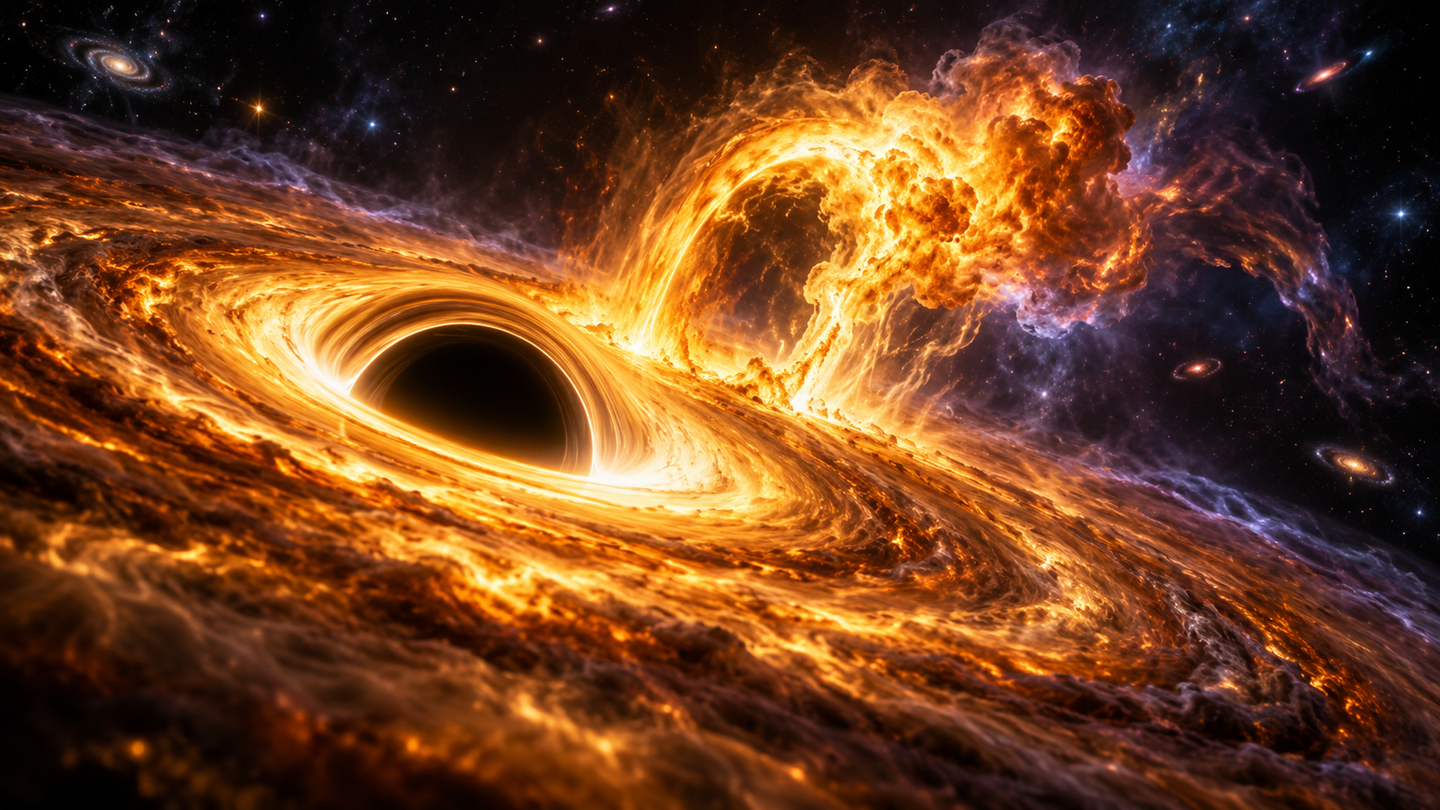
A solar-like black hole eruption in NGC 3783 links X-ray timing and a fast wind to magnetic reconnection. (CREDIT: The Brighter Side of News)
- An X-ray flare near NGC 3783’s supermassive black hole showed a timing pattern familiar from solar eruptions.
- XRISM and XMM-Newton detected the Neupert effect, supporting magnetic reconnection as the flare’s power source.
- A fast outflow strengthens the comparison with solar coronal mass ejections, although the magnetic geometry remains inferred.
An eruption near a black hole weighing about 28 million Suns followed a pattern familiar from storms on the Sun. Its high-energy X-rays rose and fell differently from its lower-energy radiation, revealing how energy moved through the surrounding gas. The sequence suggests that magnetic fields powered both a flare and an accompanying burst of escaping material.
The findings, published in The Astrophysical Journal Letters, concern the active galaxy NGC 3783. Gal Vardi, a doctoral student in the Technion Faculty of Physics, led the work under Professor Ehud Behar’s supervision. Collaborators from Japan, Europe and the United States helped analyze observations from the XRISM and XMM-Newton space telescopes.
The team reports the first detection of the Neupert effect in an active galactic nucleus, the luminous region around a feeding supermassive black hole. That effect links different kinds of radiation during some solar flares. Here, it provides observational evidence for magnetic reconnection, rather than a direct picture of the magnetic fields themselves.
A familiar storm in an unfamiliar setting
The Sun’s corona is its hot outer atmosphere, where magnetic fields can store enormous amounts of energy. Reconnection changes the arrangement of those fields and releases energy into charged particles. Some particles heat denser material, while others can escape in an eruption called a coronal mass ejection.
Astronomers have long considered a related mechanism for the hot corona above a black hole’s accretion disk. That disk consists of matter spiraling inward, while the corona produces energetic X-rays. Both occupy the black hole’s surroundings; the escaping radiation and wind do not emerge from inside its event horizon.
The analogy addresses a heating problem shared by stars and active galaxies. Their coronae can become much hotter than the underlying sources of visible or ultraviolet light. In active galaxies, coronal temperatures can approach a billion kelvins, demanding an explanation beyond simply describing matter’s inward flow.
Magnetic reconnection has therefore featured in models of black hole environments for decades. Until this event, the evidence for its role in active galactic coronae remained circumstantial, according to the authors. The new timing analysis supplies a more specific test of that longstanding interpretation.
Watching an unusual flare unfold
The observations came from a 10-day campaign targeting NGC 3783 in July 2024. XRISM led the campaign, with several other space observatories participating. This analysis concentrated on its Xtend X-ray imager and data from XMM-Newton, including its ultraviolet observations.
XRISM is a JAXA-led mission developed with NASA and significant ESA participation, while XMM-Newton belongs to ESA. Together, the observatories supplied independent views of the flare’s changing brightness. Those measurements allowed the researchers to compare radiation at different energies rather than relying on one broad brightness curve.
Several flares appeared during the campaign, typically lasting around one to two days. Most showed closely matched changes in hard and soft X-rays, terms for higher- and lower-energy photons. One event behaved differently, with the hard X-ray variation preceding the soft variation by roughly 30,000 seconds, or eight hours.
After the flare peaked, its hard X-rays dropped sharply while its soft X-rays faded more gradually. That pattern alone suggested different emission processes, but it was not the decisive test. The researchers examined whether the hard radiation tracked how quickly the soft radiation changed.
The timing signature that connected the events
The Neupert effect, first identified in solar observations in 1968, concerns precisely that relationship. Hard X-rays can trace the immediate energy release from accelerated particles, while softer radiation reflects accumulated heating. Consequently, the hard X-ray brightness can follow the rate of change of the softer emission.
This differs from expecting the two brightness curves simply to rise and fall together. A heating signal can peak while stored thermal energy continues increasing, producing a later soft X-ray maximum. The delayed soft peak therefore becomes meaningful when paired with the changing hard emission.
For XRISM, the comparison produced a correlation strength of 0.84, with a reported p-value of 0.002. XMM-Newton independently showed the same relationship, with a correlation of 0.92 and p-value of 0.02. These statistics supported the timing connection, although they do not directly measure the magnetic configuration.
The authors also tested whether their choice of time intervals created the result. The relationship remained significant when they grouped measurements into intervals between 4,000 and 8,000 seconds. Finer intervals lacked enough signal, while broader averaging blurred the flare’s distinguishing features.
The eight-hour offset between the brightness curves is different from the delay used to estimate particle travel. The hard emission and the rate of soft brightening matched within the shortest reliable time interval. Under the reconnection interpretation, that limits the travel time to less than about 4,000 seconds. Keeping these two timing comparisons separate is essential when translating the observed light into a proposed physical structure.
An eruption linked to a fast wind
A separate analysis of the same campaign had already identified an ultrafast outflow associated with the flare. Its velocity was approximately one-fifth of light speed. The new paper connects that escaping material with the timing evidence, interpreting it as the counterpart of a solar coronal mass ejection.
In the proposed sequence, reconnection accelerates charged particles around a magnetic loop above the corona. Some material escapes, while other particles travel toward denser regions near the loop’s base. There, they deposit energy and produce the softer component of the flare.
The authors do not assume every radiation mechanism matches the Sun’s. Around this black hole, they interpret both X-ray components through inverse Compton scattering, where energetic particles boost photons to higher energies. The proposed resemblance concerns magnetic energy release and subsequent heating, despite differences in how the radiation forms.
The timing also offers a tentative way to estimate otherwise inaccessible distances. Assuming particles travel close to light speed, the authors place the reconnection region within about 30 gravitational radii of the loop’s base. A gravitational radius expresses distance using the black hole’s mass, and the estimate depends on that particle-speed assumption.
What remains beyond the telescopes’ view
The researchers examined alternatives, including changing absorption and radiation reflected from surrounding material. They found no corresponding absorption change or soft-excess variation that explained the flare’s distinctive timing. Their analysis favors reconnection, but the proposed loop and particle paths remain a physical interpretation of unresolved observations.
Ultraviolet measurements offer another possible connection, with a weak flare appearing around 60,000 seconds after the hard X-ray event. The authors suggest that hard radiation illuminated and heated a more distant part of the disk. However, the ultraviolet uncertainties prevented a formal correlation measurement, making that part of the sequence less secure.
The magnetic field strength is also model-dependent, with different estimates probing different assumptions and stages of the event. This single flare does not establish whether similar structures and conditions characterize other active galaxies. Finding more Neupert-like events, and determining how often they occur, would test whether this solar analogy explains a broader class of black hole eruptions.
Dig deeper into magnetic eruptions near black holes
These resources explain the accompanying outflow, X-ray observing methods and the solar research behind the proposed connection.
Delving into the depths of NGC 3783 with XRISM – III. Birth of an ultrafast outflow during a soft flare
This companion study reports the fast wind detected during the same observing campaign. It provides the outflow evidence that the later timing analysis connects with a solar-like eruption. (Astronomy & Astrophysics, December 2025)
XRISM unveils black hole and supernova remnant surroundings
ESA explains how XRISM uses X-ray signatures to investigate hot gas and material around black holes. These earlier results provide context for the mission’s observing capabilities. (European Space Agency, September 2024)
Measurement of magnetic field and relativistic electrons along a solar flare current sheet
Solar observations probe magnetic fields and energetic electrons in a region associated with reconnection. The work helps explain the nearby physical system used as a comparison for distant black hole coronae. (Nature Astronomy, July 2020)
On the origin of radio emission in radio-quiet quasars
This study identifies a radio-to-X-ray relationship resembling that of magnetically active stars. It develops an earlier argument for magnetic heating in active galactic coronae. (Monthly Notices of the Royal Astronomical Society, October 2008)
Investigation of the Neupert effect in solar flares – I. Statistical properties and the evaporation model
A large solar-flare sample tests the timing relationship between impulsive energy release and softer X-ray emission. The study supplies background for interpreting the Neupert effect and its limitations. (Astronomy & Astrophysics, September 2002)
Research findings are available online in The Astrophysical Journal Letters.
The original story "Scientists find evidence of a solar storm near a supermassive black hole" is published in The Brighter Side of News.
Related Stories
- Astronomers solve cosmic mystery surrounding two massive black holes that shouldn't exist
- Scientists discover solar storms could hit Earth much harder than previously thought
- Extreme solar storms could hit Earth harder than scientists expected
Like these kind of feel good stories? Get The Brighter Side of News' newsletter.
Joseph Shavit
Writer, Editor-At-Large and Publisher
Joseph Shavit, based in Los Angeles, is a seasoned science journalist, editor and co-founder of The Brighter Side of News, where he transforms complex discoveries into clear, engaging stories for general readers. With vast experience at major media companies like The Los Angeles Times, Times Mirror and Tribune Publishing, he writes with both authority and curiosity. His writing focuses on space science, planetary science, quantum mechanics, geology. Known for linking breakthroughs to real-world markets, he highlights how research transitions into products and industries that shape daily life.