Scientists discover solar storms could hit Earth much harder than previously thought
Measurement uncertainty may have hidden the true strength of Earth’s response to rare and extreme solar storms.

 Edited By: Joshua Shavit

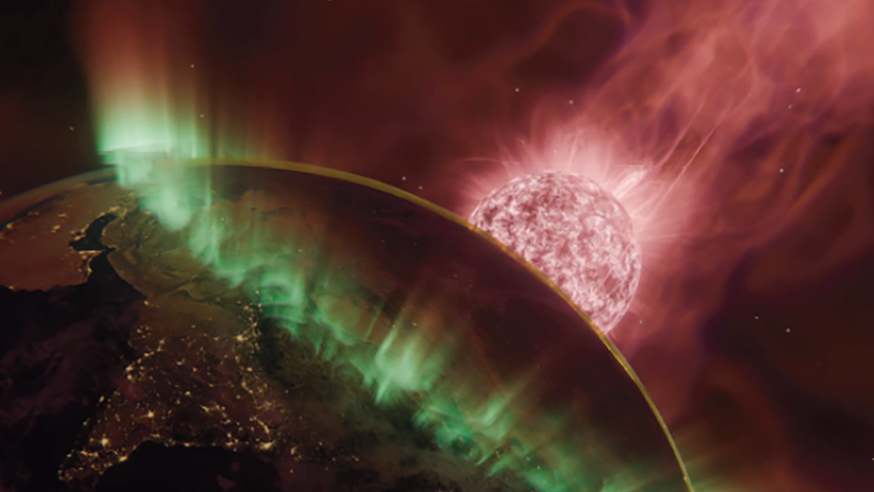
Illustration of solar wind streaming from a fuming Sun drives auroras bright enough to be seen far from the poles, a dazzling signature of an extreme geomagnetic storm. (CREDIT: Nithin Sivadas, NASA Goddard Space Flight Centre)
- New research challenges the long-held idea of “geomagnetic saturation,” suggesting Earth’s response to powerful solar storms may continue increasing instead of reaching a natural upper limit.
- Scientists found that uncertainty in solar wind measurements, including timing errors and changes between the L1 observation point and Earth, may have created the illusion that geomagnetic activity levels off during extreme events.
- If Earth has no meaningful saturation limit, rare solar storms could pose greater risks than previously estimated to satellites, GPS, communications, power grids, aviation, and astronauts.
A violent solar storm can turn the night sky bright while quietly placing modern technology under strain.
Satellites may lose altitude. Navigation signals can fail. Radio links can weaken, while astronauts and pilots face greater radiation exposure.
For decades, many scientists believed Earth’s response to extreme solar activity had a natural upper limit. Stronger solar wind appeared to stop producing equally stronger electric currents around the planet.
That apparent ceiling may not exist. New research argues that the supposed limit results from uncertainty in solar wind measurements. If the analysis is correct, rare solar storms could affect technology more severely than earlier models suggested.
The work was led by Dr. Nithin Sivadas of NASA’s Goddard Space Flight Center. Dr. Maria Walach of Lancaster University co-authored the paper.
Their conclusion challenges a long-standing idea called geomagnetic saturation. It also raises difficult questions about preparations for the most extreme space weather events.
A Protective Field With Limits of its Own
Earth’s magnetic field blocks or redirects many charged particles arriving from the Sun. Most solar activity causes only minor disruptions or colorful auroras.
“Our planet’s magnetic field does a really great job of protecting us against many space weather effects and so they often just show up as glitches or beautiful aurora,” Walach said. “There are however extreme cases, where satellites unexpectedly fall back to Earth, or we lose communication and GPS signals.”
The solar wind is a constant flow of hot, charged gas moving outward from the Sun. Solar eruptions can greatly strengthen that flow.
When intense solar wind reaches Earth, it disturbs the plasma and magnetic fields surrounding the planet. These temporary disturbances are known as geomagnetic storms.
Such storms can drive electric currents through Earth’s upper atmosphere. Those currents can interfere with satellites, communications, navigation systems, and electrical infrastructure.
Observations once seemed reassuring. As solar wind strength rose, Earth’s response also grew, but only to a point.
Measurements suggested that upper-atmosphere currents eventually leveled off. Scientists interpreted that pattern as evidence that Earth’s magnetic environment could not absorb unlimited energy. At least 10 theories tried to explain this apparent saturation, according to the supplied research summary.
The new analysis reaches a less comforting conclusion. Earth’s response may continue growing as the solar wind becomes stronger.
The Trouble Begins Far from Earth
Most solar wind measurements come from spacecraft near the first Lagrange point, commonly called L1.
That location sits roughly 1 million miles closer to the Sun than Earth. Spacecraft there provide advance measurements before solar wind reaches the planet. Yet the measured conditions do not arrive at Earth unchanged.
Solar wind can shift during its journey. Its magnetic properties may vary, and uncertainty can affect estimates of travel time.
Researchers must also estimate how disturbances move from the edge of Earth’s magnetic environment toward the upper atmosphere.
These uncertainties matter most during rare, intense events.
The team argues that scientists have often paired Earth’s response with solar wind measurements that were more extreme than the conditions actually reaching Earth.
That mismatch produces a statistical effect called regression to the mean.
“We usually assume the truth may be around its measurement. But probability theory says it leans one way. That's why space weather risks appear underestimated,” Sivadas said.
An unusually high measurement is often linked to a true value closer to the average. The difference grows more important as observations become more extreme.
When many events are combined, Earth’s response can appear to flatten. In reality, the solar wind arriving near the planet may simply be weaker than the earlier measurement suggested. The supposed physical limit may therefore be a measurement illusion.
A Million Measurements Near the Planet
The researchers tested their explanation using more than 1 million solar wind measurements from NASA spacecraft orbiting close to Earth.
Those observations reduced the distance between the measurement point and the planet’s magnetic environment. The results indicated a direct relationship between solar wind strength and currents in the upper atmosphere. Stronger solar wind produced a stronger response.
That pattern suggests no observed upper limit. Earth’s reaction continued to increase along with the force driving it.
The separate research summary describes statistical modeling based on 25 years of observations from 1995 through 2019. It says uncertainty alone reproduced the familiar saturation curve.
The model included timing errors, changes in solar wind strength, and differences between distant measurements and near-Earth conditions.
Researchers estimated that uncertainty in the solar wind driver reached at least 30%.
After applying a correction called regression calibration, the curved relationship became nearly straight. The corrected trend remained linear up to about 15 millivolts per meter. A separate measure of geomagnetic activity produced the same broad result after correction.
This agreement strengthened the case against saturation. Different measurements pointed toward the same statistical explanation.
The study does not prove that no physical limit exists under every possible condition. Extremely strong solar events remain rare, so scientists have little direct information from the highest end of the scale.
“Fortunately, these very extreme cases are rare, but this also means we have limited data to work with and only time will tell what happens at the very extreme one-in-a-thousand-year kind of event,” Walach said.
A Bigger Threat to Modern Systems
The findings matter because society depends heavily on systems exposed to space weather.
Satellites support communications, weather monitoring, navigation, banking, transportation, and emergency response.
Strong geomagnetic activity can alter the upper atmosphere, increasing drag on spacecraft. Satellites in low orbit may lose altitude faster than expected.
Communication and GPS signals can also weaken during severe disturbances. Large changes in Earth’s magnetic field can affect power networks. Radiation conditions can become more serious for astronauts and pilots.
If scientists underestimate Earth’s response, engineers may also underestimate the stress placed on these systems.
“If there is no upper limit to our planet’s response to the solar wind, modelling for extreme cases needs to take this into account and we should be vigilant of space weather effects,” Walach said.
The supplemental analysis suggests effects could reach roughly twice earlier estimates under certain extreme solar wind conditions.
That estimate depends on extending the corrected relationship beyond much of the observed record. It should not be treated as a prediction for every storm.
Still, the study removes a reassuring assumption from space weather planning. A magnetic field can protect Earth without giving technology complete protection.
When Statistics Reshape Physical Reality
The research also carries a warning beyond solar science.
Scientists often study rare events using measurements that contain unavoidable uncertainty. Extreme values create special risks for interpretation.
Regression to the mean can make a steadily increasing relationship appear to slow or stop. Researchers may then develop physical theories to explain a limit that does not exist.
The authors suggest that similar problems could affect climate studies, medical research, earthquake analysis, and artificial intelligence.
Fields that rely on uncertain measurements and nonlinear models may face the greatest risk.
This does not mean earlier research lacks value. It means the relationship between a measurement and the true value demands careful attention.
Space weather offers a vivid example. The difference between a real ceiling and an apparent ceiling could shape how societies prepare for rare solar disasters.
Practical Implications of the Research
Space weather models may need to remove assumptions that Earth’s response naturally levels off during intense storms.
Satellite operators could use revised risk estimates when planning orbits, protective procedures, and emergency responses. Power companies may also need scenarios that include stronger geomagnetic currents than older models allowed.
Navigation, aviation, and communications planners could benefit from testing systems against more severe disturbances.
Scientists will need more measurements close to Earth during powerful solar events. Better timing methods could also reduce uncertainty between distant spacecraft and Earth’s upper atmosphere.
The greatest challenge remains rarity. A one-in-a-thousand-year storm cannot be studied on demand.
Preparation must therefore rely on careful statistics, physical models, and the limited extreme events nature provides. The study’s larger lesson is simple but unsettling. Earth’s magnetic shield remains powerful, yet its response may not stop growing when the Sun becomes more violent.
Research findings are available online in the journal Nature.
The original story "Scientists discover solar storms could hit Earth much harder than previously thought" is published in The Brighter Side of News.
Related Stories
- Chang’e-6 samples reveal how Earth's magnetosphere changed the solar wind reaching the Moon
- Sunspots could predict dangerous solar storms seven years in advance
- Six-satellite 'StormWall' could stop dangerous solar storms before they hit Earth
Like these kind of feel good stories? Get The Brighter Side of News' newsletter.
Joseph Shavit
Writer, Editor-At-Large and Publisher
Joseph Shavit, based in Los Angeles, is a seasoned science journalist, editor and co-founder of The Brighter Side of News, where he transforms complex discoveries into clear, engaging stories for general readers. With vast experience at major media companies like The Los Angeles Times, Times Mirror and Tribune Publishing, he writes with both authority and curiosity. His writing focuses on space science, planetary science, quantum mechanics, geology. Known for linking breakthroughs to real-world markets, he highlights how research transitions into products and industries that shape daily life.