Galactic winds from exploding stars may block radiation that helped transform the early universe
Hubble observations connect galactic winds and reionization, finding that stronger outflows in six compact galaxies accompany less escaping ionizing radiation.
 University of Michigan Writer: Matt Davenport

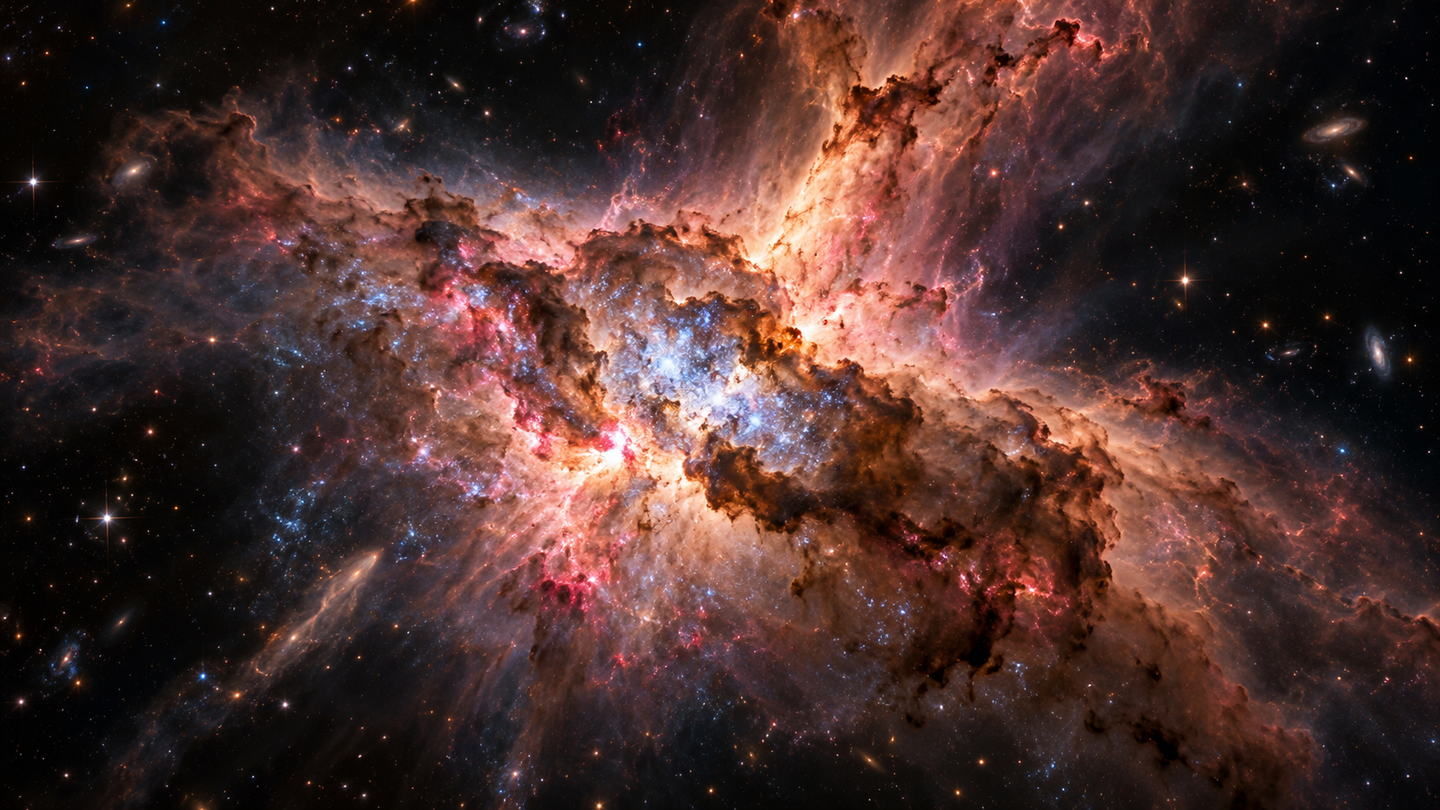
Hubble links stronger galactic winds to less escaping ionizing light, challenging a key idea about cosmic reionization. (CREDIT: The Brighter Side of News)
- Hubble observations of six compact starburst galaxies link faster, stronger galactic winds with less escaping hydrogen-ionizing radiation.
- The findings favor an early escape phase shaped by young stars’ radiation and stellar winds, before powerful supernova-driven outflows develop.
- The nearby galaxies offer clues to cosmic reionization, but the small sample does not establish how every galaxy releases ionizing light.
Winds from exploding stars may block the radiation they were expected to release into intergalactic space. Hubble observations of six compact galaxies found that faster outflows accompanied a smaller escaping fraction of hydrogen-ionizing light. The result challenges a common explanation for how young galaxies helped transform the early universe.
The study, published in Nature Astronomy, was led by astronomer Cody Carr while he worked at Zhejiang University. Carr is now a postdoctoral researcher at the University of Michigan. The international team includes senior authors Renyue Cen at Zhejiang and Stephan McCandliss at Johns Hopkins University.
“Basically, how these galaxies were leaking ionizing radiation isn't what we thought,” Carr said. The observations favor an escape window dominated by young stars, before large supernova-driven winds become established. However, the researchers emphasize that their galaxies are nearby comparisons, and their results do not describe the entire lifetime of radiation escape.
The light that changed intergalactic space
For much of its early history, the universe contained abundant neutral hydrogen between galaxies. Energetic ultraviolet photons could strip electrons from hydrogen atoms, leaving ionized gas behind. That transformation, called reionization, gradually changed the state of intergalactic matter during the universe’s first billion years.
Producing those photons was only part of the challenge. Radiation also had to escape the gas and dust surrounding its sources inside galaxies. Photons absorbed locally could not contribute to ionizing the much larger spaces between galaxies.
Astronomers call hydrogen-ionizing radiation the Lyman continuum, often shortened to LyC. Its escape fraction measures the proportion of that radiation that leaves a galaxy. A galaxy’s contribution to reionization depends on both how much ionizing light it produces and how much gets out.
One influential picture gives supernovae an important role in clearing the route. Explosions drive winds that can disrupt clouds and open lower-density channels through the interstellar medium, the material between stars. The new observations suggest that, during the early stages examined here, the winds’ accumulating material can instead increase absorption.
Six galaxies chosen for a controlled comparison
The team used Hubble’s Cosmic Origins Spectrograph to obtain detailed ultraviolet spectra of six galaxies. They selected the targets from the expanded Low-redshift Lyman Continuum Survey. The galaxies span different escape fractions while sharing broadly similar stellar masses, star-formation rates and chemical abundances.
Those similarities helped limit differences in the conditions that drive winds. The researchers also selected compact galaxies with intense star formation packed into small regions. Such properties occur frequently among strong emitters of escaping ionizing radiation and provide useful comparisons with some early galaxies.
A spectrum separates light by wavelength, revealing signatures of stars and intervening gas. Gas moving in a wind absorbs particular wavelengths, leaving features whose shapes and shifts reveal its motion. The team examined hydrogen, nitrogen and oxygen absorption to trace different temperature components of the outflows.
Distinguishing a galaxy’s wind from winds around individual stars required another step. The researchers modeled the ultraviolet light produced by its stellar populations and separated those expected features from additional absorption. Their main trends remained when they used a different normalization method, supporting the analysis beyond one particular spectral fit.
Faster outflows accompanied weaker escape
The strongest leakers generally contained younger ultraviolet-bright stellar populations, with light-weighted ages below about four million years. Weaker leakers contained older populations, with stronger signatures of galactic outflows. The comparison suggests that radiation escape declines as starbursts age and winds gather more neutral material.
This is an inferred sequence across different galaxies, rather than a recording of one galaxy evolving. The age estimates also summarize mixtures of stellar populations. The authors caution that their measurements do not resolve a smooth, continuous relationship between escape fraction and stellar age throughout the period studied.
Neutral hydrogen absorption supplied a revealing detail. Along the observed sightlines, the hydrogen features indicated nearly complete coverage by neutral gas, even in strong leakers. Differences in how much material lay along those paths, rather than simply whether gas covered them, helped explain the different escape fractions.
A covered sightline does not necessarily block every ionizing photon. A sufficiently small gas column can transmit more radiation than a thicker column covering the same area. The spectra pointed toward increasing hydrogen-column density and dust content as the winds developed, making escape progressively harder.
The researchers also combined spectra from a broader group of compact, intensely star-forming galaxies in the parent survey. Those averages generally supported the individual-galaxy trends, although some differences remained indistinguishable within the uncertainties. The stacks strengthen the interpretation without replacing the need for sharper measurements of individual systems.
Young stars may open the earliest window
The favored explanation begins with radiation and stellar winds from very young massive stars. Those processes can displace surrounding material and create relatively low-density routes with little dust. Clumping in the gas may also help photons escape before a substantial supernova-driven outflow forms.
The paper does not require complete absence of supernovae during this early phase. A few explosions from the most massive stars could contribute. Its central distinction concerns whether young-star feedback or an established, mass-laden galactic wind dominates the conditions for escape.
As more supernovae occur, they may destroy clouds and carve channels while also pushing additional neutral gas into the outflow. Dust and the growing gas column can then offset the benefit of those openings. The result is lower average escape during the early evolutionary interval examined here.
That interpretation calls for a more careful treatment of stellar feedback in simulations. Models often predict that escape peaks after supernova activity begins, whereas these observations favor an earlier peak. The authors suggest that limited resolution and incomplete treatment of small-scale gas physics could contribute to the disagreement.
A clue to reionization, with limits
The six targets do not represent every galaxy that existed during reionization. They overlap early galaxies in compactness and intense star formation, but occupy different parts of the mass and chemical-abundance distributions. Applying the result to the ancient universe therefore requires testing how those differences change the balance of feedback.
The ultraviolet observations also cannot measure the hottest wind component, which requires X-ray observations. The team had such data for only one target and detected no X-rays. That result is consistent with youth, but it does not replace a survey of hot gas across the sample.
Later stages could reverse the relationship between winds and escape. Binary-star products can continue producing ionizing light after the most massive stars die, potentially for 10 million to 50 million years. During that interval, winds might clear material effectively enough to help radiation escape again.
Carr and his colleagues are seeking additional Hubble observations to test the proposed early sequence. More detailed spectra would also provide benchmarks for simulations tracking both photon production and absorption. The remaining question is whether that short early escape window, across the wider galaxy population, supplied enough radiation to help reionize the universe.
Dig deeper into galactic winds and cosmic reionization
These studies connect early-universe observations with nearby radiation-leaking galaxies and the physical models used to explain stellar winds.
Witnessing the onset of reionization through Lyman-α emission at redshift 13
Observations of an exceptionally early galaxy provide evidence relevant to an ionized region around it. The study offers a distant-universe counterpart to investigations using nearby galaxies as comparisons. (Nature, March 2025)
Most of the photons that reionized the Universe came from dwarf galaxies
Measurements of faint early galaxies examine their ability to produce the photons needed for reionization. The findings help explain why photon production and the fraction escaping must be considered together. (Nature, February 2024)
The Low-Redshift Lyman Continuum Survey – Unveiling the ISM properties of low-z Lyman-continuum emitters
Ultraviolet spectra probe the neutral gas and dust that regulate radiation leakage in nearby star-forming galaxies. This provides background for interpreting absorption features and low-density escape routes. (Astronomy & Astrophysics, July 2022)
The Low-redshift Lyman Continuum Survey. I. New, Diverse Local Lyman Continuum Emitters
The survey presents Hubble measurements of escaping ionizing radiation from a diverse sample of nearby galaxies. It establishes the observational foundation from which the six follow-up targets were selected. (The Astrophysical Journal Supplement Series, May 2022)
Wind from a starburst galaxy nucleus
This foundational model explains how energy from vigorous star formation can drive a galactic wind. It provides context for the physical assumptions behind later studies of outflows and their effects on surrounding gas. (Nature, September 1985)
Research findings are available online in the journal Nature Astronomy.
The original story "Galactic winds from exploding stars may block radiation that helped transform the early universe" is published in The Brighter Side of News.
Related Stories
- 2,884 exploding stars deepen the mystery of dark energy
- Collapsing stars could form gravastars instead of black holes
- Do planets inherit their chemical structure from their stars?
Like these kind of feel good stories? Get The Brighter Side of News' newsletter.
Joseph Shavit
Writer, Editor-At-Large and Publisher
Joseph Shavit, based in Los Angeles, is a seasoned science journalist, editor and co-founder of The Brighter Side of News, where he transforms complex discoveries into clear, engaging stories for general readers. With vast experience at major media companies like The Los Angeles Times, Times Mirror and Tribune Publishing, he writes with both authority and curiosity. His writing focuses on space science, planetary science, quantum mechanics, geology. Known for linking breakthroughs to real-world markets, he highlights how research transitions into products and industries that shape daily life.