Scientists find first-ever evidence of fossilized blood cells in 115-million-year-old dinosaur bones
A dinosaur fossil from Brazil preserves heme-related molecules within mineralized cell-like structures, offering new evidence of ancient blood preservation.
 Curtin University Writer: Sam Jeremic

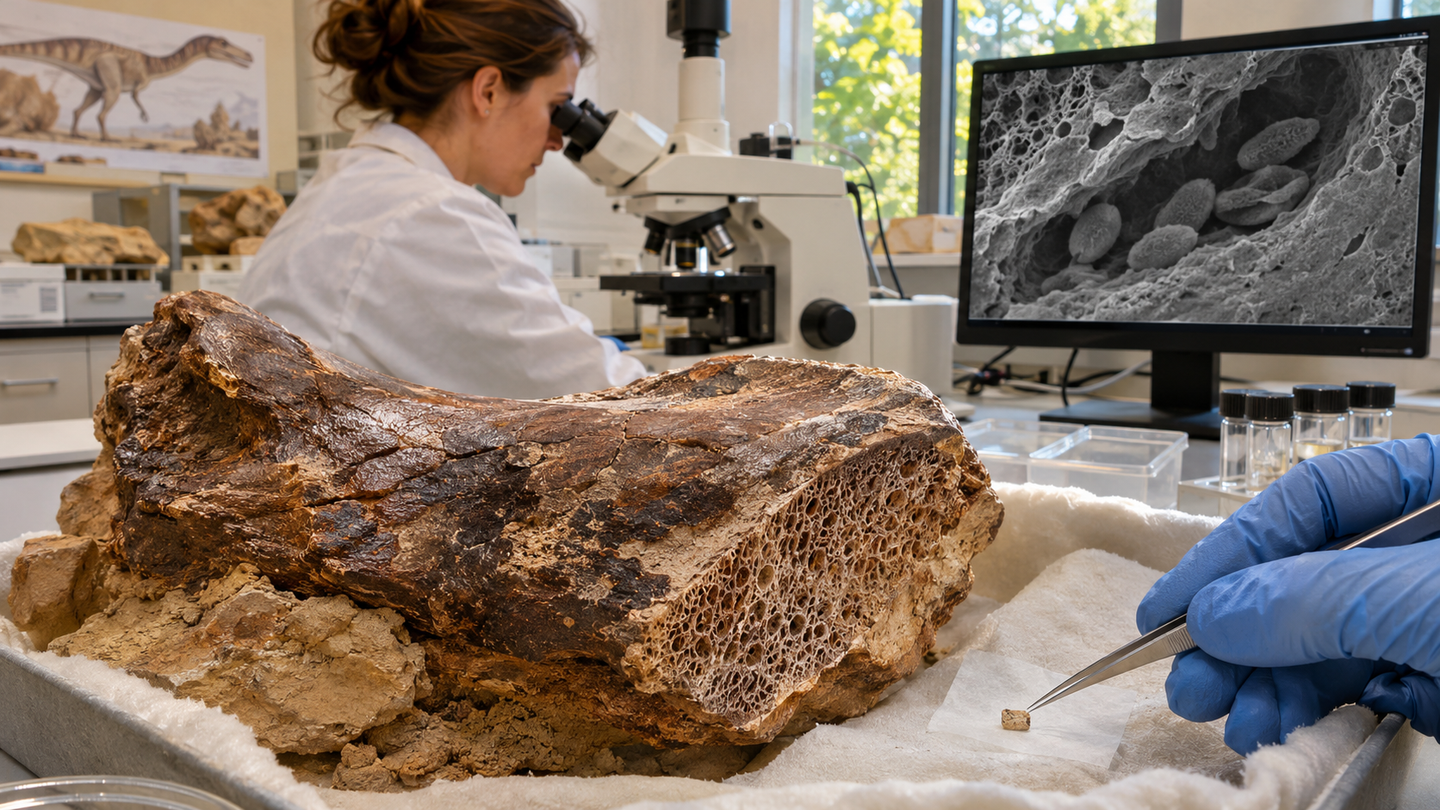
Illustrative laboratory scene depicting fossil-bone analysis. Researchers identified heme-derived molecules associated with mineralized structures interpreted as red blood cells in 115-million-year-old Aratasaurus bones. (CREDIT: The Brighter Side of News)
- A study reports blood-derived molecules in mineralized structures interpreted as red blood cells inside 115-million-year-old dinosaur bones.
- Chemical extraction, Raman spectroscopy and electron microscopy connect heme-related signals with microscopic structures in vascular canals.
- The findings strengthen evidence for exceptional molecular preservation, but do not establish intact hemoglobin proteins or dinosaur DNA.
Tiny structures inside a dinosaur's limb bones have retained chemical traces associated with blood for approximately 115 million years. The structures sit within canals that once carried blood vessels. Researchers identified heme-related molecules and mapped supporting chemical signals to the microscopic remains. Together, those findings strengthen the case that the structures represent mineralized red blood cells.
An international team led by Curtin University examined bones of Aratasaurus museunacionali, a theropod dinosaur recovered in northeastern Brazil. Their study, reported in Proceedings of the National Academy of Sciences, combines molecular identification with detailed imaging. That combination matters because a cell-like shape alone cannot establish a biological origin. The chemistry must support the interpretation.
The result adds to research investigating molecules preserved in fossil bones. Here, the important evidence concerns both what survived and where it remained. The team found molecular traces associated with hemoglobin, the protein responsible for transporting oxygen in blood. This is evidence of blood-derived remnants, rather than blood preserved in its living state.
Finding chemistry inside cell-like structures
The bones contained numerous ellipsoidal microstructures within their vascular canals. Their location and appearance suggested red blood cells, but the researchers investigated further. The species’ original description in a 2020 study documented an incomplete but articulated right hind limb, providing anatomical context for the animal now examined at molecular scales. Fossils can contain minerals or later biological material that complicate interpretation. Distinguishing original remains from those alternatives requires several complementary kinds of evidence.
The team used high-performance liquid chromatography coupled with mass spectrometry to analyze extracts from the bones. This approach separates chemical components and helps identify molecules through their mass-related signals. The analysis identified heme B and versions altered during fossilization. These were the principal compounds detected within the molecular group known as tetrapyrroles.
Heme contains an iron atom within a ring-shaped molecular framework. In hemoglobin, it enables oxygen binding. Finding heme-related compounds therefore provides a chemical link to blood, although heme identification must be interpreted in context. The study's additional imaging and comparisons supplied that context, connecting the molecular evidence with the structures inside bone.
Lead author Kliti Grice is a John Curtin Distinguished Professor and an Australian Research Council Laureate Fellow. She founded Curtin's WA-Organic and Isotope Geochemistry Centre. “To detect intact heme derived molecules in 115-million-year-old red blood cells is astonishing: this really is a landmark discovery,” Grice said.
Why location strengthens the evidence
The researchers compared the bone chemistry with the surrounding sedimentary matrix. The matrix contained porphyrin signatures associated with chlorophyll and bacteriochlorophyll. Those differed from the heme-related compounds dominating the bone extracts. The contrast supports an endogenous origin, meaning the compounds originated within the animal rather than simply entering from surrounding material.
Separate analyses examined the microscopic structures without relying solely on the extracted mixture. Raman spectroscopy detected porphyrin signals associated with heme at those locations. The method uses scattered light to investigate molecular vibrations. It helped connect the chemistry to particular structures, rather than merely showing that relevant molecules existed somewhere in the bone.
Transmission electron microscopy supplied another layer of evidence. The analyses localized iron, nitrogen and carbon, key elements of heme, to the ellipsoidal microstructures. They also identified the mineral hausmannite. Elemental signals alone would not identify a red blood cell, but their agreement with the molecular and anatomical evidence strengthens the overall interpretation.
That distinction also matters in studies of ancient proteins. Recognizing a chemical signal is only part of the investigation. Researchers must also establish its source and relationship to the fossil. Here, the agreement between extracted molecules and spatially mapped signals reduces the likelihood that unrelated material explains the findings.
A mineral-assisted route to preservation
The researchers identified hausmannite, a manganese oxide, in association with the preserved structures. They propose that mineralization helped stabilize the cellular remains and their molecular components. This offers a possible explanation for their survival across deep time. Detecting the mineral today, however, does not directly reveal every stage of the preservation process.
The team favors rapid burial in an oxygen-poor environment rich in microorganisms shortly after the dinosaur died. That setting, combined with mineral formation, may have helped preserve otherwise vulnerable biological material. The explanation concerns exceptional conditions, rather than an expectation that all dinosaur bones retain comparable remnants. Different burial and geological histories can produce very different outcomes.
The announcement also reports amino acids associated with collagen, a structural protein found in bone and connective tissues. Those building blocks should not be confused with a complete, undamaged collagen protein. Similarly, heme-derived molecules are not equivalent to an intact hemoglobin molecule. The finding concerns surviving molecular information and mineralized structures, not preserved biological function.
Understanding exceptional fossil preservation requires examining these relationships between anatomy, chemistry and minerals. A fossil may preserve different kinds of information through different mechanisms. The heme results make the chemical record especially important here. They provide evidence beyond the shape of the bone or the appearance of microscopic objects.
Building on earlier molecular discoveries
Blood-related chemistry in dinosaur fossils has a substantial research history. A 1997 study reported evidence for heme-containing compounds or hemoglobin breakdown products in Tyrannosaurus rex bone extracts. That work used several analytical approaches. It means the present finding should not be described simply as the first detection of heme-related material in dinosaurs.
A 2025 study also used resonance Raman methods to investigate partial hemoglobin preservation in dinosaur remains. The new research emphasizes the association between blood-derived molecular signals and mineralized cell-like structures within vascular canals. Its contribution lies in that combined evidence. Establishing how broadly comparable preservation occurs remains a separate question.
The international collaboration included the Japan Agency for Marine-Earth Science and Technology and Brazil's National Museum. Researchers from the Regional University of Cariri and Johns Hopkins University also participated. The project drew on chemistry, microscopy and paleontology. Funding came through the ARC Laureate Fellowship awarded to Grice in 2021.
What the molecules might eventually reveal
“It opens exciting new avenues for molecular-level palaeontology, allowing us to investigate the evolution of blood, metabolism and even activity levels in ancient animals,” Grice said. Those are prospective research directions. Detecting heme does not itself measure this dinosaur's metabolic rate or establish its endurance. Such conclusions would require additional evidence and comparisons.
Curtin's head of Earth and Planetary Sciences, Martin Van Kranendonk, highlighted potential implications for astrobiology. Understanding molecular survival on Earth can inform questions about ancient-life signatures elsewhere. The present study, however, examines a terrestrial fossil. It does not demonstrate biological remains on another planet.
The findings make the mineral environment an important part of future investigations. Researchers can ask which burial conditions preserve recognizable structures alongside their original chemical traces. Comparisons across other fossils could test how consistently those two records agree. That would help establish how much ancient physiology can be reconstructed from the molecules that survive.
Dig deeper into molecular fossil preservation
These studies explore earlier molecular evidence, mineral preservation and the dinosaur behind the new findings.
Resonance Raman confirms partial haemoglobin preservation in dinosaur remains
This study examines heme-related signals and their association with protein remnants and the mineral goethite. (Proceedings of the Royal Society A, September 2025)
In situ analysis of vascular structures in fractured Tyrannosaurus rex rib
This investigation examines mineralized vessel-like structures and illustrates why anatomy and chemistry need to be studied together. (Scientific Reports, July 2025)
The first theropod dinosaur (Coelurosauria, Theropoda) from the base of the Romualdo Formation (Albian), Araripe Basin, Northeast Brazil
The original description introduces Aratasaurus and documents the anatomy and geological setting of its remains. (Scientific Reports, July 2020)
Palaeobiology of red and white blood cell-like structures, collagen and cholesterol in an ichthyosaur bone
This study investigates cellular structures and molecular traces in a much older marine reptile fossil. (Scientific Reports, October 2017)
Heme compounds in dinosaur trabecular bone
This foundational paper reports multiple lines of evidence for blood-derived compounds in dinosaur bone extracts. (Proceedings of the National Academy of Sciences, June 1997)
Research findings are available online in the journal PNAS.
The original story "Scientists find first-ever evidence of fossilized blood cells in 115-million-year-old dinosaur bones" is published in The Brighter Side of News.
Related Stories
- A feather found in dinosaur poop could help explain why birds survived the dinosaur extinction
- First warm-blooded dinosaurs evolved 180 million years ago, study finds
- Scientists discover how crocodiles survived the asteroid that killed the dinosaurs
Like these kind of feel good stories? Get The Brighter Side of News' newsletter.
Joshua Shavit
Writer and Editor
Joshua Shavit is a NorCal-based science and technology writer with a passion for exploring the breakthroughs shaping the future. As a co-founder of The Brighter Side of News, he focuses on positive and transformative advancements in technology, physics, engineering, robotics, and astronomy. Having published articles on AOL.com, MSN, Yahoo News, and Ground News, Joshua's work highlights the innovators behind the ideas, bringing readers closer to the people driving progress.