Can traveling faster than light take you back in time?
Can traveling faster than light take us into the past? A closer look at warp drives, wormholes and quantum studies separates real effects from speculation.
 Editor: Joshua Shavit

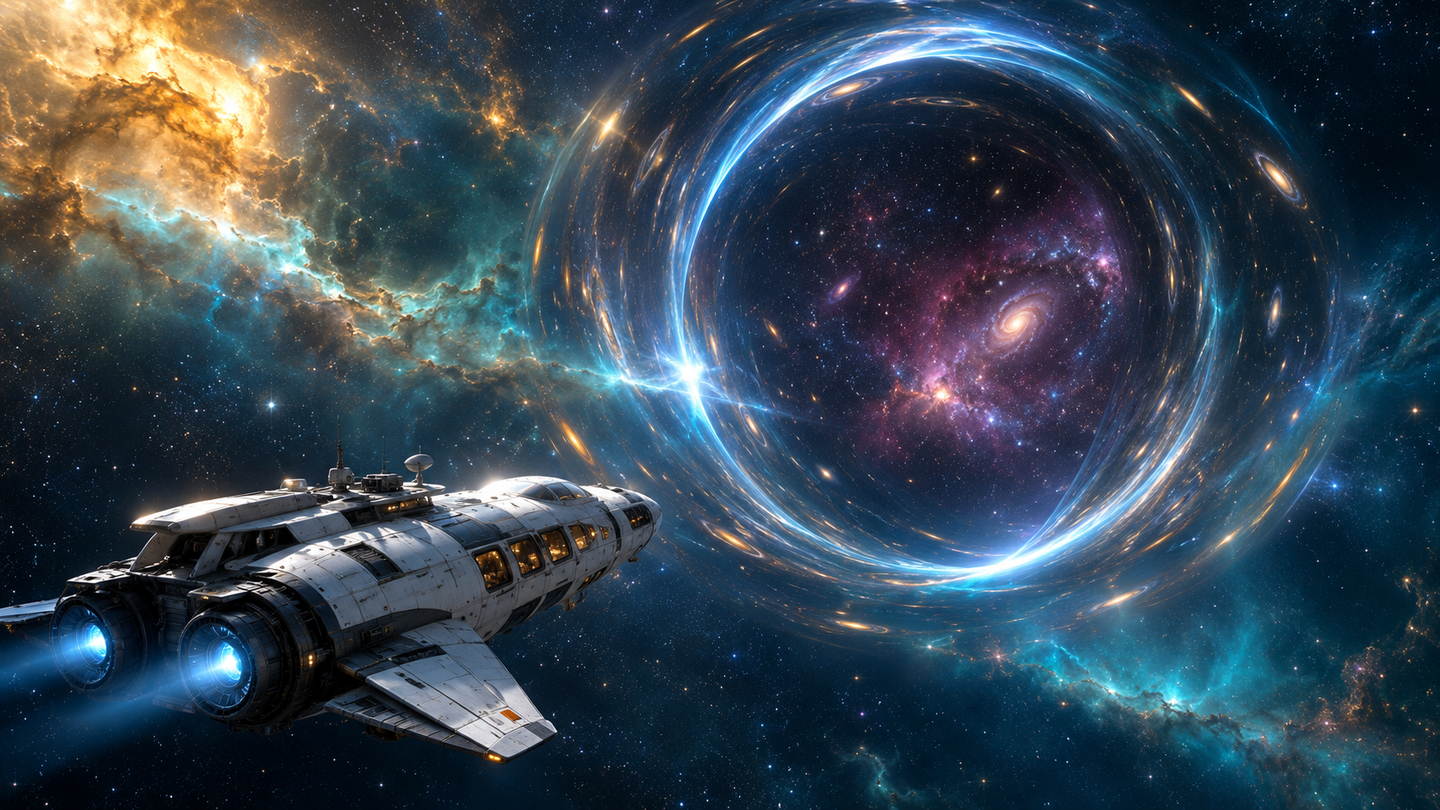
A spacecraft approaches a hypothetical wormhole in this artist’s visualization of a possible shortcut through spacetime. (CREDIT: The Brighter Side of News)
Is it possible to time travel by traveling faster than the speed of light? Suppose you could build a rocket that kept accelerating. Would its clock eventually stop, then run backward, carrying you into yesterday?
The question combines two different possibilities. Traveling into someone else’s future is supported by experiments. Returning to the past is not. The Brighter Side of News previously examined this time travel question, and newer studies have explored several proposed loopholes.
Those proposals include hypothetical particles, warped space, wormholes and quantum processes. Some produce genuine effects with misleading descriptions, such as reversing a photon’s evolution. Others work mathematically under assumptions nobody has demonstrated physically. Here is what each route actually offers.
Traveling into the future: yes, without crossing light speed
Imagine taking a fast spacecraft journey while your friend stays home. When you reunite, your watch could show less elapsed time than theirs. Your heartbeat, thoughts and wristwatch would have seemed normal throughout your trip.
This is time dilation, central to Einstein’s account of light and time. During an idealized cruise at 99.5 percent of light speed, about ten Earth years pass for each year aboard. Acceleration and the return journey complicate a real mission, but the basic effect is established.
Scientists at the National Institute of Standards and Technology have measured differences between atomic clocks caused by motion and height. Gravity changes elapsed time too: a clock deeper in a gravitational field can accumulate less time than one farther away. That helps explain the strange timing associated with black holes.
Verdict: unequal aging is real. It provides a route into Earth’s future, without providing a return ticket to Earth’s past.
Crossing the barrier: rockets, tachyons and causality
Light travels through a vacuum at about 300,000 kilometers per second. Under special relativity, accelerating an object with mass toward that speed requires ever more energy. Reaching it would require unlimited energy. A larger engine cannot carry a conventional rocket across that boundary.
You also cannot climb aboard a photon and watch time stop. Relativity provides no valid rest frame for light. Extending a moving clock’s slowing rate into backward ticking is not a permitted calculation.
Hypothetical tachyons would already occupy the faster-than-light side. They have not been detected. A proposed quantum field theory attempts to describe them, but physicist Krzysztof Jodłowski has published objections to its consistency. The proposal remains disputed, rather than an established discovery.
Another paper, Superluminal quantum reference frames, extends mathematical descriptions to hypothetical faster-than-light observers. It supplies no method for making such an observer.
Why does this raise time-travel questions? Observers moving relative to one another can disagree about the order of events separated too widely for light to connect them. If usable faster-than-light signals could travel both ways under ordinary relativity, a reply could reach you before you sent the original message.
Suppose that reply said, “Do not send the message.” Obeying it would erase the reason the reply existed. This is a conflict between cause and effect, beyond the familiar delay of seeing distant events.
Verdict: the causal problem is serious, but neither tachyons nor mathematical observers establish a working time machine.
Warp drives: changing the route through spacetime
A warp drive attempts a different maneuver. Instead of pushing a ship through nearby space faster than light, it changes spacetime’s geometry around the ship. Some proposed geometries allow a journey that outpaces light traveling through the surrounding, unmodified space.
The missing step is creating that geometry. Many superluminal models require negative energy arranged in ways nobody knows how to produce. Limited quantum effects involving negative energy do not establish that a spacecraft-sized supply is possible.
Jared Fuchs and colleagues described a positive-energy model in Constant velocity physical warp drive solution. Crucially, their solution travels below light speed. It does not solve faster-than-light time travel.
University of Queensland researchers Achintya Sajeendran and Timothy Ralph also modeled a rotating warp spacetime containing paths that loop into the past. Their paper explicitly questions whether its geometry could physically exist.
Verdict: useful mathematical investigations, with no demonstrated superluminal drive or machine for visiting yesterday.
Wormholes and other gravitational shortcuts
A wormhole would connect distant regions through a shortcut. Picture two doorways linked by a short corridor. If the doorways accumulated different amounts of elapsed time, passing through could potentially connect different dates.
Valeri Frolov, Pavel Krtouš and Andrei Zelnikov explored this possibility in a ring wormhole model. Their analysis begins with a traversable wormhole whose supporting matter violates a standard condition governing energy. It does not show how to obtain that matter or construct the doorway.
Idealized rotating black-hole geometries and other unusual spacetime models also contain paths that loop backward in time. Their existence in equations does not establish a stable, accessible route in the actual universe. Crossing a real black hole’s event horizon supplies no known return journey.
Proposals involving rapidly passing cosmic strings face similar problems: assuming extraordinary structures exist and move appropriately is different from showing that a time machine can form. Strings remain hypothetical. Other models invoke an infinitely long spinning cylinder or a rotating universe. Neither describes a demonstrated arrangement we can use.
Nor did researchers create a physical tunnel in the much-discussed quantum-computer wormhole experiment. Their study examined quantum behavior with a mathematical connection to wormhole physics.
Requiring a self-consistent history, or imagining a branching timeline, might address a paradox conceptually. Neither supplies the missing physical mechanism.
Verdict: conditional possibilities within theoretical models, without an observed traversable wormhole or usable gravitational time machine.
Quantum reversals and things that appear faster than light
Quantum entanglement produces correlations between distant measurements. It does not let you choose a message that instantly appears elsewhere. Quantum teleportation also requires ordinary communication, preserving the light-speed limit.
Experiments described as quantum time reversal can restore an earlier quantum state. Think of undoing a calculation: the earlier result returns, but the laboratory clock keeps advancing. Nobody receives tomorrow’s experimental result yesterday.
A separate study by Kaiyuan Ji, Seth Lloyd and Mark Wilde calculates limits on hypothetical backward-time communication using a particular quantum model. Calculating a channel’s capacity does not demonstrate that nature supplies the channel.
Other apparent loopholes involve wave patterns. In a recent study, researchers tracked dark points moving faster than light within structured optical fields. Those points carry no information. Likewise, unusual tunneling times or wave-peak speeds do not establish faster-than-light messaging.
Cosmic expansion is different again: sufficiently distant galaxies can recede faster than light because space between us expands. That does not let a nearby spacecraft outrun a light beam.
Verdict: real effects and worthwhile models, without demonstrated communication into the past.
Practical implications
For navigation, the useful discovery is already here. Satellite systems account for relativity’s effects on clocks. Future spacecraft could produce much larger differences in aging, although the light-speed barrier remains.
For time-machine claims, ask what was achieved: a measurement, a simulation, or an assumed geometry? Research into wormholes explores profound questions without proving a doorway exists. Traveling faster than light could create backward-time problems in relativity, but no demonstrated method lets us do it. We can reach someone else’s future. Visiting yesterday remains an unanswered possibility, not an available journey.
Dig deeper
Retrocausal Capacity of a Quantum Channel: Communicating through Noisy Closed Timelike Curves: Calculates communication limits within a hypothetical quantum model of backward-time signaling. (Physical Review Letters, June 2026)
Superluminal quantum reference frames: Examines mathematical transformations involving hypothetical faster-than-light quantum observers. (New Journal of Physics, April 2026)
Superluminal correlations in ensembles of optical phase singularities: Reports measurements of optical singularities whose superluminal motion does not carry information. (Nature, March 2026)
Looping back to the past through free fall in a controlled warp drive spacetime: Develops a theoretical warp geometry with looping paths while acknowledging uncertainty about physical realization. (Physical Review D, June 2025)
Constant velocity physical warp drive solution: Presents a positive-energy warp model that remains below light speed. (Classical and Quantum Gravity, April 2024)
The original story "Can traveling faster than light take you back in time?" is published in The Brighter Side of News.
Related Stories
- Wormholes may enable time travel, astrophysicists find
- New tachyon theory could unlock the secrets of time travel and causality
- The unexpected consequence of time travel: complete memory loss
Like these kind of feel good stories? Get The Brighter Side of News' newsletter.
Joseph Shavit
Writer, Editor-At-Large and Publisher
Joseph Shavit, based in Los Angeles, is a seasoned science journalist, editor and co-founder of The Brighter Side of News, where he transforms complex discoveries into clear, engaging stories for general readers. With vast experience at major media companies like The Los Angeles Times, Times Mirror and Tribune Publishing, he writes with both authority and curiosity. His writing focuses on space science, planetary science, quantum mechanics, geology. Known for linking breakthroughs to real-world markets, he highlights how research transitions into products and industries that shape daily life.