
Smart robotic bicycle system helps riders stay balanced and in control
A steer-by-wire bicycle combines motion measurements and steering-force estimates to distinguish a planned turn from instability. Experimental rides demonstrated selective balance assistance, although broader testing remains necessary.
 Shibaura Institute of Technology Writer: Kohei Tsuchiya

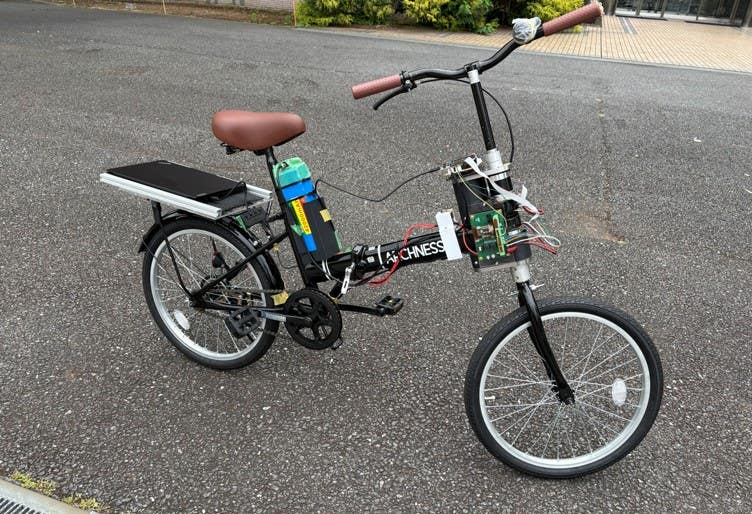
A steer-by-wire bicycle developed by researchers at Japan’s Shibaura Institute of Technology uses artificial intelligence and haptic feedback to improve rider stability and safety. (CREDIT: Associate Professor Hiroaki Kuwahara/Shibaura Institute of Technology)
A bicycle leaning into a bend can look uncomfortably similar to one beginning to fall. For its rider, the difference may be obvious. For a computerized assistance system, that distinction creates a difficult problem: trying to straighten the bicycle could interrupt exactly the turn the rider intended. The system therefore needs more context than the angle of the frame before deciding whether to step in.
A team at Japan’s Shibaura Institute of Technology has built an experimental bicycle that tackles this problem by interpreting how the rider and vehicle interact. The approach brings an important idea from robotic assistance to steering: useful support depends on recognizing what the person is trying to do.
Associate Professor Hiroaki Kuwahara and master’s student Shota Tsukase describe the work in IEEE/ASME Transactions on Mechatronics. Their system estimates movement intentions from physical signals, then activates balance assistance when it identifies instability. The rider continues to steer through ordinary turns.
Keeping the feel while changing the connection
To make that possible, the researchers changed a familiar part of the bicycle. Normally, a mechanical connection carries handlebar movements to the front wheel. Their steer-by-wire prototype replaces that connection with electronic signals, using separate motors at the handlebars and front-wheel steering assembly. Separating those assemblies lets the controller examine the rider’s input and the front wheel’s response as distinct signals.
That arrangement could leave the rider disconnected from the road unless the system also returned useful sensations. The team therefore used haptic feedback, which communicates through forces or touch. When the front tire encounters resistance, the handlebar motor reproduces a corresponding steering sensation.
The exchange works in both directions: the rider sends a steering movement forward and receives information about the vehicle’s response. Unlike the vibrations used in some touch interfaces, this feedback involves steering forces. It also gives the researchers information about the interaction between rider, bicycle and road.
“By analyzing the interaction between the rider and the vehicle, we aimed to create a mobility system that provides support only when it is truly needed,” Kuwahara said. Preserving steering feel and interpreting steering behavior were therefore connected parts of the design. The electronics needed to keep that exchange useful to the rider as well as to the classification software.
Reading a sequence of movements
The next challenge was deciding what those signals meant. A tilted bicycle alone does not reveal whether a turn is deliberate. The researchers combined seven measurements covering speed, both steering angles, estimated reaction torques at both steering assemblies, sideways acceleration and the bicycle’s lean. Taken together, these measurements provide a richer picture than a balance controller could obtain by watching the frame tilt alone.
Motor currents and a mathematical estimation method supplied the torque information without separate torque sensors. An inertial measurement unit recorded lean and sideways acceleration. Together, these movement signals described both the bicycle’s motion and its interaction with the rider.
Rather than judge each instant independently, the team used a long short-term memory network, or LSTM. This form of machine learning looks for patterns across a sequence. That matters because entering a corner and struggling to recover balance can briefly produce similar movements.
Before training the network, the researchers used K-means clustering to group experimental data into three riding categories: straight travel, cornering and instability. The method reduced reliance on manually chosen thresholds, although the authors acknowledge that ambiguous movements can still receive inconsistent labels. The network then learned to recognize those categories as the bicycle moved.
Helping without taking over a turn
Once the system classified a situation, a separate controller decided how to respond. During straight riding and intentional cornering, the additional stabilization controller stayed inactive. When the model identified instability, that controller calculated steering torque to help bring the bicycle back toward an upright position.
The distinction is central to adaptive assistance. Continuously correcting every lean would work against the movement needed to negotiate a bend. Here, the classification acts as a gate, determining when balance correction becomes appropriate.
The researchers also eased the start of an intervention rather than abruptly applying the full correction. That transition aims to preserve manageable steering as assistance begins. As with other systems designed to retain human control, how help arrives matters alongside whether it arrives.
In one riding experiment, the system identified instability about 13.5 seconds into the run. The bicycle’s lean increased, then returned toward zero after stabilization activated. Later, the model recognized the route’s curve and allowed the rider to continue cornering without that additional correction. This sequence demonstrated the intended switching behavior, although it cannot establish that every disturbance would produce a successful recovery.
What the experiments establish
The results support the basic design, while also showing why the classification problem remains difficult. Across the evaluated dataset divisions, overall accuracy stayed around 80 percent. Straight riding was easier to recognize, with average accuracy above 90 percent. The harder distinction was between two situations that share similar motions but call for different responses from the controller.
Errors appeared around transitions into and out of corners, where movements overlapped with those used to maintain balance. That limitation matters for physical assistance: a mistaken classification can affect when the machine intervenes. The system therefore targets clearly identified unstable conditions rather than treating every uncertain movement as a reason to correct the rider.
The dataset came from three experimental runs involving straight travel and cornering, with labels derived from clustering. Matching those labels does not independently establish that the model correctly reads every rider’s intent. It provides an initial test of adaptive control, rather than evidence of fewer crashes across everyday cycling conditions.
The prototype updated its classification every 10 milliseconds, separately from a faster steering-control loop. That arrangement demonstrated online operation, allowing recognition and intervention during a ride. It leaves broader questions about different riders, routes and surfaces for further experiments.
Making assistance useful beyond the test route
Those questions shape the team’s next steps. The researchers plan to recognize more riding situations and improve their understanding of road surfaces. A system intended for electric bicycles would need to respond appropriately across conditions beyond the experimental route. Recognizing a bend on that route is a starting point for learning when assistance belongs in more varied journeys.
Potential applications include electric motorcycles, shared bicycles and delivery vehicles. Kuwahara also sees possible benefits for older riders and less experienced users. Those remain proposed uses, rather than groups shown to benefit in this study. Further work would need to establish whether the assistance remains appropriate as people’s steering habits and balance responses vary.
“Our goal is to move beyond conventional automated control toward human-cooperative control,” Kuwahara said. The aim is a bicycle that recognizes when assistance is useful while leaving deliberate maneuvers to its rider. This prototype demonstrates a way to make that decision, with further testing needed to establish how reliably it can do so outside the experimental setting.
Dig deeper into bicycle balance and cooperative control
These resources explore balance assistance, force feedback and the learning method behind the prototype.
- Enabling human–robot teaming through haptic feedback: From caged automation to collaborative interaction: Reviews how force and touch feedback support communication, shared control and physical cooperation between people and machines. (Robotics and Autonomous Systems, October 2026)
- Automatic bicycle balance assistance reduces probability of falling at low speeds when subjected to handlebar perturbations: Tests steering assistance with 26 riders exposed to handlebar disturbances, finding improved recovery at a travel speed of 6 kilometers per hour. (IATSS Research, April 2026)
- Bicycle balance assist system reduces roll and steering motion for young and older bicyclists during real-life safety challenges: Examines how steering assistance affects bicycle motion during disturbances and multitasking, including comparisons between younger and older cyclists. (PeerJ, October 2023)
- A Bicycle Can Be Self-Stable Without Gyroscopic or Caster Effects: Demonstrates that bicycle stability depends on interacting design features, challenging familiar explanations based solely on spinning wheels or caster geometry. (Science, April 2011)
- Long Short-Term Memory: Introduces the neural-network architecture used to learn patterns across time, providing the foundation for the prototype’s riding-scenario classifier. (Neural Computation, November 1997)
Research findings are available online in the journal IEEE/ASME Transactions on Mechatronics.
The original story "Smart robotic bicycle system helps riders stay balanced and in control" is published in The Brighter Side of News.
Related Stories
- Portable E-Motor Turns Any Bicycle Into an E-Bike
- Extraordinary Journey: Man Bikes 2,500 Miles Across West Africa and Sahara to Pursue Education
- Researchers finally make bike-sharing work
Like these kind of feel good stories? Get The Brighter Side of News' newsletter.
Joshua Shavit
Writer and Editor
Joshua Shavit is a NorCal-based science and technology writer with a passion for exploring the breakthroughs shaping the future. As a co-founder of The Brighter Side of News, he focuses on positive and transformative advancements in technology, physics, engineering, robotics, and astronomy. Having published articles on AOL.com, MSN, Yahoo News, and Ground News, Joshua's work highlights the innovators behind the ideas, bringing readers closer to the people driving progress.