Scientists grow cow’s milk protein in everyday plants, advancing sustainable dairy production
Researchers grow milk protein in plants, opening a path to sustainable dairy without cows.

 Edited By: Joseph Shavit

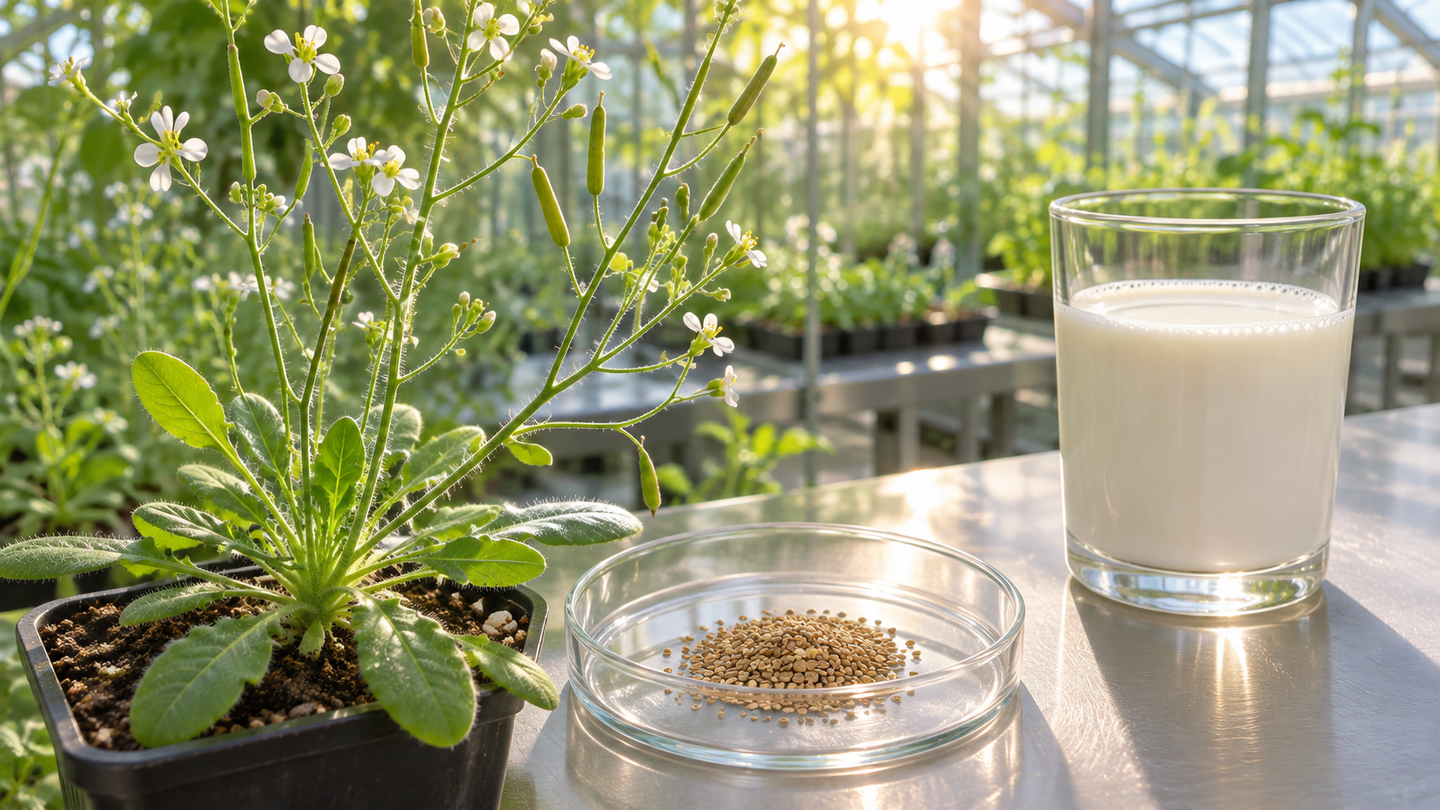
In this illustration, an Arabidopsis plant and its seeds sit beside a glass of milk. Researchers engineered the seeds to make a modified form of β-casein, a protein found in cow’s milk, and found that it accumulated in unexpected clusters associated with oil droplets. (CREDIT: The Brighter Side of News)
A quiet shift is taking place in how food could be made in the future. Scientists are beginning to explore whether plants can produce the same proteins that give milk its taste, texture, and nutrition. New research from the Hebrew University of Jerusalem suggests that goal may be closer than expected.
In a study, researchers showed that plant seeds can produce β-casein, one of the most important proteins found in cow’s milk. The findings reveal not only that plants can make this protein, but also that they may store it in ways scientists did not predict.
A Search For Sustainable Dairy
Global demand for dairy continues to grow. At the same time, concerns about climate impact, land use, and water consumption are rising.
Livestock farming contributes a significant share of greenhouse gas emissions. It also requires large amounts of feed and water. These pressures have led scientists to look for new ways to produce food.
Plant-based milk alternatives already exist, but they often lack the texture and functionality of real dairy. The difference comes down to proteins.
Milk contains a group of proteins called caseins. These proteins form structures that give dairy its creamy feel and allow cheese to melt and stretch.
Among them, β-casein plays a key role. It makes up about one third of milk proteins and helps create the familiar properties of dairy products.
Turning Plants Into Protein Factories
To recreate dairy proteins without cows, researchers turned to a method known as plant molecular farming. This approach uses plants as living systems to produce complex proteins.
Plants offer several advantages. They grow using sunlight, water, and soil. They can also produce large amounts of material at relatively low cost.
However, producing animal proteins in plants is not simple. Proteins must fold correctly and remain stable inside plant cells. They must also be stored in a way that allows them to accumulate.
The research team, led by Prof. Oded Shoseyov, set out to solve this problem. They engineered plant seeds to produce bovine β-casein by inserting the gene responsible for the protein.
To improve storage, they attached the protein to a plant molecule called oleosin. This molecule naturally binds to oil bodies, which are small lipid storage structures inside seeds.
An Unexpected Discovery Inside Cells
The scientists expected the protein to collect in storage compartments known as vacuoles. These areas typically hold proteins in plant cells.
Instead, they found something entirely different.
Using advanced imaging, the team observed that the milk protein formed new structures inside the seeds. These structures appeared as dense clusters linked to tiny oil bodies.
Rather than following the intended path, the protein created its own storage system.
“One of the most exciting aspects of science is when nature surprises you,” said Prof. Oded Shoseyov. “We set out to send the protein to one location inside the cell, but instead discovered that the plant had effectively created its own storage solution.”
These clusters resembled natural casein micelles, the same type of structures found in milk. This similarity suggests that plants may be able to recreate not just the protein, but also its functional form.
Measuring How Much Protein Was Produced
The researchers tested several versions of the engineered plants to find the most effective design.
The best performing seeds produced β-casein at about 1.26 percent of total soluble protein. This level is higher than many previous attempts to produce similar proteins in plants.
Although the percentage may seem small, it marks a meaningful step forward. Earlier studies often produced much lower levels, sometimes below 0.5 percent.
The plants remained healthy and continued to grow. Seed germination rates stayed strong, showing that the added protein did not harm development.
Why Storage Matters For Protein Production
Where a protein is stored inside a cell can determine how much of it accumulates. If a protein is unstable, it may break down before it can build up.
The unexpected storage near oil bodies may offer advantages. These lipid structures could help protect the protein and keep it stable.
The findings suggest that plants may have natural pathways for handling complex proteins. By understanding these pathways, scientists may be able to improve production in future studies.
Expanding Beyond Model Plants
The study first used a model plant often chosen for laboratory research. However, the team has already moved beyond this stage.
Researchers recently introduced the same concept into safflower plants. This crop grows well in hot and dry conditions, making it suitable for large scale agriculture.
Using crops like safflower could help bring the technology closer to real world use. It may allow protein production in regions with limited resources.
A Step Toward Real Dairy Without Animals
The ability to produce casein in plants could change how dairy products are made. Instead of relying on livestock, future systems may grow key ingredients directly in crops.
This approach differs from traditional plant based alternatives. Rather than replacing dairy proteins, it aims to recreate them.
If successful, this method could produce milk proteins with the same nutritional and functional qualities as those from animals.
It may also reduce environmental impact. Crops require fewer resources than livestock and produce fewer emissions.
Challenges Still Ahead
Despite the progress, several hurdles remain.
Scientists need to increase protein yields to levels suitable for large scale production. They must also develop efficient methods to extract and purify the proteins.
Regulatory approval and public acceptance will play important roles as well. Consumers will need to trust and understand how these products are made.
Researchers also need to study how these proteins behave in food systems. It is not enough to produce them. They must perform the same way in products like cheese and yogurt.
Practical Implications Of The Research
This research could reshape how food is produced in the coming decades. By enabling plants to produce dairy proteins, scientists may create a more sustainable food system that reduces reliance on livestock.
For consumers, this could lead to dairy products that match traditional taste and texture while lowering environmental impact. It may also expand access to high quality protein in regions where dairy farming is difficult.
For researchers, the study provides new insight into how plant cells handle complex proteins. The discovery of alternative storage pathways could improve not only food production, but also the development of plant based systems for medicine and nutrition.
In the long term, plant molecular farming may offer a flexible platform for producing a wide range of valuable proteins. This could include ingredients for food, pharmaceuticals, and industrial applications.
Dig deeper into casein and plant molecular farming
Heterologous Caseins: The Role of Phosphorylation in Their Functionality and How to Achieve It
A review examines how phosphate groups affect casein and why reproducing those properties in other organisms is challenging. (Foods, July 2025)
Exploring recent progress of molecular farming for therapeutic and recombinant molecules in plant systems
The authors review how plants can make proteins and other molecules for different applications. (Heliyon, September 2024)
How plants solubilise seed fats
Researchers review the structure and role of oleosins in seed oil bodies. (Biophysical Reviews, February 2022)
The structure of the casein micelle of milk and its changes during processing
The review explains how casein particles are organized and how processing can change them. (Annual Review of Food Science and Technology, April 2012)
Processing and localization of bovine beta-casein expressed in transgenic soybean seeds
An earlier experiment follows bovine β-casein production and storage in soybean seeds. (Transgenic Research, June 2001)
Research findings are available online in the journal Frontiers in Plant Science.
The original story "Scientists grow cow's milk protein in everyday plants, advancing sustainable dairy production" is published in The Brighter Side of News.
Related Stories
- Dairy or plant-based: which type of milk provides the most health benefits
- Milk and wheat proteins identified as potent defenses against cholera
- Scientists create smart lactation pad to monitor breast milk in real time
Like these kind of feel good stories? Get The Brighter Side of News' newsletter.
Joshua Shavit
Writer and Editor
Joshua Shavit is a NorCal-based science and technology writer with a passion for exploring the breakthroughs shaping the future. As a co-founder of The Brighter Side of News, he focuses on positive and transformative advancements in technology, physics, engineering, robotics, and astronomy. Having published articles on AOL.com, MSN, Yahoo News, and Ground News, Joshua's work highlights the innovators behind the ideas, bringing readers closer to the people driving progress.