JWST finds Nāpōwawāʻenakaulua, a record-setting quasar pair from the cosmic dawn
Two bright sources from cosmic dawn may form the closest quasar pair known from that era. Their spectra favor two black holes, with lensing still possible.
 NOIRLab Writer: Silvia Onorato

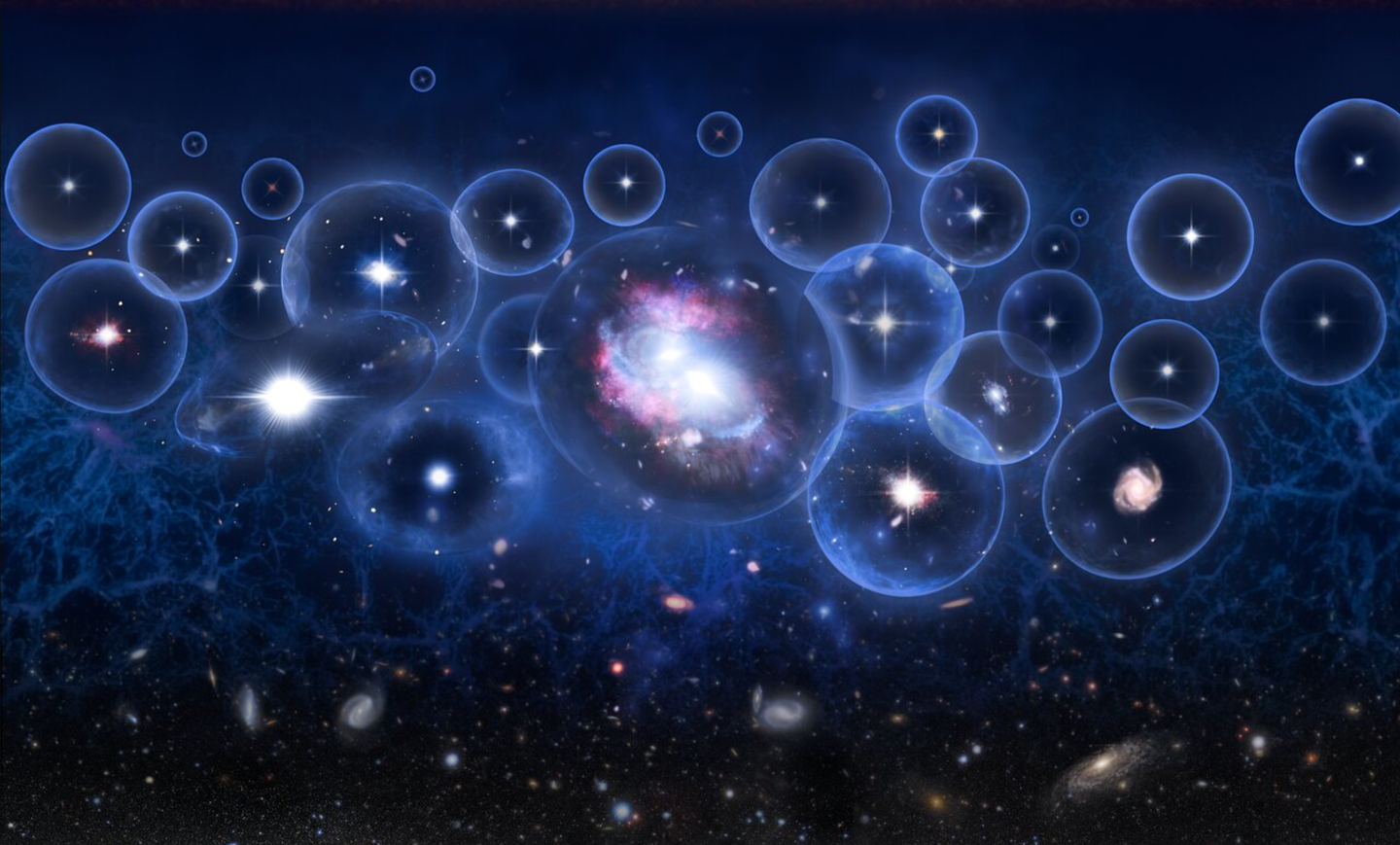
An artist’s impression of Nāpōwawāʻenakaulua, the oldest compact pair of quasars ever observed. (CREDIT: International Gemini Observatory/NOIRLab/NSF/AURA/P. Marenfeld/M. Zamani)
- Webb and Gemini North observed two quasar-like sources as they appeared about 900 million years after the Big Bang.
- The sources are about 18,100 light-years apart in projection. If they are distinct quasars, they form the closest known pair from that era.
- Differences in their spectra favor two separate sources, although the team could not definitively rule out a gravitational lens.
One of the brightest objects in a survey of the early universe had a faint neighbor. The two points were less than an arcsecond apart on the sky. Both showed the hallmarks of a quasar, the intense glow produced by gas falling toward a supermassive black hole. Seeing two points was the first clue. Figuring out whether they represented two black holes took a closer look.
Silvia Onorato of NSF NOIRLab led the team that identified the system, J1602+4228AB. The study in The Astrophysical Journal Letters combines observations from the James Webb Space Telescope and Gemini North. The light shows the sources as they appeared about 900 million years after the Big Bang, during a period astronomers call cosmic dawn.
The sources are about 18,100 light-years apart as projected onto the sky. At that distance, the two would fit well within the span of the Milky Way. If they are distinct quasars, the system would be the most distant compact quasar pair yet identified and the closest known from that period. Other Webb searches have found candidate pairs among a different population of compact red objects.
The paper estimates black hole masses of about 1.5 billion and 400 million times the Sun’s mass, assuming the sources are separate. Each would be unusually massive for such an early time. Finding both in one apparent neighborhood adds another dimension to the question of how the first black holes grew so quickly.
How Webb and Gemini separated the light
The fainter source turned up during a visual inspection of the Aether survey, a Webb program led by Emanuele Paolo Farina. The survey collected near-infrared observations of 200 quasars across a range of distances from the early universe. The team had set out to examine known targets. The neighbor of J1602+4228A was a find within one of those observations.
Webb’s instrument recorded a spectrum at each point across a small patch of sky. That let astronomers examine where the light came from and how it varied with wavelength. Gemini North then gathered separate spectra from the two sources using its near-infrared spectrograph. Favorable conditions on Maunakea helped the team collect the data over two nights. Additional optical observations helped characterize the fainter source.
Seeing the neighbor at all matters when interpreting searches for early galaxies. A bright quasar can hide a dim source that appears close to it. And even if two galaxies each contain a black hole, both may shine as quasars for only a short part of their lives. Those limits can shape which active black holes show up together in a survey.
Two quasars or two images of one
The sources have nearly identical redshifts, a measure of how far cosmic expansion has stretched their light. That is consistent with two objects in the same region. It is also consistent with one object whose light traveled to Earth along two paths. A foreground galaxy can bend light enough to create multiple images, as other observations of gravitational lensing have shown.
The team looked for a distinction in light from gas around each source. Differences in brightness or color can arise when dust dims one image or individual stars in a lens magnify parts of a quasar. Narrow emission lines come from a more extended region. They give researchers a way to compare gas motion on scales less affected by magnification from individual foreground stars.
One set of oxygen lines showed different signatures of gas flowing toward Earth. The brighter source had a stronger feature on the short-wavelength side of the line. The team takes that difference as evidence for two distinct sources. The paper also notes a possible foreground galaxy near the fainter source and leaves detailed lens modeling for follow-up. Other Webb studies use magnified light to study distant black holes, illustrating why identifying the effect of foreground galaxies matters.
The reported distance between the sources is a projected separation. It describes how far apart they appear across the sky once astronomers account for their distance. It does not measure how far one lies in front of the other. The near match in redshift supports a close association, while the true three-dimensional separation remains uncertain.
Why a close quasar pair matters at cosmic dawn
A galaxy interaction can disturb the motion of gas and help funnel it inward. That process could feed an existing black hole, but it still leaves the question of when the black hole first formed and how much it grew before the encounter. Work on early growth tests possible routes to those large masses.
The team proposes that the pair could mark an unusually dense region of the early universe. In such an environment, galaxies could interact and send gas toward their centers. If both black holes received fuel around the same time, both could shine as quasars. The observations offer a place to test that idea, while the sequence that built the two black holes remains unknown.
Black holes gain mass when they capture matter. The gas heats up as it moves inward, producing much of the light astronomers see. The challenge is to account for how large the black holes became with so little cosmic time available. Work on black hole seeds explores how a head start or periods of rapid growth might help. A close quasar pair also raises the question of whether a shared environment helped both objects grow.
The search for more pairs
One discovery in a survey of 200 targets offers a starting point for asking how often quasars light up so close together. The sample began with known quasars, and its sensitivity to a faint companion depends on how near and how bright that companion is. The team’s estimate therefore applies to a specific range of separations and brightnesses.
A broader search could also look for galaxies around the pair. Finding an excess of neighbors would give the dense-region hypothesis an independent test. Deeper observations could help determine whether the possible foreground galaxy contributes to the appearance of the sources. These are distinct questions: one concerns the pair’s surroundings, and the other concerns whether there are two quasars in the first place.
The pair has a Hawaiian name, Nāpōwawāʻenakaulua, created through the A Hua He Inoa program with the ʻImiloa Astronomy Center and Ka Haka ʻUla O Keʻelikōlani. The name evokes two dark celestial bodies and the energy released around them.
The system gives the next surveys a concrete comparison for other early quasars. More examples, including the close neighbors Webb can resolve, would help show whether this system represents a rare case or a population that surveys have struggled to see.
Dig deeper into quasar pairs
Discovery of merging twin quasars at z = 6.05
Researchers report a separate pair from a similar era and examine signs of interaction. (arXiv, May 2024)
A close quasar pair in a disk–disk galaxy merger at z = 2.17
Observations resolve two quasars in a much later galaxy merger. (Nature, April 2023)
A candidate kiloparsec-scale quasar pair at z = 5.66
A research record summarizes the evidence for another close pair and the alternative lensing explanation. (The Astrophysical Journal, December 2021)
A Constraint on Quasar Clustering at z=5 from a Binary Quasar
The authors use an early quasar pair to examine how often such objects cluster. (arXiv, January 2016)
Simulations of the formation, evolution and clustering of quasars
Simulations examine how galaxy mergers can feed black holes and drive quasar activity. (Nature, February 2005)
Research findings are available online in The Astrophysical Journal Letters.
The original story "JWST finds Nāpōwawāʻenakaulua, a record-setting quasar pair from the cosmic dawn" is published in The Brighter Side of News.
Related Stories
- Astronomers use AI to discover seven rare quasar lens candidates
- Powerful black hole pushes quasar's winds across 300,000 light-years
- ESA's Euclid telescope discovers 31 new quasars dating back 800 million years
Like these kind of feel good stories? Get The Brighter Side of News' newsletter.
Joseph Shavit
Writer, Editor-At-Large and Publisher
Joseph Shavit, based in Los Angeles, is a seasoned science journalist, editor and co-founder of The Brighter Side of News, where he transforms complex discoveries into clear, engaging stories for general readers. With vast experience at major media companies like The Los Angeles Times, Times Mirror and Tribune Publishing, he writes with both authority and curiosity. His writing focuses on space science, planetary science, quantum mechanics, geology. Known for linking breakthroughs to real-world markets, he highlights how research transitions into products and industries that shape daily life.