Purdue researchers probe how to generate and control photons on quantum chips
Three Purdue experiments explore how to make, control and stabilize the light that future quantum circuits could use.
 Purdue University Writer: Kayla Albert

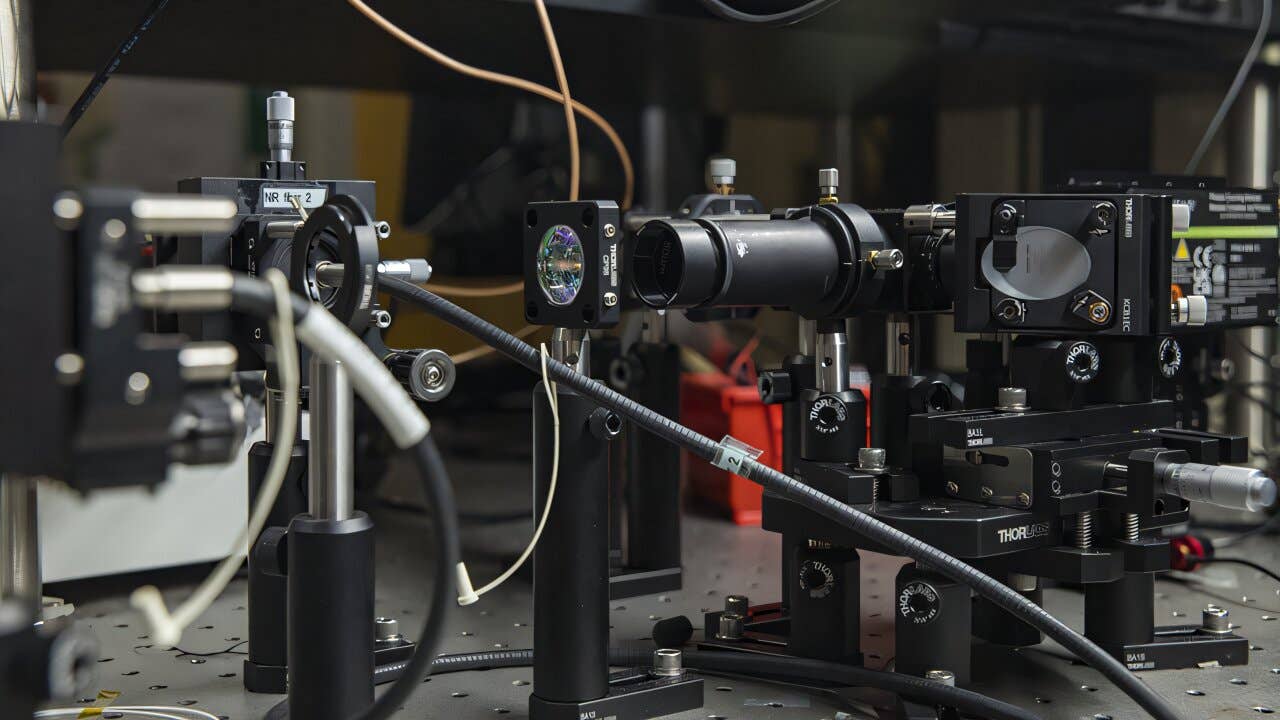
An experimental setup at Purdue University uses two laser beams, a spatial filter, and a single-photon detector to demonstrate how an individual photon can switch a stronger beam of light on and off, a potential breakthrough for processing information in quantum photonic circuits. (CREDIT: Purdue University/Kevin Crisp)
- Defects in silicon nitride can emit individual photons at room temperature.
- A separate experiment used one photon to trigger a change in a stronger beam through an electron avalanche.
- A machine-learning model forecast some frequency shifts in recorded emitter data. Applying those predictions to stabilize a live source is future work.
A quantum chip that uses light needs a reliable way to make individual photons, guide them through a circuit and keep their properties consistent enough for the intended calculation. Each job poses a different engineering problem. At Purdue University, researchers have reported separate experiments that address photon production, optical switching and the tendency of a source’s frequency to drift.
Vladimir Shalaev and Alexandra Boltasseva helped develop the photon sources and the optical switch. Alexander Kildishev and graduate student Pranshu Maan led the work on predicting frequency shifts, reported in Nature Communications. The results show what can be done with individual components and what remains to be tested when they work together.
In photonic computing, a qubit can be encoded in a property of light, such as which path a photon takes through a chip. A circuit can use both paths in a quantum superposition. Interference between the paths lets a calculation combine their contributions. Related work on quantum chips also uses controlled interference to extract information.
The challenge grows when a circuit needs many photons. Each source must provide suitable light at the right time, and the circuit must carry it with little loss. Building larger systems also means finding ways to produce and verify quantum entanglement across more components.
Tiny defects can provide single photons
The source work began with silicon nitride, a material already used in optical chips to guide light. Small defects in the material can absorb energy from a laser and emit light as they relax. Certain defects tend to emit one photon at a time. The team reported this behavior at room temperature in Science Advances.
A source that emits photons individually solves one problem. It still needs to deliver them into a usable optical path, with enough consistency for different sources to work together. The Purdue team also explored placing emitters in nanoscale pillars, a step toward organizing the sources where a circuit could use them. Fabrication matters because a chip designer needs to know where the usable emitters will be.
A source’s single-photon behavior can be tested by checking how often two detectors register light at nearly the same time. A low coincidence rate indicates that the emitter rarely sends out two photons together. Separate measurements are needed to determine how efficiently it sends usable photons into the chip.
Operating a source at room temperature can simplify part of the setup. The temperatures required by the whole system depend on its detectors, sources and other components. Research on silicon spin qubits illustrates how differently those requirements can play out on another platform. And as experiments with light-based computing show, a chip’s performance depends on how it generates, routes and reads light.
One photon can trigger a change in another beam
Photons normally pass through one another with little interaction. That makes light useful for carrying information but complicates attempts to use a weak optical signal to control another one. The Purdue researchers took advantage of a material response that amplifies the effect of a single photon. They reported the result in Nature Nanotechnology.
In the experiment, a photon absorbed in silicon triggered a cascade of charge carriers called an avalanche. The cascade changed how light traveled through the material, which allowed the team to modulate a separate, stronger beam. The switch used the electrical response inside the device to connect the two optical signals.
The experiment therefore has two distinct optical inputs. The weak input starts the avalanche, and the stronger input supplies the light whose transmission changes. The result is a way to detect the effect of one photon on a second signal, a specific task within the broader problem of optical control.
The demonstration shows that a single photon can initiate a measurable optical change. A quantum gate would have to preserve and manipulate the quantum state in a controlled way. That requires evidence beyond the ability to switch a stronger beam. Other work on qubit control and optical processing illustrates how much the design depends on which information the light must retain.
A source’s changing frequency can leave a pattern
Two photons that need to interfere must match closely in the properties that the circuit can distinguish. Frequency is one of those properties. The light from a solid-state emitter can shift as its local environment changes. That wandering, called spectral diffusion, can make photons from different emission events harder to match.
Maan and colleagues measured silicon nitride emitters at about 4 kelvins, where cooling suppresses some disturbances from vibrations in the material. They found that the fluctuations of some emitters had a measurable dependence on earlier behavior. The strength of those links varied from one emitter to another. That distinction matters for quantum interference because a shift with a recognizable pattern is easier to anticipate than a highly erratic one.
The team trained a model to use earlier measurements to predict later shifts. In a representative interval for the more stable emitter, the measured frequency change was about 98 gigahertz. The model left a mismatch of about 6 gigahertz when its prediction was compared with the measurement.
Results were weaker for the less stable emitter. Like research on quantum errors, this work identifies a specific source of error before attempting to suppress it in a working device.
A quantum photonic chip needs stable sources
The prediction was evaluated against recorded data. The proposed next step is to use the forecast to tune the source before its frequency drifts too far. That would require hardware that can respond quickly enough, plus measurements showing that the resulting photons match more closely. A prediction error measured on a recorded trace cannot establish how well a physical correction would work.
The forecasts may also help researchers choose which sources to put on a chip. If some emitters drift in more predictable ways, those might be easier to tune together. A larger study could check how often that behavior occurs and whether it persists as devices age or operate under different conditions. That would give engineers another way to compare sources before attempting larger circuits.
Other noise can also affect a quantum photonic chip, including losses along the optical path and differences in when photons arrive. Correcting frequency drift would address one part of that problem. Tests of interference between separate sources would help show whether the correction improves the property the circuit needs.
A practical quantum photonic chip would need sources, switches, routing and detectors that work together. Loss in one component can reduce the chance that enough photons reach the next. Work on photonic chips therefore depends on how the pieces perform in combination. For the Purdue team’s forecasting approach, the immediate test is whether a prediction can keep light from separate emitters better aligned during operation.
Dig deeper into quantum photonics
All-optical modulation with single photons using an electron avalanche
Purdue researchers show how one photon can trigger a change in a stronger beam. (Nature Nanotechnology, November 2025)
Room-temperature single-photon emitters in silicon nitride
The team characterizes defects that can emit individual photons in a material used for optical chips. (Science Advances, December 2021)
Quantum computational advantage with a programmable photonic processor
Researchers use a programmable optical processor to run a particular sampling experiment. (Nature, June 2022)
Quantum computational advantage using photons
The experiment shows how a specialized optical system can perform a sampling task. (Science, December 2020)
Integrated photonic quantum technologies
A review examines how chips generate, manipulate and detect quantum states of light. (Nature Photonics, October 2019)
Research findings are available online in the journal Nature Communications.
The original story "Purdue researchers probe how to generate and control photons on quantum chips" is published in The Brighter Side of News.
Related Stories
- World’s first superconducting quantum heat engine looks to transform quantum computing
- Quantum cat strategy reduces errors and speeds up quantum computing
- Scientists unlock scalable entanglement for next-generation quantum computing
Like these kind of feel good stories? Get The Brighter Side of News' newsletter.
Shy Cohen
Writer