Scientists recycle plastic bottles and corn waste into protein-rich cookies
NASA-backed researchers are using microbes and 3D printing to turn waste carbon into edible µBites.

 Edited By: Joseph Shavit

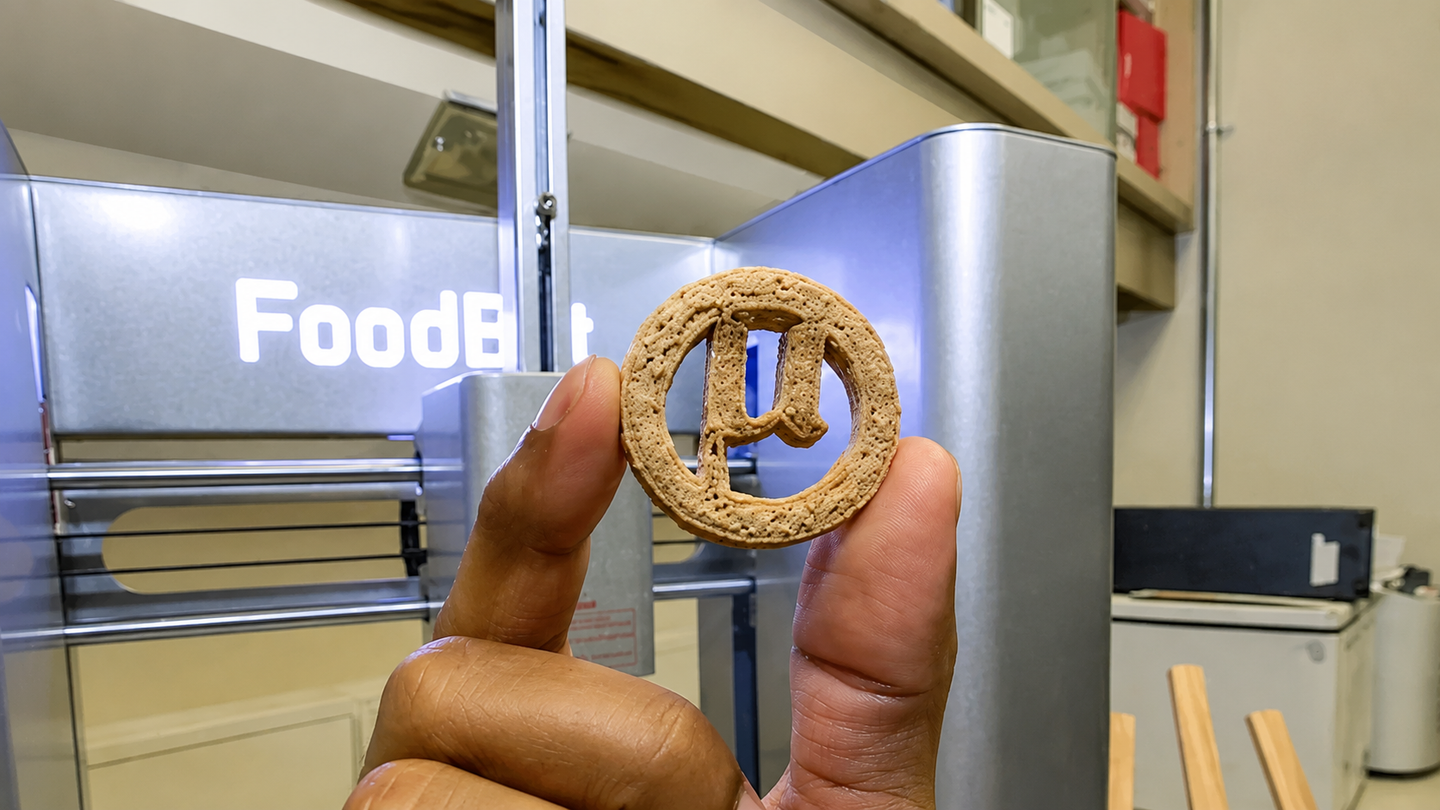
This cookie is made using waste plant materials and plastic and could feed humans everywhere from submarines to spaceships.
(CREDIT: SIU Carbondale Communications)
- Researchers programmed yeast to turn plastic and agricultural waste into proteins, vitamins and flavorings for edible cookies.
- The process breaks PET bottles and plant waste into smaller pieces that microbes can rebuild into food ingredients.
- The cookies have not yet been taste-tested, but the technology could eventually help produce food in disaster zones, submarines and deep-space missions.
Plastic bottles and corn waste could someday become part of an edible cookie, thanks to microbes programmed to rebuild discarded carbon into protein, vitamins and flavor molecules. The approach could give trash a second use while helping produce food where ordinary supplies are scarce.
A team at Southern Illinois University Carbondale is developing the system as part of a NASA-led project focused on food production for deep-space exploration. The researchers are presenting their results at ACS Fall 2026, the American Chemical Society meeting being held Aug. 23-27 at McCormick Place.
The idea starts with a simple chemical fact. Polyethylene terephthalate, or PET, contains carbon. So do foods.
“We were trying to develop technologies for plastic upcycling to make more valuable products. We thought, why not focus on making food? Because plastic is carbon and food is carbon,” explains Associate Professor Lahiru Jayakody.
Turning tough waste into microbe-sized pieces
PET is widely used in soda and water bottles. Its carbon-rich molecules can be broken apart and rebuilt into other products, including materials that microbes can consume.
Jayakody’s team is using microorganisms as biological factories rather than relying only on laboratory chemical reactions and solvents.
“Microbes are very clever. So, we are using their traits to solve the problems we created.”
Scientists have long used microbes, including yeast, to manufacture useful molecules. Insulin, for example, can now be made by programmed yeast rather than extracted from animal pancreases. Jayakody and graduate student Sandhya Jayasekara are applying the same general concept to food production.
They programmed several yeasts, including baker’s yeast, to convert molecules found in plastic and agricultural waste into proteins, vitamins and flavorings.
The raw materials include PET plastic, discarded corn stalks and leaves, and other biomass. Before yeast can use those materials, however, the waste must first be broken into smaller, accessible components.
The researchers do that with a proprietary process called oxidative hydrothermal dissolution. The method was created by SIU Carbondale Geology Professor Ken Anderson.
It uses water and oxygen under high temperature and pressure to break down tough material. The resulting pieces can then be fed to the engineered yeasts.
A cookie built from converted waste
Once the yeast receives those smaller molecules, it reforms them into new food ingredients. The products include proteins, fats and acids.
The team then adds fiber, starch and sweetener. That mixture is extruded through a 3D printer to form protein-rich cookies called µBites, pronounced “microbites.”
The cookies have not yet been taste-tested because the researchers are still awaiting institutional approval for that step. Their current data indicate that the µBites are safe to eat.
For now, the team has evaluated how the cookies smell and whether people would consider eating them. Most participants gave the aroma favorable marks and said they would be willing to eat the cookies in situations where resources were limited.
That distinction matters because the current version is being developed for environments where dependable food supplies may be difficult to maintain. NASA’s involvement places deep-space missions among the project’s intended settings.
Jayasekara is also working to make the product more appealing beyond emergency or highly constrained situations.
“We’re using microbes to develop the cookie into a more attractive, consumer-friendly product,” says Jayasekara.
Yeast adds vanilla and vitamin precursors
One part of that effort involves programming yeast to make ingredients that improve flavor or nutrition.
Baker’s yeast can now produce vanilla flavoring from plant biomass. A different yeast strain can convert ethylene glycol from PET into beta-carotene, which the human body can turn into vitamin A.
That expands the role of the microbes beyond simply generating protein. The same platform could help produce multiple components of a finished food from waste-derived carbon.
The current recipe still depends on added starch, fiber and sweetener. Jayakody and his colleagues want eventually to produce those ingredients through microbes as well.
If they can do that, a larger share of the cookie could come directly from biological conversion rather than from separately supplied ingredients.
The team hopes µBites could be ready for public consumption within a few years. Possible settings include disaster zones and other places with limited food access, along with submarines, lunar settlements or Mars colonies.
Those uses remain future goals, not current deployments. The researchers still need institutional approval before conducting taste tests, and the product is not yet described as ready for consumers.
Practical implications of the research
The project links two problems that usually get treated separately: waste disposal and food production. Instead of viewing plastic and plant waste only as material to discard, the researchers are testing whether microbes can recover their carbon and rebuild it into edible compounds.
That could matter most in places where carrying or storing large food supplies is difficult. A system that converts available waste into useful food ingredients could reduce dependence on conventional resupply in resource-limited environments.
The approach also gives plastic upcycling a different target. Rather than turning discarded material into another industrial product, the process aims to recover enough value from its carbon to support nutrition.
Jayakody sees microbial production as one possible response to rising pressure on the global food system. “Global food demand is expected to rise 35–56% by the year 2050, and about 30% of the world population will be at risk of hunger in the future. The way to address that, I believe, is by using microbes,” he concludes.
For the team, the next steps are practical ones: expanding what the yeasts can produce, reducing reliance on added ingredients and moving toward approved human taste testing. If those efforts succeed, µBites could become a demonstration of how waste carbon can be redirected into food where conventional options are limited.
Dig deeper into plastic upcycling and microbial food
These studies focus specifically on recycling or upcycling discarded materials into proteins or other food-related products, closely matching the waste-to-food approach behind the story.
Bioprocess parameter screening and condition selection for single-cell protein production using yeast co-culture and agro-food waste substrates
Researchers used a yeast co-culture to convert agro-food waste into single-cell protein, achieving protein concentrations of 8.2 grams per liter and demonstrating stable production during continuous fermentation. (Process Safety and Environmental Protection, 2026)
Valorisation of food waste through self-fermentation and photosynthetic bacterial protein production: efficiency, microbial dynamics and safety assessment
This study converted discarded food into protein-rich photosynthetic bacteria, while also testing digestibility, allergens and heavy metals to assess whether the resulting protein could be suitable for food-related applications. (Bioresource Technology, 2025)
Valorizing agricultural waste: Utilizing corn plant leftover to grow yeast biomass, as a potential source of sustainable protein
Researchers turned leftover corn stalks and leaves into a growth medium for yeast, producing protein-rich biomass and demonstrating how agricultural waste could become a source of alternative food protein. (Future Foods, 2025)
Killing two birds with one stone: chemical and biological upcycling of polyethylene terephthalate plastics into food
This analysis examines how PET plastic could be chemically broken down and biologically converted by microorganisms into edible microbial protein, directly linking plastic recycling with future food production. (Trends in Biotechnology, 2022)
From stale bread and brewers spent grain to a new food source using edible filamentous fungi
Researchers fermented stale bread and brewing waste with edible fungi, increasing protein and other nutrients while producing a food with textural properties similar to a commercial soybean burger. (Bioengineered, 2020)
Research findings are available online in the journal ACS.
The original story "Scientists recycle plastic bottles and corn waste into protein-rich cookies" is published in The Brighter Side of News.
Related Stories
- New recycling process converts plastic waste into useful chemicals using only water and oxygen
- Chemists convert plastic waste into a powerful new tool to capture carbon dioxide
- Breakthrough discovery transforms plastic waste into common painkiller
Like these kind of feel good stories? Get The Brighter Side of News' newsletter.
Joshua Shavit
Writer and Editor
Joshua Shavit is a NorCal-based science and technology writer with a passion for exploring the breakthroughs shaping the future. As a co-founder of The Brighter Side of News, he focuses on positive and transformative advancements in technology, physics, engineering, robotics, and astronomy. Having published articles on AOL.com, MSN, Yahoo News, and Ground News, Joshua's work highlights the innovators behind the ideas, bringing readers closer to the people driving progress.