New recycling process converts plastic waste into useful chemicals using only water and oxygen
New method converts plastic waste into valuable chemicals using only water and oxygen, offering a simpler recycling solution.
 Cardiff University Writer: Jonathan Rees

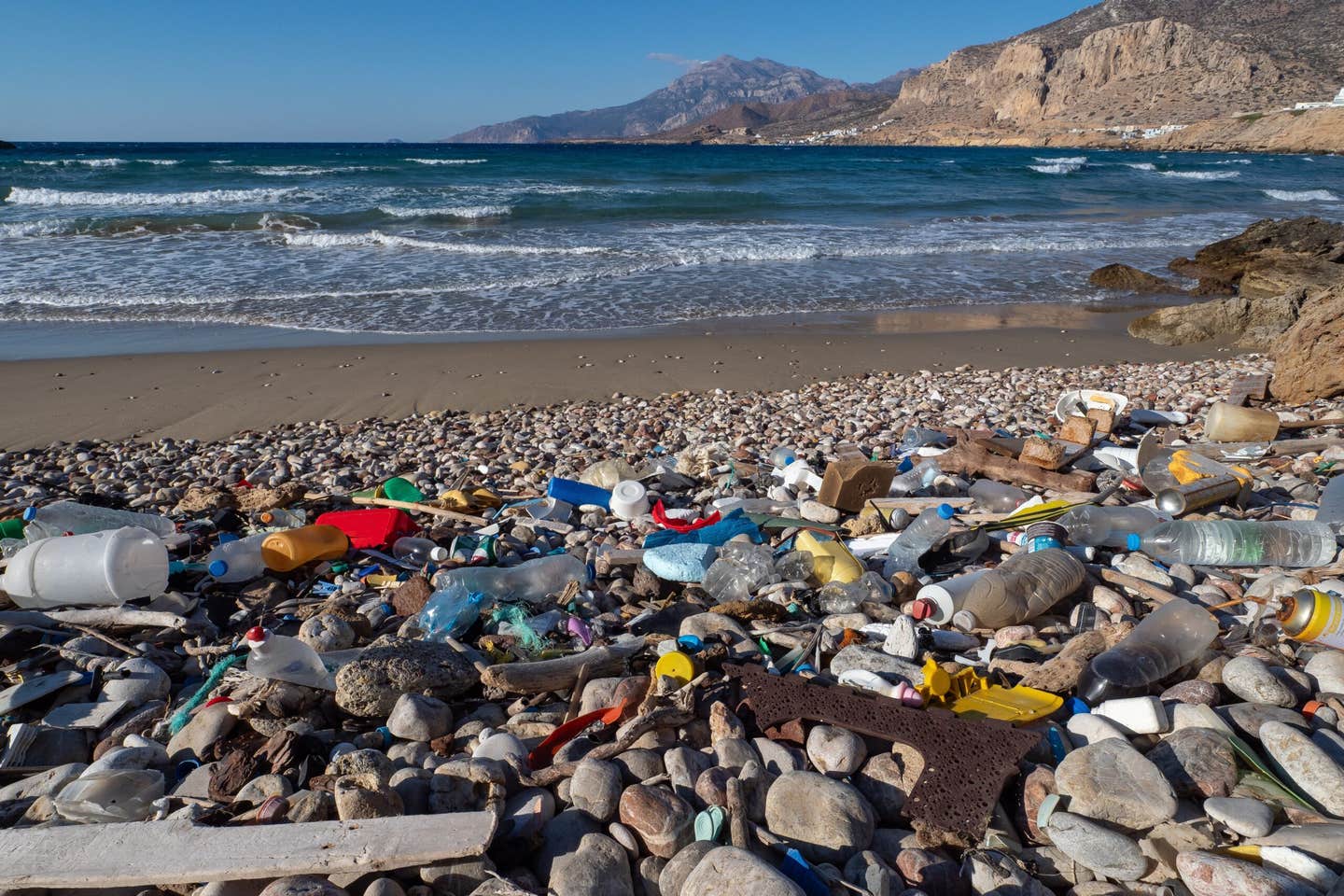
Researchers develop a catalyst-free process that turns plastic waste into useful chemicals using water and oxygen. (CREDIT: Shutterstock)
- Researchers developed a catalyst-free recycling method that uses only water and oxygen to break down durable plastics such as polyethylene and polypropylene.
- Microscopic droplets generate reactive hydroxyl radicals that convert mixed and contaminated plastic waste into valuable organic acids used in medicines, food additives, and biodegradable materials.
- The process worked with common waste products, tire rubber, tap water, and seawater, while larger-scale tests suggest it could offer a practical and profitable alternative to landfills and incineration.
Plastic waste continues to pile up across the planet, filling landfills and drifting into oceans. A new study offers a striking shift in how that waste might be handled. Researchers report that common plastics can be broken down into useful chemicals using only water and oxygen, without the need for costly or toxic additives.
The work comes from a collaboration led by Zhejiang University with partners including Cardiff University and the University of Tokyo. The team says the approach could simplify recycling while making it more practical at scale.
A Growing Problem With Few Easy Solutions
Plastic production has surged over recent decades. Much of that material, especially items like packaging and containers, ends up discarded after a short use. Durable plastics such as polyethylene and polypropylene resist natural breakdown. That durability, while useful in daily life, creates long-term environmental harm.
Traditional recycling methods struggle to keep up. Mechanical recycling often downgrades plastic quality. Chemical recycling methods can break plastics into smaller molecules, but they usually require catalysts. These substances can be expensive, sensitive to contamination, and sometimes harmful.
Because real-world waste contains additives and mixed materials, catalysts often fail. This limits how widely those methods can be used.
A Simpler Idea Using Water And Oxygen
The new method avoids those challenges by removing catalysts entirely. Instead, it relies on a reaction that occurs naturally at the boundary between water and melted plastic.
When plastic is heated and stirred in water, it breaks into tiny droplets. These droplets create a large surface where water and plastic meet. At this interface, unusual chemistry takes place.
The researchers found that highly reactive molecules form spontaneously in this environment. These molecules, called hydroxyl radicals, can break strong chemical bonds. They act like precise tools, cutting long plastic chains into smaller pieces.
Professor Yong Wang of Zhejiang University, the study’s lead author, said the approach removes a major barrier to adoption. “By eliminating the need for expensive or toxic catalysts entirely, we have removed one of the major economic and environmental barriers to the industrial adoption of chemical plastic recycling.”
How Microdroplets Drive The Reaction
The key to the process lies in the behavior of microscopic droplets. At very small scales, liquids can create strong local electric fields. These fields help split water molecules and generate reactive species.
In this system, the droplets form when molten plastic disperses in water. The surface of each droplet becomes an active site for chemical reactions. Oxygen in the system helps sustain the process by interacting with electrons released during the reaction.
Professor Graham Hutchings of Cardiff University explained the importance of this discovery. “We are awash with plastic waste, and we need viable solutions for its effective recycle. Our discovery shows the way, demonstrating that water and oxygen alone, under the right microdroplet conditions, are powerful enough to drive the selective oxidation of some of the most chemically inert and durable materials on Earth.”
Turning Waste Into Valuable Chemicals
Instead of producing low value materials, the process converts plastics into organic acids. These compounds serve as building blocks in many industries. They are used in medicines, food additives, and the production of biodegradable materials.
In experiments using polyethylene, the team achieved nearly complete conversion. About 69 percent of the material turned into short chain diacids. These are especially valuable because they can be used to make new materials.
The reaction occurs under relatively mild conditions. Temperatures remain far below those used in many other chemical recycling methods. This reduces energy use and simplifies equipment requirements.
Works With Real World Waste
A major strength of the method is its ability to handle mixed and contaminated plastics. Many recycling systems require carefully sorted materials. This process does not.
The researchers tested common waste items such as plastic bags, gloves, and bottle caps. In each case, the system converted the material effectively. Additives that would normally disrupt reactions had little impact.
The process also worked with different types of plastics and even rubber from old tires. This flexibility could make it useful in real recycling environments, where waste streams vary widely.
Another practical advantage is its tolerance for different water sources. The reaction worked with both tap water and seawater. This opens the possibility of using the method in coastal or resource limited areas.
Scaling Up For Industry
Laboratory success does not always translate into real world use. To address this, the team tested the process at a larger scale.
They processed a 300 gram batch of plastic in a larger reactor. The results remained strong, with high conversion and product yields. This suggests the approach can be expanded without losing efficiency.
The researchers propose using continuous systems for industrial applications. In these designs, plastic and water would flow through reactors, allowing constant processing.
Such systems could be built at different sizes, from local facilities to larger plants. This flexibility could help manage plastic waste closer to where it is generated.
Economic And Environmental Promise
The absence of catalysts reduces costs and simplifies operation. It also avoids the need to replace or regenerate materials that degrade over time.
Preliminary economic estimates suggest the process could be profitable at scale. Facilities could turn low value waste into higher value chemical products. This creates an incentive to collect and process plastic rather than discard it.
The environmental impact also appears favorable. By converting waste into useful materials, the method reduces the need for new raw resources. It also avoids emissions associated with incineration.
Compared with landfilling, the approach prevents long term accumulation of plastic. It also avoids the release of microplastics into the environment.
A New Direction For Recycling
The study highlights a shift in thinking about plastic waste. Instead of treating it as a problem to dispose of, it can be viewed as a resource.
By using simple inputs like water and oxygen, the method offers a cleaner path forward. It avoids many of the complications that have limited previous technologies.
The discovery also shows how small scale phenomena can have large impacts. The chemistry at tiny droplet surfaces may hold the key to solving a global challenge.
Practical Implications Of The Research
This research could reshape how societies handle plastic waste. By enabling efficient conversion into valuable chemicals, it creates a pathway toward a circular economy. In such a system, materials are reused rather than discarded.
For industry, the method offers a way to reduce costs and improve sustainability. Companies could process mixed waste without complex sorting. This could increase recycling rates and reduce reliance on landfills.
For communities, especially in regions with limited infrastructure, the approach could provide local solutions. The ability to use seawater and simple equipment makes the technology adaptable.
For researchers, the findings open new areas of study. Understanding microdroplet chemistry may lead to other innovations in energy, materials, and environmental science.
Ultimately, the work shows that even the most stubborn materials can be transformed with the right approach. It offers a hopeful step toward reducing pollution and creating more sustainable systems.
Research findings are available online in the journal Nature.
The original story "New recycling process converts plastic waste into useful chemicals using only water and oxygen" is published in The Brighter Side of News.
Related Stories
- Chemists convert plastic waste into a powerful new tool to capture carbon dioxide
- Scientists use coffee and plastic waste to brew up a new way to capture carbon
- Solvent-based recycling and AI could be the key to solving plastic waste
Like these kind of feel good stories? Get The Brighter Side of News' newsletter.
Joseph Shavit
Writer, Editor-At-Large and Publisher
Joseph Shavit, based in Los Angeles, is a seasoned science journalist, editor and co-founder of The Brighter Side of News, where he transforms complex discoveries into clear, engaging stories for general readers. With vast experience at major media companies like The Los Angeles Times, Times Mirror and Tribune Publishing, he writes with both authority and curiosity. His writing focuses on space science, planetary science, quantum mechanics, geology. Known for linking breakthroughs to real-world markets, he highlights how research transitions into products and industries that shape daily life.