Scientists use AI and nanotechnology to detect signs of life in space
Single-molecule electrical measurements capture selected features of meteorite and desert extracts, with further validation needed.
 University of Osaka Writer: Saori Obayashi

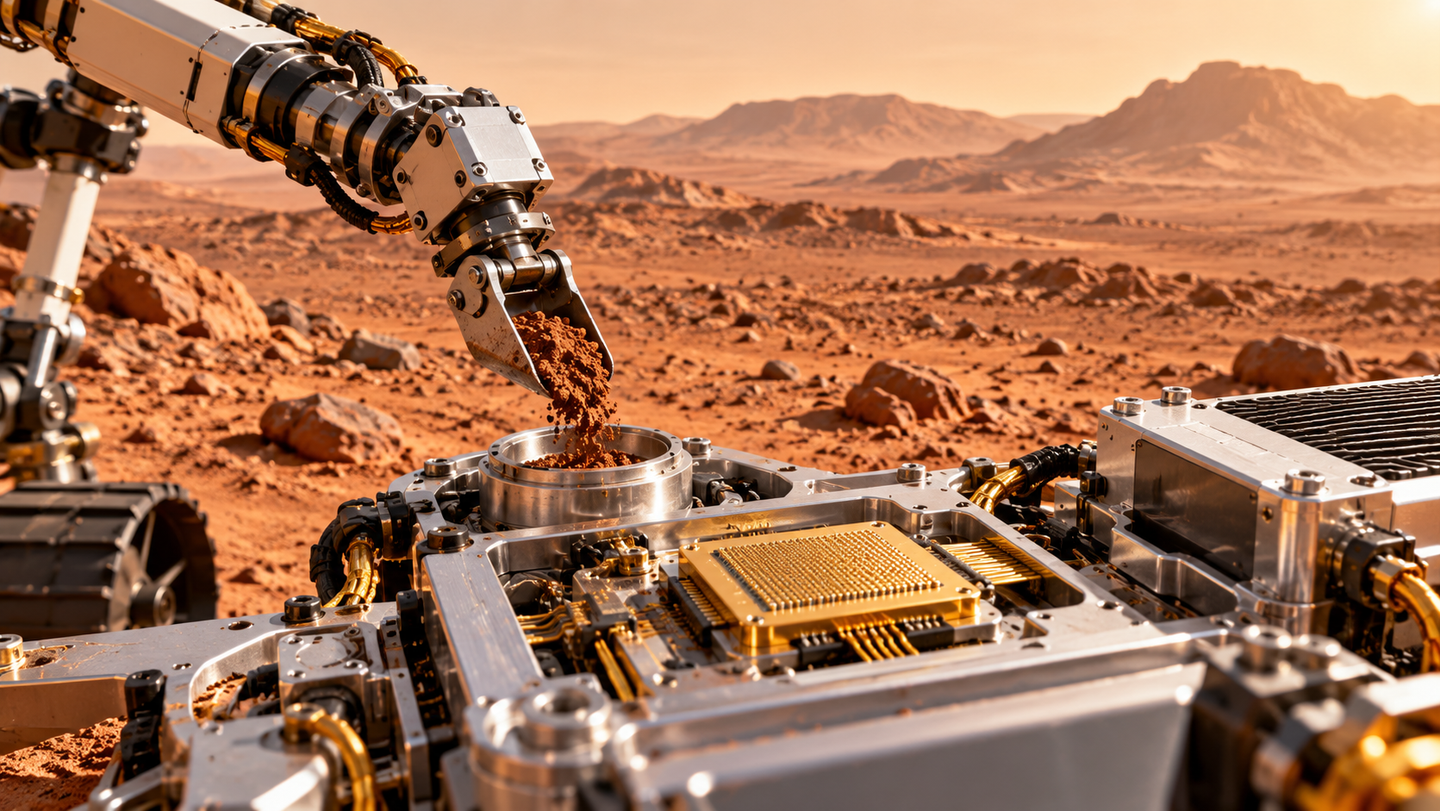
Gold nanogaps and AI distinguish mirror-image amino acids, offering a possible route to compact instruments for the search for life. (CREDIT: The Brighter Side of News)
- Researchers combined gold nanogap electrodes with machine learning to distinguish mirror-image amino acids through single-molecule electrical signals.
- Tests on meteorite and desert-soil extracts captured selected compositional features, but agreement with conventional analysis varied by molecule and sample.
- The method could support compact instruments for future astrobiology missions, although molecular handedness alone cannot establish extraterrestrial life.
A molecule’s shape can carry information that its chemical formula does not. Two amino acids may contain identical atoms yet arrange them as mirror images, a distinction that matters when scientists examine possible traces of life.
Researchers at the University of Osaka have developed an electrical method for reading that molecular handedness one molecule at a time. Their system combines atomically pointed gold electrodes with machine learning to interpret the signals produced as molecules enter a tiny gap.
The study, published in Nature Communications, tested amino-acid standards and prepared extracts from a meteorite and desert soils. Takahito Oshiro is the lead author, and Masateru Taniguchi is a senior author.
The results establish a laboratory approach to measuring molecular chirality. They do not demonstrate the detection of extraterrestrial life or a completed instrument ready for a planetary mission.
Why molecular handedness matters
Chirality describes structures that are mirror images but cannot be superimposed, like left and right hands. The two forms of a chiral amino acid are designated L and D.
Earth’s biological systems strongly favor L-form amino acids in proteins. That preference makes the relative abundance of the two forms potentially informative when scientists investigate organic material from space.
Of the 20 standard amino acids studied, 19 have L and D forms. Glycine is the exception because it lacks this handedness, giving the researchers 39 molecular forms to examine.
Nonbiological chemistry often produces roughly equal amounts of the two forms, known as a racemic mixture. However, an imbalance does not automatically imply biology: nonliving processes can also generate unequal abundances, and contamination from Earth can complicate interpretation.
Chiral measurements therefore need complementary evidence. Their value lies in helping characterize a sample’s chemistry and history, rather than providing a stand-alone verdict about life.
Gold electrodes turn molecules into signals
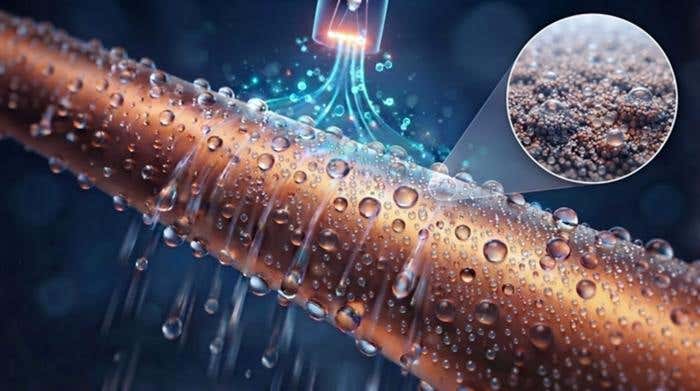
The team formed its sensing gap by mechanically breaking a thin gold wire and carefully controlling the separation between its ends. Measurements used electrode distances around half a nanometer, smaller than one billionth of a meter.
When a molecule diffused into the gap, it changed the electrical tunneling current between the electrodes. The instrument recorded that change as a waveform showing current over time.
The signal’s peak height and duration were not enough to distinguish some mirror-image molecules. For tryptophan, those measurements overlapped substantially between the L and D forms.
The researchers therefore extracted additional information from each waveform. They divided its duration into 12 segments, allowing machine-learning classifiers to analyze differences throughout the electrical event.
The approach requires no optical detection or added molecular recognition agents at the sensing junction. That could simplify future detector designs, although the environmental samples still required substantial chemical preparation.
The detailed physical explanation remains unresolved. Molecular orientation, temporary interactions with the gold and the local electrode structure may all contribute to the observed differences.
Stronger results for paired forms than broad identification
For tryptophan, the classifier achieved an F1 score of 0.827 when distinguishing its two forms. F1 combines precision and recall, reflecting both incorrect assignments and missed identifications.
Across the 19 chiral amino acids, the average F1 score was 0.876. Individual results ranged from 0.784 for glutamine to 0.974 for isoleucine.
A separate tryptophan test used measurements from different nanogap chips for training and evaluation. Its test score reached 0.859, providing evidence that discrimination could extend beyond the original measurement dataset.
Identifying molecular type and handedness across all 39 forms was harder. The F1 score fell to 0.49, still above the random-choice comparison but substantially below the paired-form results.
Mixture experiments also showed that classified counts did not always reproduce the prepared proportions accurately. One uneven five-component mixture produced a 56% error for alanine’s relative proportion.
The system demonstrated sensitive detection under controlled conditions, with a tryptophan detection limit of 0.03 nanomolar. The authors caution that this is not an established identification or quantification limit for complex environmental samples.
Meteorite and desert extracts test the approach
The team examined material from Australia’s Murchison meteorite and two sites in Chile’s Atacama Desert. It compared nanogap results with liquid chromatography–mass spectrometry, an established reference method.
The environmental analysis targeted glycine and the L and D forms of five other amino acids. This 11-form panel supported selected compositional comparisons, rather than a comprehensive inventory of everything in the extracts.
To reduce uncertain assignments, the researchers retained events only when the classifier’s highest predicted probability reached 0.5. Other events were rejected or labeled unknown, without assigning them a chemical identity.
The filter retained 49.7% of extracted events from Murchison, compared with 28.3% and 25.4% from the desert samples. It retained only 6.8% from a preparation blank, removing most blank-derived events from the targeted analysis.
In Murchison, the method recovered a pattern rich in glycine, alanine and glutamic acid. However, some proportions differed from the reference measurements, and agreement in L/D ratios depended on the amino acid and sample.
The desert results also contained discrepancies. Some molecules lacked enough retained events for reliable ratios, underscoring the challenge of separating target signals from background in chemically complicated material.
A possible tool for future missions
Electrical detection offers potential advantages for compact instruments because it avoids an optical readout. The researchers suggest it could reduce instrument size and sensitivity to vibration in future exploration systems.
Those advantages concern the sensing approach, not the elimination of every preparation step. The study’s natural samples underwent hot-water extraction, acid hydrolysis and purification before measurement.
Further work must test representative backgrounds, calibrate against realistic sample mixtures and improve recognition of molecules absent from the training data. Contamination-controlled validation will also be essential before planetary use.
The immediate advance is a way to obtain handedness information from individual electrical events. Combined with established analytical methods and other evidence, that information could help future missions investigate organic chemistry and assess possible biosignatures.
Dig deeper into molecular handedness and the search for life
These resources explore amino acids in asteroid samples, the interpretation of chirality and the limits of chemical biosignatures.
Abundant ammonia and nitrogen-rich soluble organic matter in samples from asteroid (101955) Bennu: Reports organic compounds and amino-acid handedness in carefully preserved asteroid samples. (Nature Astronomy, 2025)
Challenges and Opportunities in Using Amino Acids to Decode Carbonaceous Chondrite and Asteroid Parent Body Processes: Examines how amino-acid distributions reflect chemical processing in meteorite and asteroid parent bodies. (Astrobiology, 2025)
Can Chirality Answer Whether We Are Alone?: Discusses the potential of molecular handedness for life detection and the instrumentation needed to investigate it. (Chirality, 2024)
Extraterrestrial amino acids and amines identified in asteroid Ryugu samples returned by the Hayabusa2 mission: Measures amino acids, amines and chiral compositions in returned asteroid material. (Geochimica et Cosmochimica Acta, 2023)
The Search for Chiral Asymmetry as a Potential Biosignature in our Solar System: Reviews biological and nonbiological asymmetry and criteria for interpreting possible chemical signs of life. (Chemical Reviews, 2020)
Research findings are available online in the journal Nature Communications.
The original story "Scientists use AI and nanotechnology to detect signs of life in space" is published in The Brighter Side of News.
Related Stories
- New analysis finds signs of life on Mars actually came from Earth
- Scientists warn we may be missing signs of alien life across the universe
- New SETI program helps students detect signs of advanced life beyond Earth
Like these kind of feel good stories? Get The Brighter Side of News' newsletter.
Joseph Shavit
Writer, Editor-At-Large and Publisher
Joseph Shavit, based in Los Angeles, is a seasoned science journalist, editor and co-founder of The Brighter Side of News, where he transforms complex discoveries into clear, engaging stories for general readers. With vast experience at major media companies like The Los Angeles Times, Times Mirror and Tribune Publishing, he writes with both authority and curiosity. His writing focuses on space science, planetary science, quantum mechanics, geology. Known for linking breakthroughs to real-world markets, he highlights how research transitions into products and industries that shape daily life.