Rare meteorite crashes into New Jersey home revealing clues to the origin of life
A rare New Jersey meteorite reveals ancient brine chemistry and organic molecules linked to the origins of life.
 Edited By: Joseph Shavit

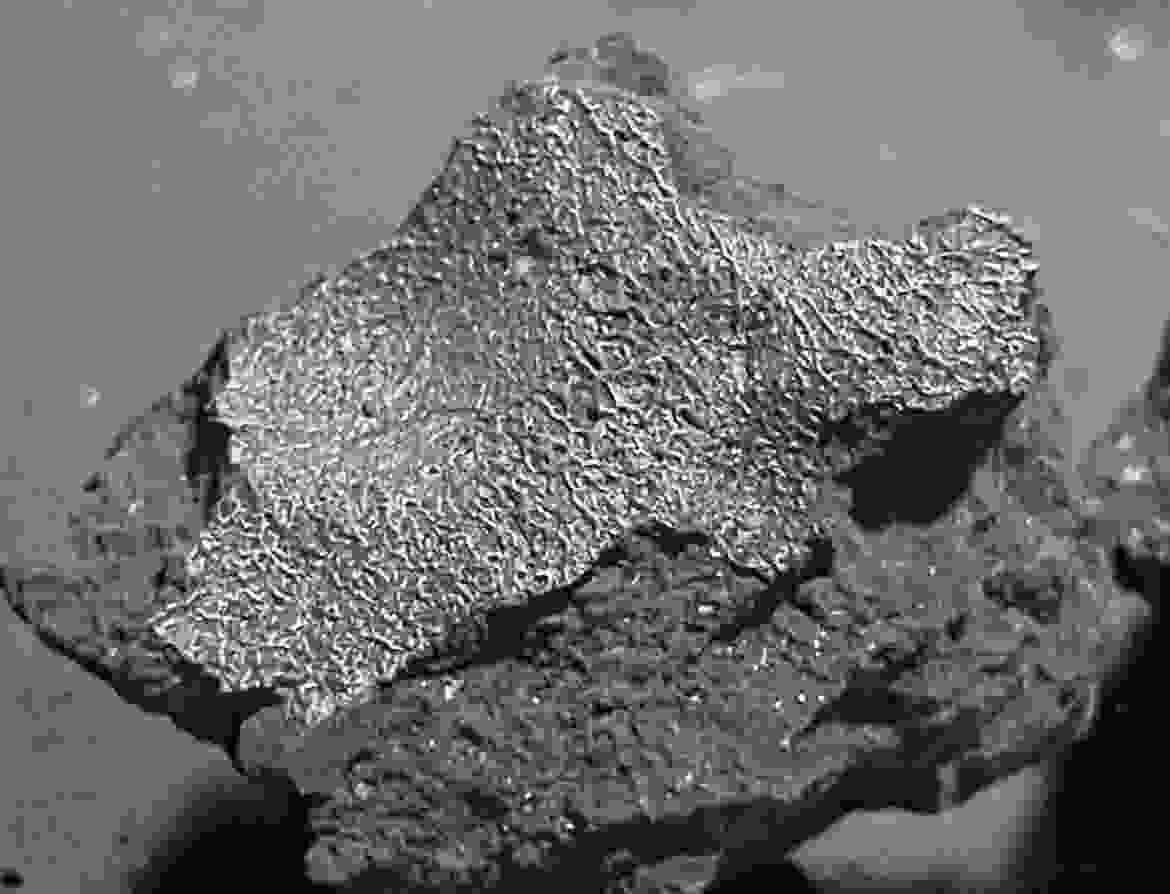
A meteorite that crashed into a New Jersey home contains rare evidence of ancient salty water and organic molecules tied to life’s origins. (CREDIT: SETI Institute)
- A meteorite crashed through a New Jersey home in July 2024, allowing scientists to recover unusually pristine fragments from an ancient asteroid.
- The rare CM1/2 carbonaceous chondrite preserved evidence of salty liquid water, mineral reactions, carbon compounds, and amino acids formed early in the solar system.
- The discovery supports the idea that chemically active asteroids helped create and deliver some of life’s essential building blocks to early Earth.
A loud crack shook a quiet New Jersey home on a summer afternoon. Dust drifted through a bedroom. Black fragments scattered across a bed. What fell from the sky that day was not just debris. It was a rare piece of an ancient asteroid, carrying chemical clues tied to the origins of life.
A Fireball Over The Northeast
On July 16, 2024, a bright meteor streaked across the northeastern United States. Witnesses from several states reported the flash. Some also felt a shockwave ripple through the air.
The object entered Earth’s atmosphere at about 32,000 miles per hour. It traveled just south of the Statue of Liberty. As it burned, it broke apart high above the ground.
Mike Hankey of the American Meteor Society described how the path was traced. “Our cameras in Northford, Connecticut, and Douglassville, Pennsylvania, as well as a doorbell camera in Wayne, New Jersey, captured the meteor, and from that we measured its trajectory,” he said. “The path traced back to low in the asteroid belt.”
The meteor became invisible at about 22 miles above Earth. After that, radar picked up a cloud of falling debris stretching toward New Jersey. The largest fragments fell near Hillsborough.
A Crash Inside A Home
One of those fragments did not land quietly. It crashed through the roof of a house. The homeowner described the moment clearly.
“I was at home at the time, heard a loud crash and found a hole in the ceiling of the master bedroom,” he said. “I smelled a strong sulfur-like odor and saw many black fragments along with debris and black dust that covered my bed, carpet and surrounding areas.”
The homeowner acted quickly. Wearing gloves, he collected the pieces and stored them carefully. That quick response helped preserve the material in near-pristine condition.
Scientists later recovered about 1.35 kilograms of fragments. The sample became known as the Hillsborough meteorite.
A Rare Type Of Space Rock
Researchers soon confirmed that the meteorite belongs to a group called CM carbonaceous chondrites. These are primitive space rocks that formed early in the solar system.
However, this one stood out. It was classified as a CM1/2 carbonaceous chondrite, a rare intermediate type. Only one other meteorite of this kind has ever been seen falling to Earth.
Mike Zolensky of NASA’s Johnson Space Center explained the difference. The material showed more signs of water alteration than typical CM2 meteorites. This placed it between two known categories.
Peter Jenniskens of the SETI Institute highlighted its importance. “Thanks to the homeowner’s quick reaction, these are the most pristine CM1/2 meteorites we know of,” he said.
The meteorite’s fragile structure made it even more valuable. It had not been altered by rain, soil, or handling. That preserved delicate chemical details.
Signs Of Ancient Salty Water
One of the most surprising discoveries came from the meteorite’s chemistry. Scientists found evidence of concentrated salty fluids, also known as brines.
Jenniskens described the finding. “A forensic study of the fragments revealed that they contained preserved bits from near the surface of a primitive asteroid where it experienced concentrated salty fluids, a process not previously known from this type of proto planet world,” he said.
These salty fluids likely formed near the surface of the meteorite’s parent asteroid. Water evaporated over time, leaving behind concentrated salts.
Researchers identified a compound formed from uranium, iron, and oxygen in earlier related work. In this case, they focused on salt-rich regions inside the rock. These regions suggested that liquid water once moved through the asteroid.
This discovery matters because brines can drive chemical reactions. They keep important elements dissolved and active. That makes them ideal environments for forming complex molecules.
Organic Molecules Inside The Rock
The Hillsborough meteorite also contained a rich mix of organic compounds. These included carbon-based molecules and amino acids.
Queenie Chan of Royal Holloway University of London explained the significance. “Isotope studies of carbon and nitrogen suggest that primitive carbonaceous chondrites, including CM-types, delivered organic matter to the early Earth,” she said.
The meteorite contained about 1.8 percent carbon and smaller amounts of nitrogen. These levels match other primitive meteorites linked to early Earth chemistry.
Scientists also found many amino acids. These molecules are essential building blocks of proteins. Some of the amino acids found are rare on Earth and point to a space origin.
Danny Glavin of NASA’s Goddard Space Flight Center and his team studied these compounds. Their results suggest that the molecules formed within the asteroid itself, likely influenced by brine chemistry.
Phil Schmitt-Kopplin of Technical University Munich added another layer to the story. “A high fraction of compounds were the product of organic chemistry with minerals,” he said.
This interaction between minerals and organic molecules may have helped create more complex chemical structures.
A Window Into The Early Solar System
The Hillsborough meteorite formed billions of years ago. It likely came from a parent asteroid in the main asteroid belt.
Over time, that asteroid broke apart. Smaller fragments traveled through space until one reached Earth.
During its journey, the meteorite preserved chemical signatures from its origin. These include traces of water activity, salt formation, and organic reactions.
Scientists believe these processes were common in the early solar system. Small bodies like asteroids may have hosted active chemical environments.
These environments could have produced molecules that later reached Earth.
Why This Discovery Matters
The study offers new insight into how life’s building blocks may have formed. It shows that even small asteroids can host complex chemistry.
It also suggests that brine activity was more widespread than previously thought. Before this, such processes were mainly linked to other meteorite types.
The Hillsborough meteorite expands that understanding. It shows that similar chemistry occurred in CM-type asteroids as well.
This strengthens the idea that organic molecules were delivered to Earth from multiple sources.
Practical Implications Of The Research
The findings deepen understanding of how organic molecules form in space. This helps scientists trace the origins of life on Earth. It also guides the search for life beyond Earth.
By studying meteorites like Hillsborough, researchers can identify environments that support complex chemistry. This knowledge can be applied to missions exploring asteroids, moons, and planets.
The discovery of stable brine-related chemistry may influence future space exploration. It suggests that salty environments on other worlds could support similar reactions.
For planetary science, this research improves models of early solar system evolution. It shows that chemical diversity existed even in small bodies.
For humanity, the work brings a clearer picture of how life’s ingredients may have formed and spread. It connects events in deep space to the origins of life on Earth.
Research findings are available online in the journal Science Advances.
The original story "Rare meteorite crashes through New Jersey home into clues to the origin of life" is published in The Brighter Side of News.
Related Stories
- Rare meteorite points to a long-lost planet from our early solar system
- Lunar meteorite discovery reveals violent chapter in the inner solar system 3.5 billion years ago
- Iron meteorites unlock secrets of the early solar system and Earth's origin
Like these kind of feel good stories? Get The Brighter Side of News' newsletter.
Joseph Shavit
Writer, Editor-At-Large and Publisher
Joseph Shavit, based in Los Angeles, is a seasoned science journalist, editor and co-founder of The Brighter Side of News, where he transforms complex discoveries into clear, engaging stories for general readers. With vast experience at major media companies like The Los Angeles Times, Times Mirror and Tribune Publishing, he writes with both authority and curiosity. His writing focuses on space science, planetary science, quantum mechanics, geology. Known for linking breakthroughs to real-world markets, he highlights how research transitions into products and industries that shape daily life.