Ten thousand faults reveal how the Moon’s radius shrank by about 45 meters
Thousands of lunar scarps and ridges reveal slow contraction and offer clues to moonquakes and the moon’s thermal history.
 NASM Writer: Marc Sklar

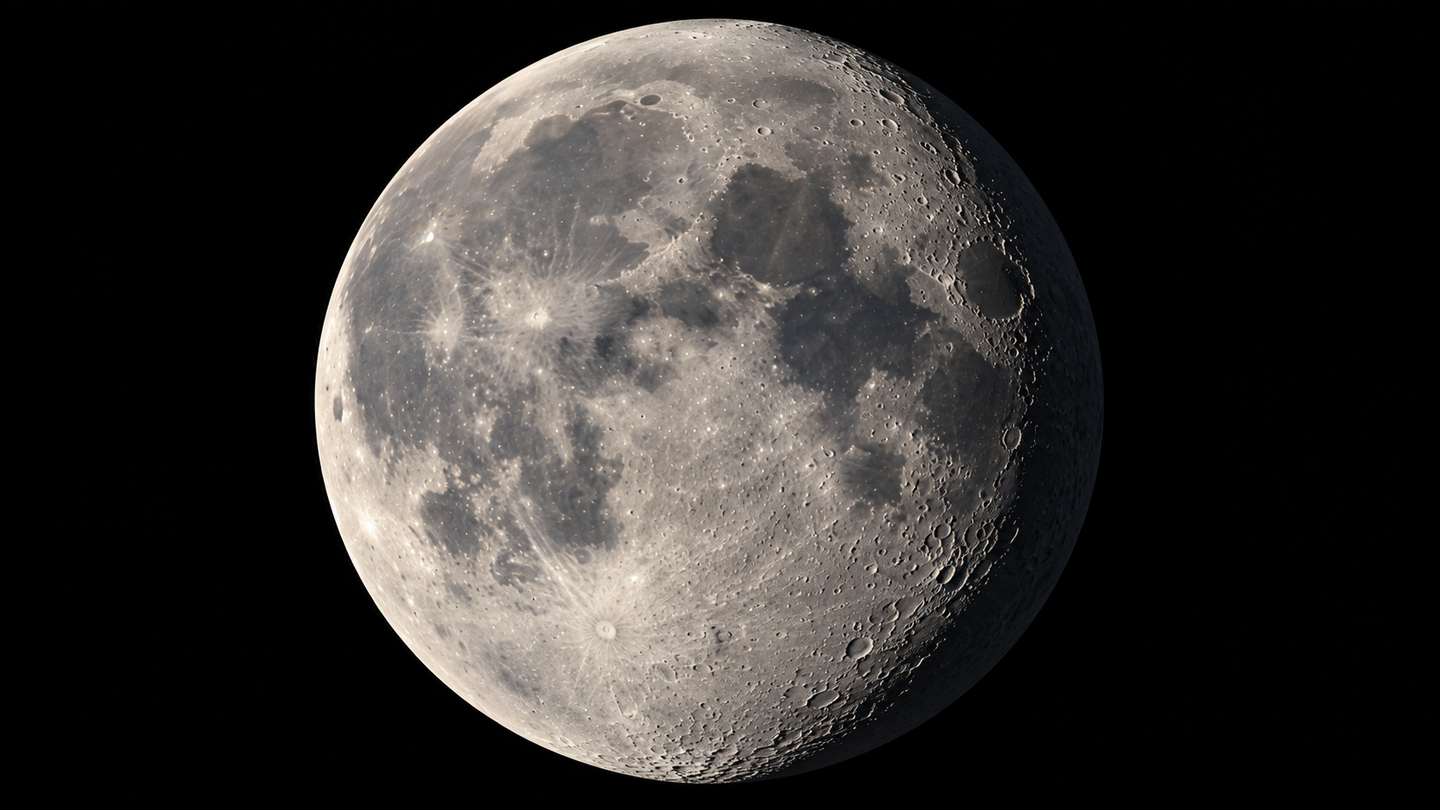
Lunar fault mapping indicates the moon’s radius shrank about 45 meters during a late stage of cooling and contraction. (CREDIT: Shutterstock)
- Mapping more than 8,900 lunar scarps and incorporating over 2,600 small mare ridges yielded an estimated radius decrease of 42 to 46 meters.
- That contraction reflects a late stage of lunar history, with the average rate depending on when widespread faulting began.
- The fault network offers clues to moonquakes and interior cooling, but does not establish that every mapped fault is active today.
Small cliffs scattered across the moon preserve a record of its slow contraction. As the interior cooled, compression pushed crustal material along faults, leaving ridges and scarps at the surface. A much larger inventory of those features now puts the estimated decrease in lunar radius at roughly 45 meters.
The assessment, published in The Planetary Science Journal, draws on images from NASA’s Lunar Reconnaissance Orbiter Camera, or LROC. Thomas R. Watters, scientist emeritus at the Smithsonian’s National Air and Space Museum, led the study with Maria Banks, Cole Nypaver and Mark Robinson.
Their calculation combines fault-related landforms in the bright lunar highlands and dark volcanic plains called maria. It measures contraction recorded by geologically young structures, rather than all shrinking throughout the moon’s history. The result also raises questions about why widespread surface faulting appears to have developed relatively late.
A larger map of a contracting world
The survey contains more than 8,900 lobate scarps, the small, cliff-like features associated with thrust faults. These form when compression drives one block of crust over another. Their surfaces typically slope steeply on one side and more gently on the other.
The researchers combined that population with more than 2,600 small mare ridges documented in related work. Together, the features provide evidence for a global network of more than 10,000 young faults. They were not all newly discovered in this single study.
Earlier surveys had far less imagery to work with. Apollo photographs supported a catalog of 71 scarps, while a later LROC-based study used roughly 3,200. Since its 2009 launch, Lunar Reconnaissance Orbiter has greatly expanded the high-resolution coverage available for mapping.
“The number of these young faults revealed in LROC images is much greater than I ever imagined,” Watters said. Most scarps have heights measured in tens of meters, although some exceed 150 meters. Their lengths range from less than a kilometer to tens of kilometers.
Turning surface cliffs into a radius estimate
Counting faults alone cannot reveal how much a planetary body has contracted. Researchers must estimate how much shortening each structure represents. The team therefore measured the relief of 42 representative scarps using terrain models made from pairs of LROC images.
The measured scarps ranged from about 4 to 164 meters in relief. Their lengths spanned approximately 0.3 to 14 kilometers.
Those measurements helped establish a relationship between fault length and displacement. The researchers applied that relationship to the broader mapped population, estimating how much the surface had shortened. The calculation depends on assumptions about fault geometry, including the angle at which faults dip underground.
Combining the highlands and maria produced an estimated surface-area contraction of approximately 0.0048% to 0.0053%. Translated into a change in radius, that corresponds to about 42 to 46 meters. The commonly quoted 45-meter figure summarizes that range; it is not a direct measurement made by comparing two global diameter readings.
The highland scarps dominate the estimate. Small mare ridges add a previously omitted contribution, but the maria occupy a much smaller fraction of the lunar surface. Assumptions about displacement and fault angles also affect the inferred total.
A tiny average rate over immense spans
The timing of contraction is less certain than the mapped landforms themselves. If approximately 45 meters of shrinking accumulated uniformly over 400 million years, the average would be about 11 centimeters per million years. Spreading the same change over 800 million years gives roughly 6 centimeters per million years.
Expressed annually, that is approximately 0.06 to 0.11 micrometers. These are averages calculated under an assumption of steady contraction. They do not demonstrate that the radius decreases by an identical amount every year, or that individual faults move continuously.
Several observations support the scarps’ geological youth. Some cut across small impact craters, while crater-counting studies place activity on particular features within the past 150 million years. Other evidence suggests still younger deformation, but the entire mapped network cannot be assigned one formation date.
“Young” therefore describes these features relative to the moon’s ancient surface. It does not mean that thousands of new cliffs appeared during the spacecraft’s mission. The orbital images reveal a geological record accumulated over much longer periods.
Faults offer clues to present-day moonquakes
The moon lacks Earth’s system of moving tectonic plates. Its outer rocky shell instead behaves as a single plate, with contractional faults distributed widely across it. That arrangement means potentially active structures are not confined to familiar plate-boundary belts.
Earlier research linked some shallow moonquakes recorded by Apollo instruments with nearby scarps. The new paper discusses that evidence alongside landslides near faults and stresses associated with contraction and tides. These observations support the possibility that some thrust faults remain active.
The estimated contraction would generate compressional stresses of roughly 4 megapascals under the study’s assumptions. That is consistent with the scale of stress drops estimated for shallow moonquakes. It does not identify the next quake’s location, timing or magnitude.
Faults are also unevenly distributed. Some regions contain long clusters, while areas with the thickest crust have relatively few scarps. That relationship may reflect differences in how the crust deforms, but fewer mapped faults alone cannot certify a location as safe for future missions.
Why did widespread faulting arrive so late?
The modest contraction estimate challenges some thermal-history models, which predict much greater cumulative shrinking. If comparable thrust faulting had continued for billions of years, older structures might have grown into much larger scarps. The absence of a clear population of such degraded ancient cliffs is an important puzzle.
One possible explanation involves the megaregolith, the thick layer of fractured, porous material produced by impacts. Acting as insulation, it may have limited heat loss and delayed substantial contraction. Changes in that insulating layer over time could then have allowed cooling and contraction to become more effective.
A different possibility is that a strong outer shell resisted faulting while stresses accumulated. Only after a threshold was reached would widespread near-surface thrust faults form. The paper treats these as possible explanations, rather than demonstrating one settled history of the interior.
The enlarged fault inventory gives those ideas a stronger observational test. It also shows how an apparently quiet world can preserve evidence of continuing geological change. Better mapping and seismic observations can help connect the surface record with processes still operating beneath it.
Dig deeper into lunar shrinking and moonquakes
These studies trace the discovery of young lunar faults and explore their connection to crustal structure and seismic activity.
Evidence of Recent Thrust Faulting on the Moon Revealed by the Lunar Reconnaissance Orbiter Camera: Reports early LROC evidence for young contractional landforms distributed across the lunar surface. (Science, 2010)
The Crust of the Moon as Seen by GRAIL: Uses gravity measurements to investigate lunar crustal thickness and porosity, providing context for interpreting fault distribution. (Science, 2013)
Shallow seismic activity and young thrust faults on the Moon: Examines connections between relocated Apollo moonquakes, young scarps and stresses acting on the crust. (Nature Geoscience, 2019)
Tectonics and Seismicity of the Lunar South Polar Region: Investigates faults, potential seismic sources and slope stability in a region important for lunar exploration. (The Planetary Science Journal, 2024)
A New Global Perspective on Recent Tectonism in the Lunar Maria: Maps small mare ridges and assesses their contribution to recent contraction within the volcanic plains. (The Planetary Science Journal, 2025)
Research findings are available online in The Planetary Science Journal.
The original story "Ten thousand faults reveal how the Moon’s radius shrank by about 45 meters" is published in The Brighter Side of News.
Related Stories
- Buried volcanic structure suggests that our Moon once had a powerful magnetic field
- NASA discovers a massive new lunar impact that blasted a 728-foot crater into the Moon
- The Moon’s far side could open a window into the universe before the first stars were born
Like these kind of feel good stories? Get The Brighter Side of News' newsletter.
Joseph Shavit
Writer, Editor-At-Large and Publisher
Joseph Shavit, based in Los Angeles, is a seasoned science journalist, editor and co-founder of The Brighter Side of News, where he transforms complex discoveries into clear, engaging stories for general readers. With vast experience at major media companies like The Los Angeles Times, Times Mirror and Tribune Publishing, he writes with both authority and curiosity. His writing focuses on space science, planetary science, quantum mechanics, geology. Known for linking breakthroughs to real-world markets, he highlights how research transitions into products and industries that shape daily life.